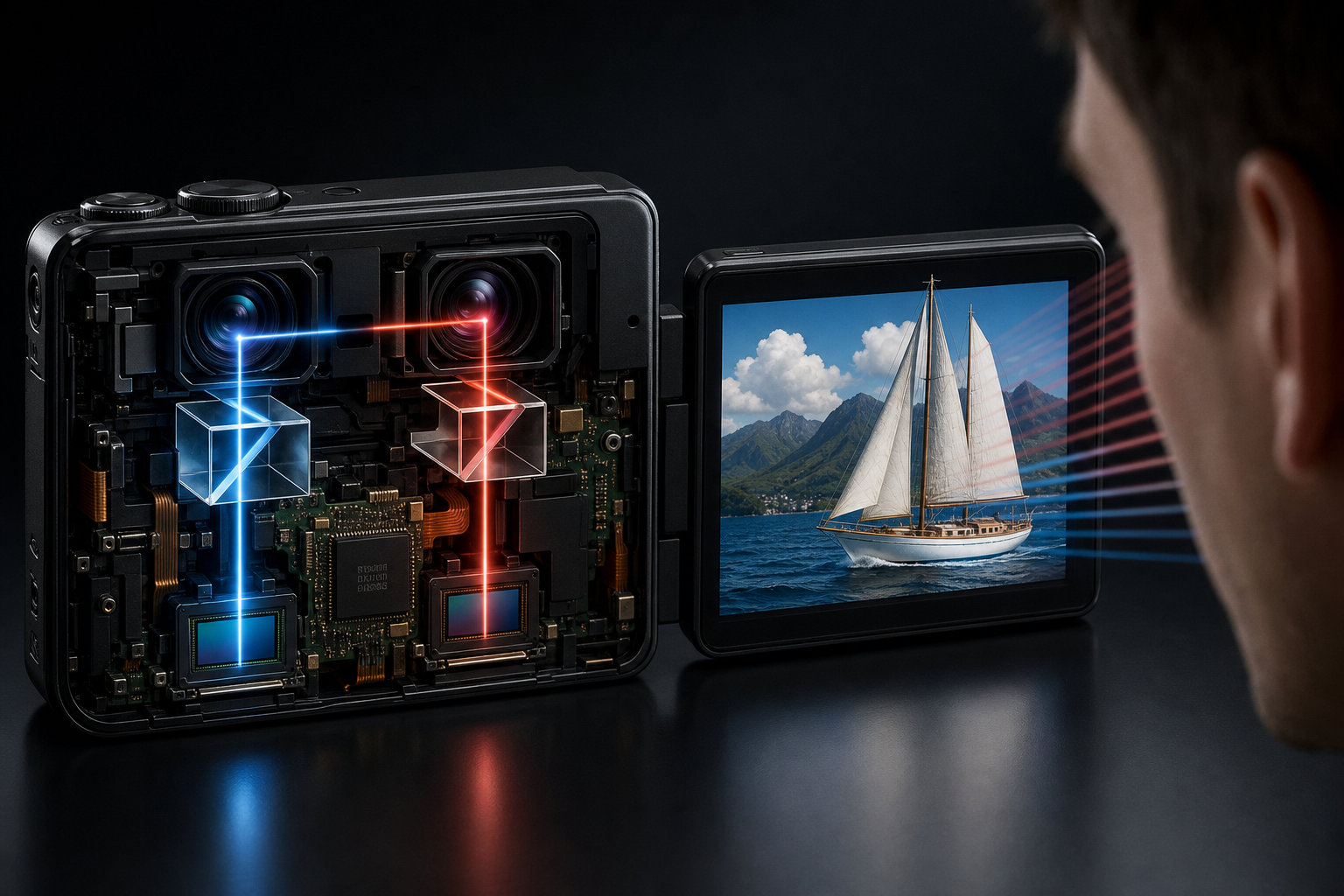
The Fujifilm FinePix REAL 3D W1 did not create the impression of depth solely by applying software processing to a single photograph. It had two lenses, two CCD sensors, and a processor that handled data from the left and right imaging paths. It was therefore a stereoscopic camera in the literal, optical sense of the term.
The glasses-free preview was just as important as the method of capture. The built-in 2D/3D screen directed different images to the left and right eyes, allowing the depth effect to be assessed without an additional viewer. The combination of a dual photographic system, stereo-pair processing, and an autostereoscopic display formed a coherent system for working with stereoscopy.
Two photographs instead of simulated depth
Stereoscopic vision is based on each eye observing a scene from a slightly different position. The differences between these two views, known as divergence or disparity, can be used to recreate the impression of depth. A stereo camera must therefore provide a pair of appropriately offset images: one intended for the left eye and the other for the right.
The W1 achieved this in hardware. It used two optical modules with Fujinon lenses offering a 3× zoom range, as well as two 10-megapixel CCD sensors. Each path observed the scene from its own viewpoint, allowing the camera to capture the left and right components of the stereoscopic pair simultaneously.
This is the most important feature distinguishing this design from 2D-to-3D conversion. In conversion, the starting point is a single flat image, and the second view must be derived from scene analysis and assumptions about its geometry. In the W1, both views came directly from two optical systems. Information about perspective differences was therefore recorded while the photograph was being taken rather than inferred only after capture.
It is a design fact that the camera has two lenses, two sensors, and two data paths. The technical conclusion is that the W1 should be regarded as a fully fledged stereo camera rather than a single-lens camera equipped merely with a depth effect.
Real Photo Engine 3D and the importance of joint processing
Two lenses and two sensors provide the source material, but by themselves they do not yet form a complete system. Data from both paths must be handled as a linked pair. In the FinePix REAL 3D W1, this task was performed by a processor the manufacturer called Real Photo Engine 3D.
Its role was to process data from the left and right imaging modules. From the user's perspective, what mattered was that the two photographs did not function as incidental, independent frames taken separately. The camera was designed from the outset to work with a stereoscopic pair.
This has practical significance. In stereoscopy, simply having two similar photographs is not enough. They must depict the same moment and corresponding framing, while the differences between them should result primarily from the offset between the observation points. The W1's architecture integrated the capture of both views into a single body and passed them to a shared processing system.
This does not mean that the camera automatically solved every problem of spatial composition. The design could make capturing a pair easier, but the photographer still had to pay attention to the distance from the scene, the position of the nearest objects, and the strength of the resulting effect.
77 mm stereo base: a parameter that shapes the image
The distance between observation points is called the stereoscopic base. In the W1, the lens spacing was 77 mm. This was not an adjustable parameter: it resulted from the physical placement of the two modules in the body.
The base affects the perspective differences between the left and right photographs. Its significance cannot, however, be considered separately from the photographed scene. The same distance between the lenses can produce a different result depending on the position of the nearest subject, the depth of the scene, and the lens settings.
A fixed base simplifies operation because the photographer does not need to set the spacing between two separate cameras. At the same time, it limits the flexibility characteristic of setups in which the camera positions can be adjusted to suit the scale of the scene. The W1 therefore offered the convenience of an integrated device but required shots to be composed with its fixed geometry in mind.
In practice, the suitability of a 3D shot should not be assessed solely on the basis of the 77 mm figure. The distance of the foreground from the camera is equally important. An object positioned very close to the camera can produce much greater differences between the views than a distant element. This is why the camera manual provided recommendations for shooting with automatic parallax adjustment.
Parallax and recommended shooting distances
Parallax is the visible shift in an object's position between the left and right images. It is the basis of the depth effect, but excessive parallax can make it difficult to fuse the two views into a single 3D image.
The W1 manual states that, with automatic parallax adjustment active, the recommended 3D shooting range begins at approximately 1.0 m at the wide-angle setting and approximately 2.0 m at telephoto. This information should not be equated with a general statement of the minimum focusing distance. It concerns the recommended use of the camera in stereoscopic mode and a specific method of adjusting parallax.
The difference between the recommendations for wide-angle and telephoto settings shows that 3D image geometry depends on more than the stereo base alone. The optical setting and framing also change the spatial relationships within the pair. Users should therefore not assume that a shot that works correctly at wide angle will remain equally easy to view after switching to telephoto from the same position.
What to check before pressing the shutter release
- Foreground distance — this is particularly important in 3D photography because nearby elements can exhibit substantial parallax.
- Zoom setting — the manual provides different recommendations for wide-angle and telephoto settings.
- The result on the 3D screen — the glasses-free preview made it possible to assess not only the framing but also the impression of depth.
- Viewing comfort — a stronger depth effect does not necessarily mean a better photograph; the ability to fuse the views comfortably is important.
The final point is a practical interpretation arising from the nature of stereoscopy, not a claim that the camera independently assessed the comfort of every shot. Automatic parallax adjustment assisted the user but did not replace deliberate scene composition.
Glasses-free 2D/3D screen
The FinePix REAL 3D W1 was equipped with a 2.8-inch screen capable of operating in 2D or 3D mode. In stereoscopic mode, it used light-direction control to deliver a different image to each eye. This gave the viewer an impression of depth without requiring anaglyph, polarized, or active glasses.
This type of solution is described as autostereoscopic: the views are separated by the display itself. This differs from anaglyph imaging, in which two images are color-coded and separated by colored filters in the glasses. In the W1's screen, the key was directing light so that each eye received the correct view.
Integrating such a display into the camera had considerable practical significance. In a traditional stereo photography workflow, checking focus and exposure on an ordinary 2D screen does not yet reveal how the pair will be perceived stereoscopically. The W1 made it possible to see the effect without transferring the files to a separate device.
The glasses-free preview did not, however, change how the photograph was created. The screen was a presentation tool, while the two lenses and two sensors remained the source of the spatial information. This distinction is important: an autostereoscopic display can show two views, but in the W1 those views were first genuinely captured through separate optical paths.
An integrated system rather than a single feature
The significance of the W1 cannot be reduced to a single specification. The camera combined three stages of the workflow: hardware capture of the left and right images, joint data processing, and glasses-free presentation of the result. Each of these elements served a different function, and only their interaction created a practical 3D photographic system.
For novice users, the ability to capture a pair with a single device was important. For those interested in stereoscopic technology, the predictable 77 mm base and the ability to observe the consequences of scene arrangement were equally significant. The camera simplified operation but did not eliminate the laws of stereo geometry.
This is precisely why the W1 remains a good example for explaining the difference between stereoscopic photography and an effect added to a single image. In the former case, two viewpoints already exist at the moment of exposure. In the latter, an additional view must first be created. The FinePix REAL 3D W1 clearly belonged to the first group.
Summary
The FinePix REAL 3D W1 was a stereo camera because of its specific architecture: two Fujinon 3× lenses, two 10-megapixel CCD sensors, a 77 mm base, and a Real Photo Engine 3D processor handling data from both paths. The 2.8-inch 2D/3D screen allowed the pair to be viewed without glasses by directing different images to the left and right eyes.
The design did not relieve the photographer of the need to control parallax. With automatic adjustment active, the manual recommended 3D photography from approximately 1.0 m at wide angle and 2.0 m at telephoto. These limitations do not undermine the device's stereoscopic nature—rather, they show that true 3D results from the geometry of two viewpoints, not merely from a mode label on the camera body.