The history of View-Master is often told primarily as the story of a recognizable stereoscopic viewer. However, the device itself was only part of a larger system. Its significance was also determined by the reels, their subject matter, the way they were produced, and their distribution. It is the changes in the repertoire that reveal how a medium initially associated with landscapes and tourism became a vehicle for licensed entertainment aimed at children.
The most important transformation did not involve abandoning stereoscopy. View-Master continued to offer three-dimensional images viewed through a dedicated viewer. What changed was the answer to the question of what the user was supposed to see: first distant places and attractions, and later also Disneyland, Disney characters, and content related to films and television programs.
Debut in 1939: stereoscopy as travel
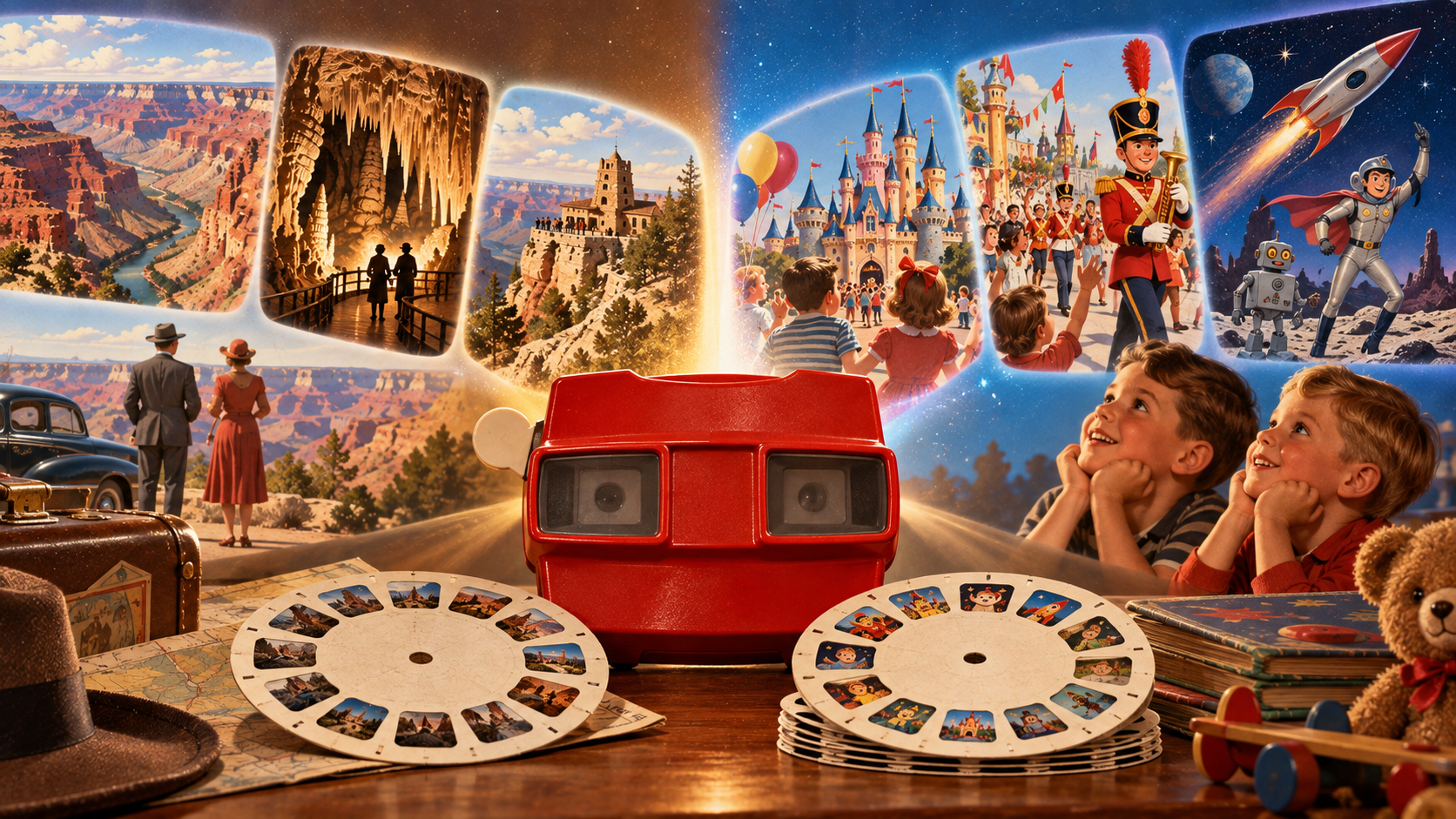
View-Master debuted at the New York World’s Fair in 1939. The first series of reels mainly featured landscape views and tourist attractions. Popular subjects included Carlsbad Caverns and the Grand Canyon.
This repertoire placed the device within the longer tradition of using stereoscopy to explore places that viewers could not see in person. A three-dimensional image offered a different experience from an ordinary photograph. It did not replace actual travel, but it enhanced the impression of viewing a particular setting by presenting it stereoscopically.
The term “armchair tourism” aptly describes the cultural function of these materials. The user remained at home but, through successive images, directed their attention toward caves, canyons, and other attractions. The reel therefore served as a small, repeatable medium for a visual excursion.
It is a fact that landscapes and tourist destinations were among the primary subjects of the early series. Interpreting View-Master as a type of domestic travel medium, however, remains an interpretation. This perspective stems from the combination of the stereoscopic form of presentation and the selection of places, but it does not mean that the device could recreate the full experience of being there.
Why the reel was as important as the viewer
The viewer can be regarded as the means of access, while the reels constituted the system’s actual repertoire. Without new subjects, the device would have had limited usefulness. Each new set of views provided a reason to use the same equipment again.
This relationship helps explain the format’s longevity. Users did not need to receive an entirely new device to discover more places or stories. The content provided the change. View-Master can therefore be analyzed not only as a single optical product, but also as a combination of three elements:
- a viewer used to view stereoscopic images,
- reels serving as an interchangeable content medium,
- a repertoire that could be expanded with new places, characters, and productions.
This perspective is supported by the scope of the Oregon Historical Society’s collection. The company-related holdings include not only devices and finished reels, but also concept materials, packaging, and promotional items. This documentation shows that View-Master content went through a design process and was placed within a specific commercial framework.
This is an important distinction. The history of stereoscopy is not limited to optics and viewer design. It also encompasses the selection of subjects, the organization of material, packaging design, and the way it was presented to potential audiences. View-Master is a clear example of a device whose cultural function depended on an entire publishing infrastructure.
1951 and the acquisition of Tru-Vue
The turning point came in 1951, when Sawyer’s purchased its competitor Tru-Vue. Through the acquisition, it obtained stereoscopic licensing rights to Disney characters. The View-Master range was subsequently expanded to include three-dimensional images of Disneyland and materials related to Disney films and programs.
The change had greater significance than simply adding another group of subjects. A view of the Grand Canyon appealed primarily to interest in a real place. A reel related to a recognizable character, film, or program, by contrast, drew on the viewer’s relationship with stories and characters known from other media.
The license therefore made it possible to connect stereoscopy with the existing circulation of popular culture. View-Master no longer had to present the world solely as a collection of places worth seeing. It could also show worlds, characters, and scenes that had significance through film, television, and the Disney brand.
From documenting a place to expanding a story
There is a significant difference in reception between a tourist reel and a licensed one. In the first case, the main point of reference is the place. In the second, the image can form part of a broader narrative experience: viewers recognize a character or production and connect the scene they are viewing with knowledge acquired outside View-Master.
This does not mean that one type of content was technically more stereoscopic than the other. What differed primarily was the function of the images. Landscape materials offered a visual substitute for travel, while the licensed repertoire incorporated the viewer into the world of children’s entertainment.
This is why the acquisition of Tru-Vue can be interpreted as the moment when the value of content rights became as important as the ability to present three-dimensional images itself. The technology provided a distinctive way of viewing, while the licenses supplied subjects already present in the audience’s imagination.
Disneyland as a combination of both models
Images of Disneyland occupy a special place in this history because they combined two roles of the View-Master repertoire. On the one hand, they presented a specific attraction and thus continued the tourist orientation of earlier reels. On the other hand, they were connected with the world of Disney and its licensed content.
They can therefore be regarded as a bridge between “armchair travel” and children’s popular culture. Viewers saw a place, but that place was also part of a recognizable entertainment system. The transition from landscapes to licensing did not necessarily take the form of a sudden break. Both uses of stereoscopy could coexist within the same format.
This continuity is important when assessing View-Master. The device did not become a children’s medium because its fundamental technical concept was changed. What changed above all was the repertoire and, with it, the set of associations surrounding the viewer and reels.
From an aid for viewing the world to an object of childhood
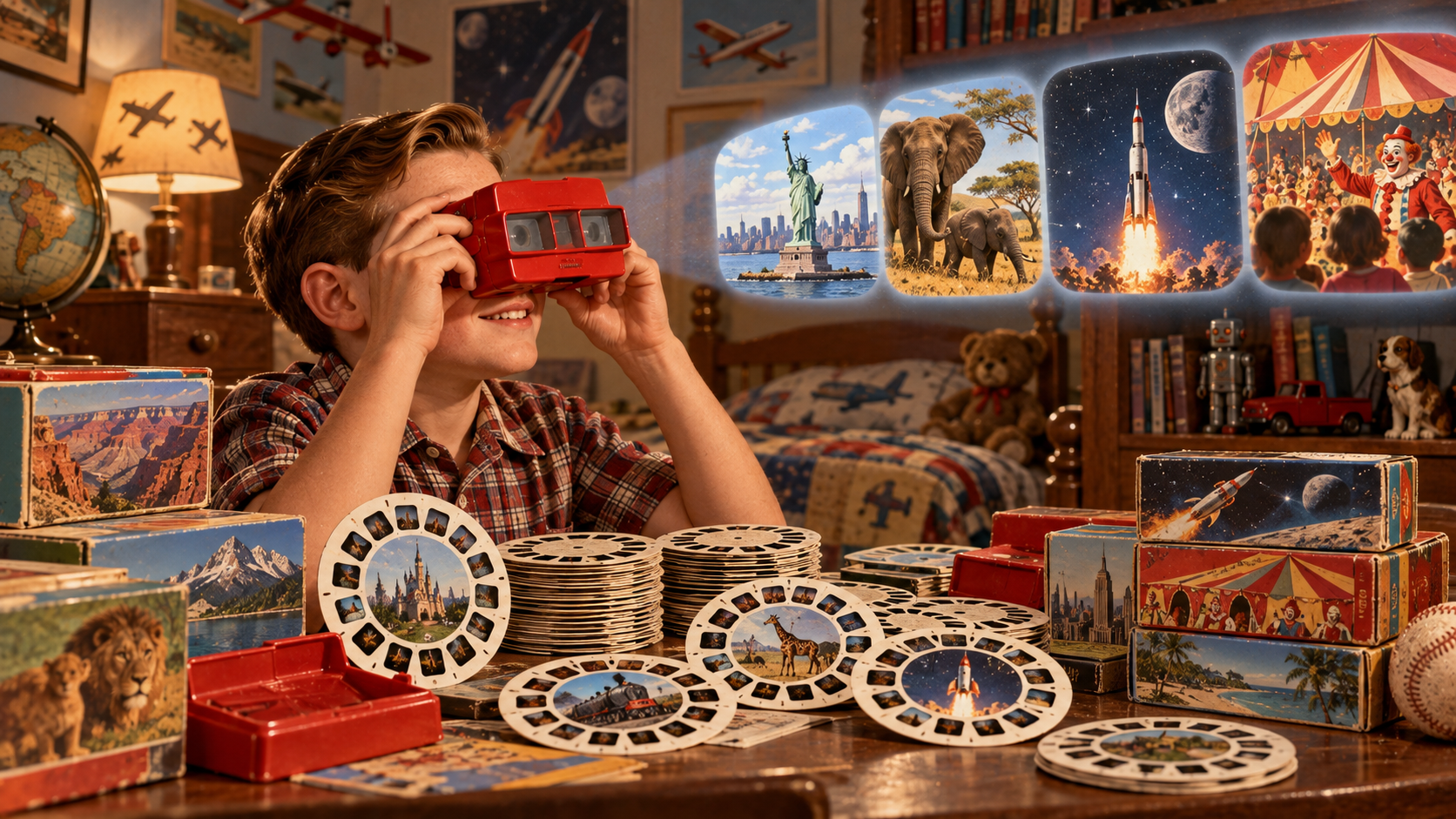
Museum studies draw attention to the widespread presence of View-Master in children’s culture. However, this stage should not be considered separately from its origins in tourism. In both cases, the device offered access to something not directly present before the user: a distant landscape, an attraction, a character, or a scene known from another medium.
The early model was based on curiosity about the world. The later one relied more heavily on familiarity with brands, films, programs, and characters. The technical medium remained recognizable, but its cultural significance shifted from viewing places at home toward collecting and experiencing licensed content.
Describing View-Master solely as a toy therefore oversimplifies its history. It overlooks its tourist roots and the role of stereoscopy as a way of presenting the world. In turn, describing it only as an optical viewer does not explain why particular reels could capture the interest of successive audiences. Understanding the phenomenon requires both perspectives: the device and the repertoire.
The end of landscape reels as a symbol of change
According to a History.com article published in 2025, Mattel ended production of landscape and tourist reels in December 2008. At the same time, reels featuring animated content remained in the Fisher-Price range.
This information clearly demonstrates the long-term direction of the transformation. The subjects with which View-Master’s history began eventually disappeared from production, while the animated repertoire continued. This does not mean that historical tourist reels lost their significance as collectibles or documents of visual culture. It does, however, indicate which content model retained its place in the later product range.
From the perspective of media history, this is an example of a situation in which a format can endure while its primary use changes. The stereoscopic reel began as a medium for landscapes and attractions, but over time it became more strongly associated with animation and children’s entertainment.
View-Master as a system of visual culture
The materials preserved by the Oregon Historical Society make it possible to study View-Master more broadly than through finished examples of viewers alone. Reel designs, packaging, and promotional items document the path from an idea for a subject to content presented to the audience.
This perspective raises new research questions. How were places selected for stereoscopic presentation? How was licensed content adapted to the reel format? How did the packaging communicate the subject and its connection with a film, program, or attraction? The material provided does not offer a basis for detailed answers, but it confirms the existence of documentation that makes analysis of these processes possible.
View-Master therefore deserves attention for more than nostalgia alone. Its history demonstrates the relationship between viewing technology and the content economy. The viewer provided a consistent method of presentation, while the reels made it possible to respond to audiences’ changing interests.
The technology remained, but perceptions of it changed
From its debut in 1939 to the later dominance of animated subjects, View-Master evolved from a stereoscopic guide to attractions into a medium associated with children’s entertainment. The decisive factor was not only the device’s design, but also the ability to expand its repertoire regularly.
The acquisition of Tru-Vue in 1951 and the obtaining of rights to Disney characters marked a key moment in this evolution. Licensed content did not erase View-Master’s technical identity, but gave it a new context. The same format could show the Grand Canyon, Disneyland, or scenes related to film and television.
The View-Master phenomenon grew precisely out of this combination: easy access to stereoscopic images and a repertoire that changed along with visual culture. The history of the reels is a reminder that a device’s significance is not always determined solely by its specifications. Sometimes the worlds that can be viewed through it are equally important.