
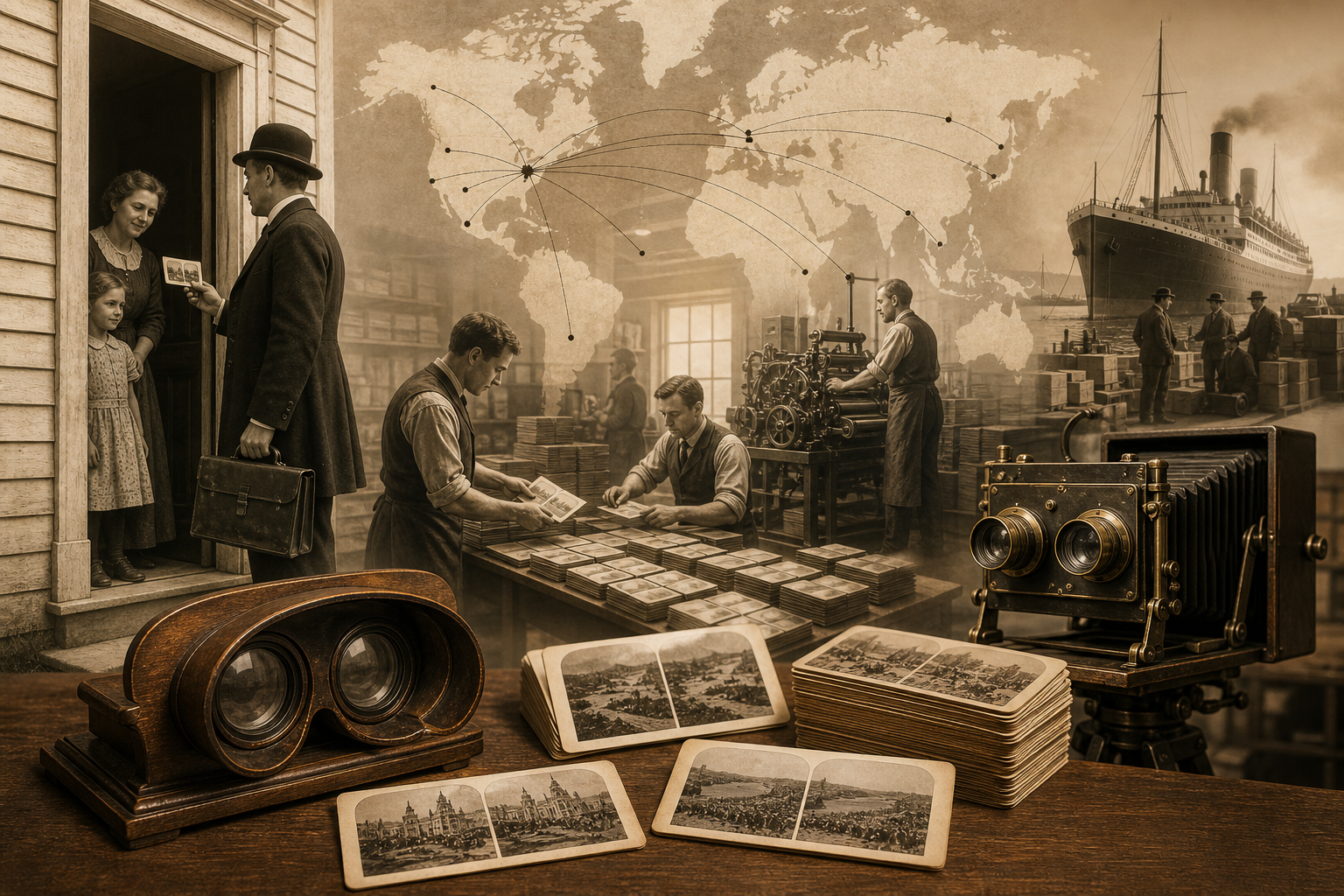
Underwood & Underwood did not begin as a major producer of stereoscopic images. Founded in 1882 in Ottawa, Kansas, the company initially distributed stereographs made by photographers from the eastern United States. Its founders, brothers Elmer and Bert Underwood, found customers for these materials in the West, using door-to-door sales, among other methods.
Less than two decades later, the scale of its operations was already industrial. In 1901, the company published 25,000 stereographs a day and, according to the University of Chicago archives, also sold 300,000 stereoscopes annually. A fundamental transformation occurred between these two stages: a distributor of other photographers’ work became an organization combining image acquisition, production, the sale of viewing devices, and the development of a network of branches.
The company’s history is therefore interesting not only as a chapter in the history of stereoscopic photography. It also shows how three-dimensional images could become a product manufactured and distributed on a mass scale.
Beginnings in Kansas: the market first, production later
Elmer and Bert Underwood founded the company in Ottawa, Kansas, in 1882. During its initial period, their business was not based on extensive in-house photographic production. They distributed stereographs originating from photographers working in the eastern United States, directing them to the western market.
A stereograph was intended to be viewed in a stereoscope. From a commercial perspective, the image card and the device used to view it formed an interconnected system. Surviving data from a later period, covering both the publication of stereographs and the sale of stereoscopes, indicate that Underwood & Underwood operated on both sides of this system.
Door-to-door sales played an important role in the company’s first distribution model. It was a direct way of reaching customers without restricting operations to a single store or local market. Archival sources confirm the use of this method, but the material provided does not give details about how the salespeople’s work was organized. Unverified procedures or figures for the size of the sales network should therefore not be added to this history.
A cautious conclusion can nevertheless be drawn: before the company developed its own photographic and printing facilities, it gained experience in distributing a finished product. This sequence allowed it to learn about the market first and only later increase its control over the creation of stereographs. This is an interpretation of the development model based on the chronology of documented activities, not a statement made by the founders themselves.
1897 and the move to in-house image resources
In 1897, Underwood & Underwood began employing staff photographers and freelancers. This marks an important turning point in the company’s history. It no longer had to base its offerings exclusively on materials obtained from external publishers or photographers. It could organize the creation of its own image resources, drawing both on permanent staff and outside contributors.
The combination of these two forms of employment had organizational significance. Staff photographers formed part of the company’s internal resources, while freelancers made it possible to obtain photographs without limiting the entire process to permanent personnel. The materials provided do not, however, specify the number of photographers, their individual assignments, or the proportions between the two groups. What is certain is that this form of organized collaboration began in 1897.
From the perspective of the history of stereoscopy, this represented a step away from trading existing cards and toward controlling what would appear in the catalog. For a company engaged in the mass publication of images, having sales channels alone was not enough. It also needed a regular supply of photographs that could be prepared and put into circulation.
Printing plants as an element of scale
The next stage came in 1897–1898. Underwood & Underwood then gained control of the photomechanical printing plants of J. F. Jarvis, Charles Bierstadt, and William H. Rau. This was more than simply an increase in the number of assets it owned. Gaining control of printing facilities strengthened the company’s position in the part of the process that followed the taking of a photograph.
Based on these facts, Underwood & Underwood’s model can be described as moving toward the integration of successive stages of its operations. The company first distributed stereographs by other photographers. It then employed its own creators and contributors while simultaneously gaining control of photomechanical printing plants. Direct sales and the development of branches were added to this.
“Integration” is used here as an analytical term. The sources provided document the individual activities but do not present them as a management theory formulated by the Underwood brothers. The chronology nevertheless shows that the company encompassed an increasing number of the links required to produce and distribute stereographs.
Control over printing was particularly important with a large volume of publications. However, taking a photograph should not be equated with producing a finished card. These were separate stages: the image material first had to be obtained and then prepared for publication in a form intended for the customer. Underwood & Underwood’s documented activities covered both areas.
25,000 stereographs a day
The most telling indicator of scale is the figure given for 1901: 25,000 stereographs published each day. This number describes a company that was already very far removed from its initial stage of distributing other people’s cards in the western market.
However, this figure should not automatically be multiplied by 365 days and the result presented as annual production. The materials provided do not specify how many days the plants operated or whether the daily output was maintained throughout the year. The safe approach is to retain the figure in the form given by the archive: 25,000 stereographs a day in 1901.
The University of Chicago also cites annual sales of 300,000 stereoscopes. The two figures should not be compared directly because they concern different products and different reporting periods. Together, however, they show two complementary areas of activity: the company supplied both stereoscopic images and the devices needed to view them.
This distinction is important for understanding the market of the period. A stereoscope was not an individual photograph but a tool that enabled the use of successive cards. Stereographs, in turn, formed a collection to which the customer could return and which could be expanded. The archival data do not make it possible to determine how many buyers purchased both types of products or what specific sales sets looked like, so such details should not be assumed.
From Ottawa to New York and overseas branches
Underwood & Underwood’s growth was not confined to Kansas. Archival materials list branches in Baltimore, London, and Canada, among other locations, as well as the relocation of the company’s headquarters to New York. The phrase “among other locations” is important here: the list cited in the source package does not necessarily include every branch.
The geographical expansion of the business complements the picture of a company building an extensive distribution system. Initially, the brothers connected photographs from the eastern United States with customers in the West. Later, the company had its headquarters in New York and a network extending beyond its original region, including London and Canada.
There is no need to portray this expansion solely as a series of spectacular successes. The available facts primarily demonstrate a change in scale and structure. The company ceased to be an enterprise associated with just one city and a single direction of distribution. It became an organization operating through multiple centers.
What was the company’s advantage based on?
The most convincing explanation for the growth of Underwood & Underwood cannot be reduced to the appeal of the photographs themselves. The material provided contains neither a catalog of photographic subjects nor data that would allow their artistic qualities to be assessed. It does, however, document the organizational mechanism well.
- Distribution: the company began by distributing stereographs made by photographers from the eastern part of the country in the West.
- Direct sales: it used a door-to-door model.
- Content acquisition: from 1897, it employed staff photographers and freelancers.
- Production facilities: in 1897–1898, it gained control of the plants of J. F. Jarvis, Charles Bierstadt, and William H. Rau.
- Scale: in 1901, it published 25,000 stereographs a day, while the University of Chicago archives report sales of 300,000 stereoscopes annually.
- Reach: it developed branches beyond Kansas and moved its headquarters to New York.
Taken together, these elements support a view of a company organized around the entire circulation of stereographs: from acquiring the image and reproducing it to reaching the customer and supplying them with a stereoscope. It was this combination of stages, rather than a single isolated invention, that best explains the industrial scale of operations evident in the data from 1901.
The company as part of the history of 3D imaging
The case of Underwood & Underwood is a reminder that the history of stereoscopy is not solely the history of optics, cameras, and methods of taking pairs of photographs. Production, printing, and distribution were equally important. Without efficient reproduction and sales, even an extensive collection of photographs could not have reached a broad audience.
The path from a company founded in Ottawa in 1882 to an enterprise publishing 25,000 stereographs a day in 1901 led through several distinct stages. The Underwoods began as distributors, used door-to-door sales, developed their own photographic resources, gained control of photomechanical printing plants, and expanded their geographical reach.
The documented figures show the result, but the process is equally important. Underwood & Underwood built scale by combining photography with the organization of production and commerce. As a result, the company’s history remains a useful study of how stereography moved from individual cards and local distribution to the mass circulation of three-dimensional images.