The modern anaglyph is easy to recognize: two color-coded views are superimposed, while glasses with different filters direct the appropriate image to the left and right eye. The red–cyan combination is the most common today. This description is technically useful, but historically incomplete. The technique did not emerge at a single moment, nor did it initially have the form familiar today.
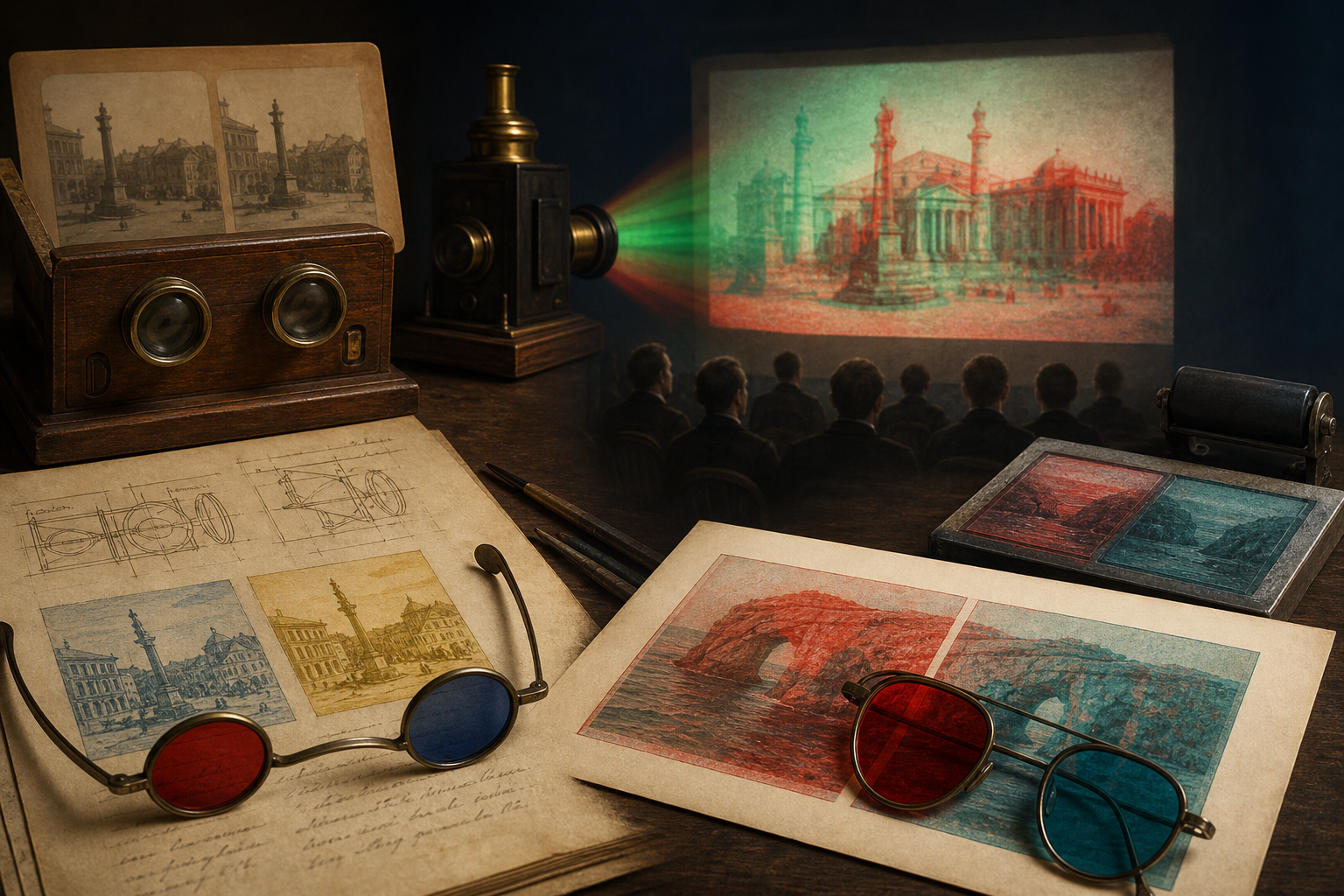
Its birth is better presented as a sequence of three achievements. In 1853, Wilhelm Rollmann described experiments involving the separation of images by means of color. In 1858, Joseph-Charles d’Almeida applied a similar principle to projection intended for an audience. Louis Ducos du Hauron, in turn, developed a method for superimposing color separations in print and patented it in 1891. The establishment of the name “anaglyph” is associated with this final stage.
First the Principle, Then the Familiar Format
The basic idea of the anaglyph is to encode the two components of a stereoscopic image in such a way that they can be placed on a single surface and then separated again during viewing. Colored filters positioned in front of the eyes act as selectors. Each is intended to allow the appropriate component to be seen while limiting the visibility of the other.
In this approach, color is not merely an aesthetic element. It becomes a tool for conveying separate information to each eye. This function is precisely what connects Rollmann’s early experiments, d’Almeida’s projections, Ducos du Hauron’s printing process, and the later red–cyan practice.
However, the principle itself should not be equated with a single specific set of filters. Red–green and red–blue systems appeared throughout the technique’s history, while Rollmann’s experiments also included blue-and-yellow drawings viewed through red and blue filters. The current arrangement of red for the left eye and cyan for the right is an important standard used for many printed anaglyphs, but it is not the starting point of this history.
1853: Wilhelm Rollmann’s “Color Stereoscope”
The first of the three key stages consisted of Wilhelm Rollmann’s experiments, described in 1853. They involved separating images intended for the two eyes by means of color. The experiments included blue-and-yellow drawings as well as red and blue filters.
The most important point here is not the choice of colors as judged from the perspective of modern anaglyph glasses. The significance of the experiment lies in the very use of color differences to control what reaches each eye. Rollmann thus demonstrated the basis of the later process: two views do not have to be presented side by side in separate fields. They can be separated through color coding and filtration.
This distinction helps avoid anachronism. The early solution should not be described as though it were a ready-made equivalent of today’s red–cyan anaglyph. It was a stage in the formation of the technical principle, not yet the final form of the popular printed medium.
1858: d’Almeida Brings the Method to the Screen
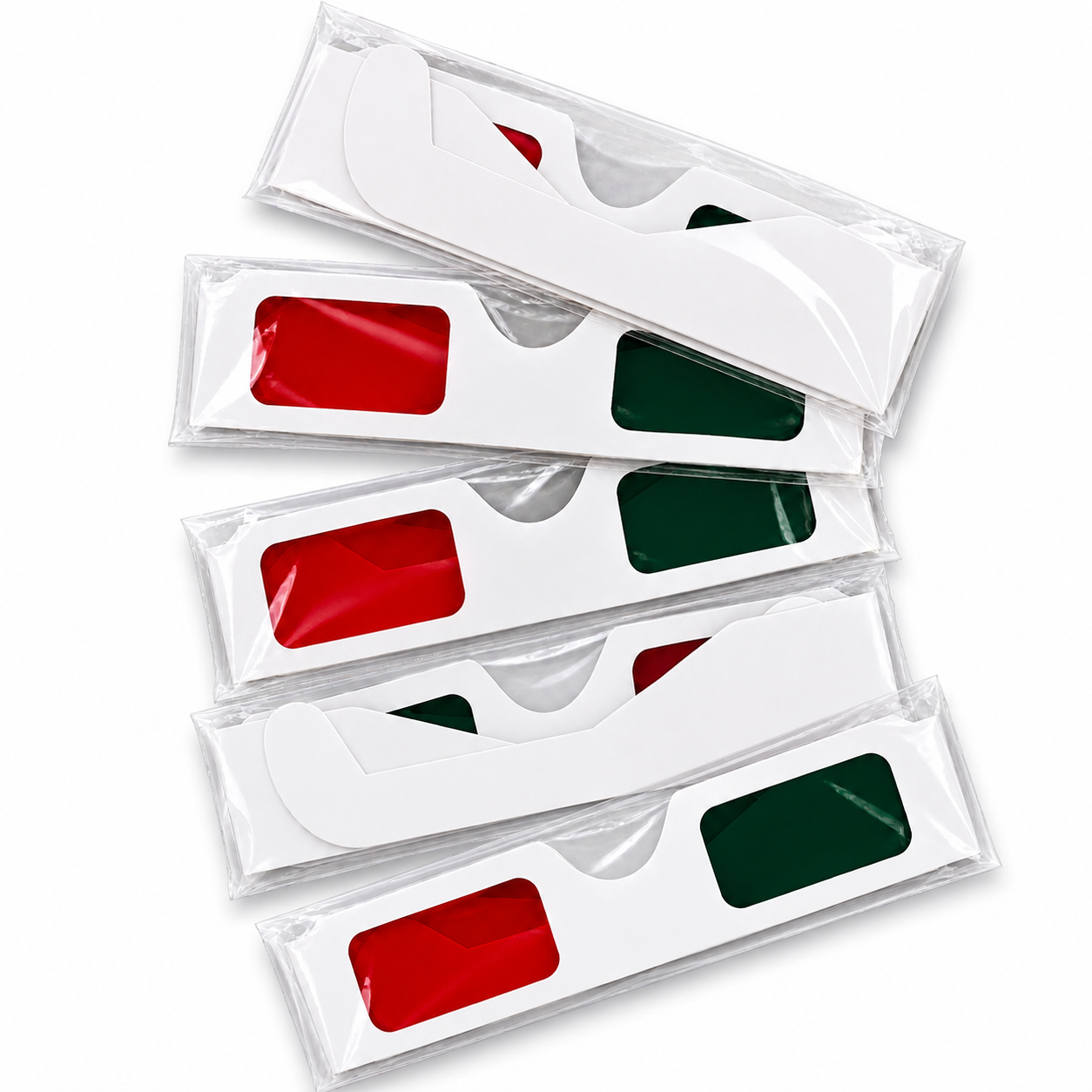
Five years after Rollmann’s account, Joseph-Charles d’Almeida presented a projection-based solution. In 1858, he described the projection of two superimposed images using red and green filters. The audience viewed the projection through glasses fitted with corresponding filters.
This represented a significant change in the scale of application. In Rollmann’s experiment, the key point was to demonstrate that views could be separated using color. With d’Almeida, the same general idea was applied in a projection system intended for a group of viewers. Both images occupied the same screen space, while their separation occurred only at the level of the viewer’s glasses.
This stage can be regarded as an important precursor to later methods of presenting stereoscopic images to groups. However, this does not mean that d’Almeida’s projection was identical to modern 3D cinema. The source material confirms the specific red–green arrangement and viewing by an audience, but provides no basis for attributing the parameters or features of later systems to this solution.
Why Was Projection a Distinct Achievement?
The transition from an experiment with colored drawings to projection was not merely a change of medium. The method had to preserve the separation of the two components despite their being superimposed on the screen, while also allowing them to be viewed by many people. In the audience, each observer used their own pair of filters, but everyone looked at the same composite image.
From a historical perspective, it is therefore worth distinguishing between two contributions: Rollmann described an early use of color to separate views, while d’Almeida demonstrated a projection-based form of this idea. Combining both events into a single, undefined “invention of the anaglyph” erases the distinction between the optical principle and the method used to present it to an audience.
1891: Ducos du Hauron and the Printed Anaglyph
The third stage was the adaptation of the method to printing. Louis Ducos du Hauron developed a method for overprinting color separations and patented it in 1891. Unlike projection, the two encoded views could be fixed as a superimposed image on printed material.
It is this stage that sources associate with the establishment of the term “anaglyph.” Chronology matters here: the principle of separating views by means of color was known earlier, but the named and practically developed printing technique appeared later. The origin of the idea, projection for an audience, and the printing process should therefore not be treated as a single event.
Printing also changed the nature of access to the image. Projection required the display of two components, whereas overprinting made it possible to combine them on a single, permanent surface. Appropriate filters were still required for viewing, but the image itself no longer depended on an ongoing projection show. This is an interpretation arising from the difference between the media described, not an additional claim about specific print runs, audiences, or commercial applications.
From Red and Green to Red and Cyan
The history of the anaglyph did not follow a simple pattern in which a single pair of colors was established from the outset. Documented solutions include red–green and red–blue combinations, among others. Rollmann’s early experiments additionally show that the relationship between the colors of the drawings and those of the filters did not simply correspond to today’s standard.
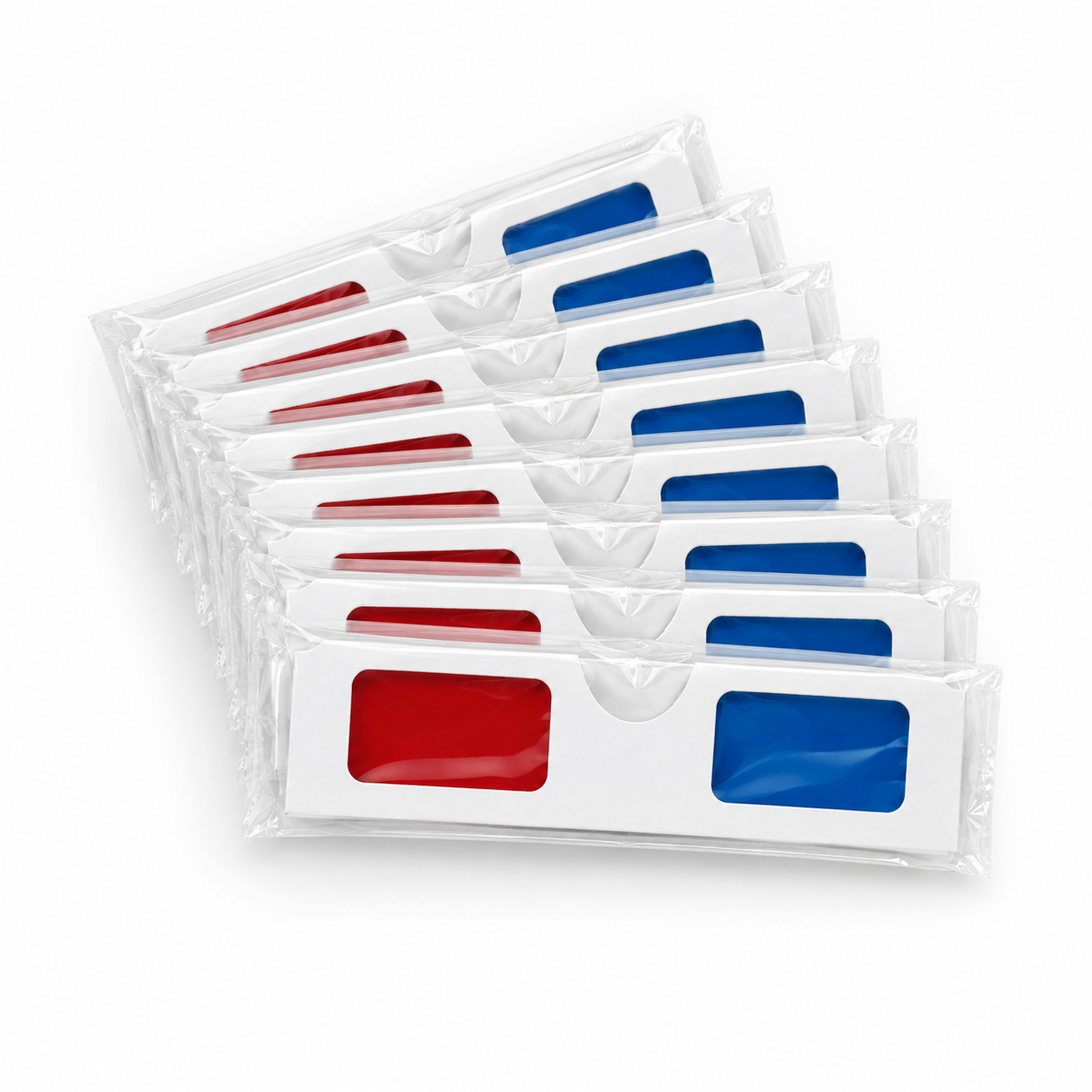
Today, many printed anaglyphs typically use an arrangement in which the red filter is placed in front of the left eye and the cyan filter in front of the right. This is the configuration associated with popular anaglyph glasses. However, a widely used configuration must be distinguished from the technique as a whole. The anaglyph is a method of color multiplexing two views, not merely the name of a single pair of filters that remained historically unchanged.
The various color combinations show that the method’s development involved searching for a way to separate the components effectively. Based on the materials provided, however, it is not possible to compare the quality of individual combinations numerically or assign precise parameters to them. It can nevertheless be stated that red–cyan glasses are the result of the later standardization of the practice, rather than equipment present at every stage in the birth of the anaglyph.
Three Stages Instead of One Inventor
The clearest chronology of the technique’s development is as follows:
- 1853 — Wilhelm Rollmann: a description of the color separation of images intended for the two eyes, using blue-and-yellow drawings and red and blue filters.
- 1858 — Joseph-Charles d’Almeida: projection of two superimposed images through red and green filters, viewed by an audience wearing appropriate glasses.
- 1891 — Louis Ducos du Hauron: a patented method for superimposing color separations in print, also associated with establishing the name of the anaglyph process.
This division is not intended to identify a single “true” inventor. Rather, it shows that different types of innovation were needed to create a useful technique: the idea of separation, a presentation method, and a way to permanently fix the image. Each of the researchers listed represents a different stage in this sequence.
What Does the History of the Anaglyph Really Mean?
The anaglyph is a good example of a technology whose modern, easily recognizable form can obscure its complex origins. Red–cyan glasses did not appear as a finished invention in 1853. First came experiments with encoding views by means of color, then the use of this principle in projection for an audience, and only later the development of a practical overprinting process and the establishment of its name.
The dates, names, and color configurations described remain facts. Viewing them as three complementary phases—the discovery of the principle, the scaling up of the presentation, and adaptation to printing—is an interpretation. This perspective explains the development of the anaglyph better than attempting to reduce its entire history to a single moment or one pair of colors.
Today’s red–cyan arrangement is therefore an important chapter, but not the beginning of the story. It began with experiments exploring how color could separate information intended for the left and right eye.