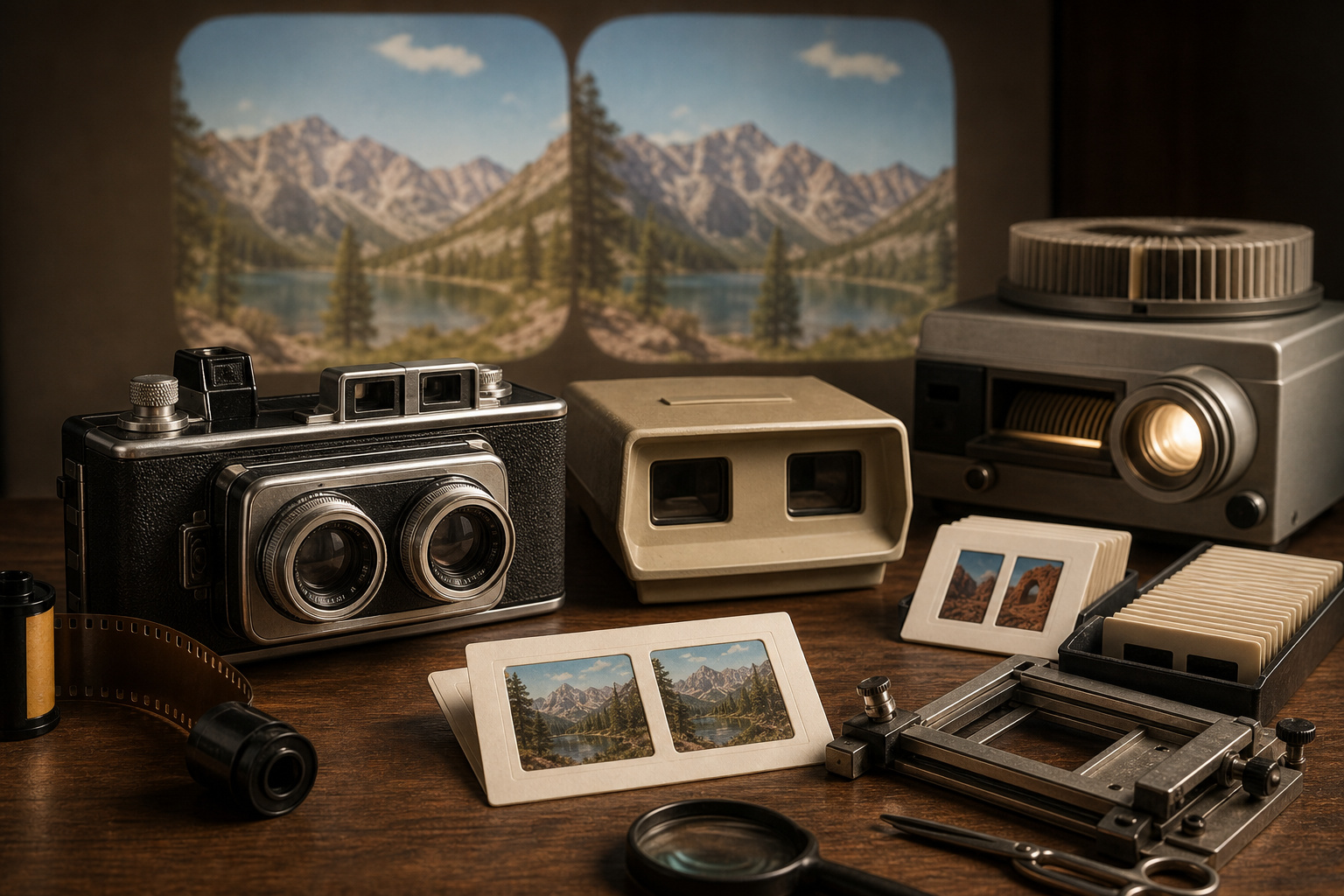
The Stereo Realist occupies an important place in the history of stereoscopic photography not only because it took stereoscopic photographs on 35 mm film. Its significance also stemmed from the system surrounding it: the 5P slide format, viewers, projectors and the tools needed to prepare finished stereo pairs. The camera was the starting point of an entire process leading from pressing the shutter release to viewing a three-dimensional image.
Historical studies portray the Stereo Realist as the device that started or strongly drove the stereophotography boom of the 1950s. This view, however, requires clarification. Its success was not solely the result of the design of a single camera body. Equally important were the use of 135 film, the ability to create color slides and the availability of equipment for mounting, viewing and projecting them.
From Seton Rochwite’s design to its market launch
The origins of the Stereo Realist date back to 1943. That was when Seton Rochwite presented David White with a design for a new stereoscopic camera. The device went on public sale in the summer of 1947. These dates show that the journey from concept to marketable product took several years and spanned the final phase of World War II and the beginning of the postwar growth of the photographic market.
The camera’s debut alone does not fully explain its later significance. Stereoscopic cameras had existed before, as had methods for viewing pairs of photographs. What mattered in the case of the Stereo Realist was the combination of these elements in a solution based on a widely known photographic medium and supported by a range of matching accessories.
A fact confirmed by the sources is both Rochwite’s involvement in the development of the design and David White’s introduction of the camera to the market in 1947. An interpretive conclusion, however, is that the Realist’s greatest market innovation was not a single technical feature, but the organization of a complete method for taking and presenting stereo photographs.
How the Stereo Realist worked
The Stereo Realist used type 135 cartridge film, that is, 35 mm film. The camera simultaneously took two photographs of the same scene. Each showed the subject from a slightly different viewpoint, and together they formed a stereoscopic pair intended to be viewed as a three-dimensional image.
This simultaneous capture of two frames is fundamental to stereo photography. The pair must provide the left and right eyes with two corresponding views. A twin-lens camera completes this stage in a single exposure instead of requiring successive photographs to be taken after repositioning a single camera.
This did not mean, however, that the finished 3D effect was created directly on the film. The negative or slide film contained two flat frames. Depth could only be seen once they had been properly prepared and presented so that each eye received its intended image. This is precisely why mounting and viewing equipment was just as important as the camera itself.
The Realist 5P format: a small frame, an important standard
The Stereo Realist took photographs in a format known as Realist or 5P. Each of the two nearly square frames had nominal dimensions of 24 × 23 mm. The designation 5P refers to a frame width corresponding to five film perforations.
The format name therefore describes neither the number of photographs nor the type of three-dimensional effect, but the way in which the 35 mm film strip was used. Perforations are holes arranged along the edges of the film. They provide a convenient reference point when describing the width of the image and its position on the film.
The significance of 5P extended beyond the geometry of an individual frame. An established format made it possible to design matching mounts, viewers and projection equipment. For the user, the compatibility of these components meant that taking the photograph was only the first stage of a predictable process.
5P can therefore be viewed as the common language of the system. The camera defined the image dimensions, the mounting tools helped prepare the pair, and the presentation device had to conform to the same arrangement. This is an interpretation of the standard’s function, but it is based on the confirmed fact that David White offered not only cameras, but also an extensive range of equipment for processing and viewing stereo slides.
From film to a three-dimensional image
The David White system included viewers, projectors, film cutters, slide-mounting aids, cases and a stereoscopic slide-mounting service. This list clearly illustrates how many stages separated exposure from the presentation of a finished photograph.
- Capture: the camera simultaneously recorded two images on 135 film.
- Preparation: the appropriate sections of film had to be separated and placed in a mount as a stereo pair.
- Pair verification: both frames had to be assigned to the correct eye and presented in the proper arrangement.
- Viewing: the finished slide could be placed in a viewer or used in a projection system.
The sequence above is a reconstruction of the workflow based on the functions of the listed devices, rather than a quotation from a manual. It does, however, explain why the product range included both cutters and mounting aids, as well as viewers and projectors. Without preparation of the pair, the two photographs remained merely adjacent images on a strip of film.
The availability of a slide-mounting service also had practical significance. Users did not have to perform every step themselves. David White supported both those who wished to process the material on their own and photographers who used a ready-made service.
Viewer and projector: two methods of presentation
A stereo viewer and a projector served different roles. The former was intended for directly viewing a prepared pair. A projector, by contrast, allowed the slides to be presented in a different way. The very fact that both types of device were offered indicates that the system was not limited to a single usage scenario.
From the standpoint of stereoscopy, image separation remained the most important requirement: the left and right views had to reach the corresponding eyes. The source package provided does not give details of the design of individual viewers or the projection technique, so specific filters, optical arrangements or parameters should not be attributed to them. It can, however, be stated that these devices were an integral part of the Stereo Realist product range.
The Stereo Realist 2.8 and its optical equipment
The Stereo Realist family was not limited to a single version. One of the later variants was the Stereo Realist 2.8. Its documented specifications should be distinguished from the general description of the entire series, because not all parameters can automatically be attributed to the basic Model 1041.
The Realist 2.8 had two 35 mm White Anastigmat lenses with an aperture range from f/2.8 to f/22. The camera was equipped with a coupled split-image rangefinder and a separate optical viewfinder. The rangefinder was used for focusing, while the viewfinder was used to compose the frame. These were therefore two separate components serving different photographic tasks.
The “2.8” designation referred to the maximum aperture of these lenses. It should not be treated as the name of the image format, which remained part of the Realist 5P system. This distinction is important because descriptions of historical equipment can easily confuse the camera-body variant, lens parameters and slide format.
Why the camera alone was not enough
Stereoscopic photography places different demands on the user than taking a single flat photograph. It requires two corresponding images, proper preparation of the pair and a device that presents each eye with its intended view. The Stereo Realist handled the first stage, but its usefulness on the market depended on the other parts of the system.
This is where the significance of David White’s strategy becomes apparent. The company did not leave buyers with only a camera and unprocessed film. It offered cutting and mounting tools, a ready-made mounting service, devices for individual viewing and projection equipment. Cases completed the system by providing storage and transport for the equipment.
This does not mean that stereophotography became a process requiring no additional work. On the contrary, the presence of specialized accessories is a reminder that the slides still had to be prepared after the film was developed. The system lowered the organizational barrier because the individual components were designed as parts of a single environment, but it did not eliminate the multistage nature of analog stereo photography.
A camera or an ecosystem?
Describing the Stereo Realist as the camera that started the postwar boom in 3D photography is supported by historical studies, but it can lead to an overly simplistic picture of events. The camera body was the most visible component, but it did not operate in a vacuum. It used 135 film, created pairs in an established format and belonged to a product range covering the entire image-presentation chain.
The most convincing interpretation of its significance is therefore as follows: the Stereo Realist helped develop the market not only as an image-capturing device, but as the center of a coherent system. The 5P format organized the relationships between the camera, the mount and the viewing device. Accessories and the mounting service addressed users’ practical needs. Viewers and projectors gave meaning to the pairs recorded on film.
This perspective also provides a better understanding of the history of 3D equipment. The success of a stereoscopic solution is rarely determined solely by the quality of image capture itself. Format compatibility, the availability of a presentation method and the ability to guide the user through every stage of the workflow are equally important.
The significance of the Stereo Realist years later
The Stereo Realist remains a useful example of how three-dimensional imaging technology becomes a solution for a broader audience. It requires not only a camera, but also an image standard and viewing infrastructure. In this case, these consisted of 135 film, a pair of 24 × 23 mm frames in the 5P format, mounting equipment, viewers and projectors.
The story of the design begun by Seton Rochwite in 1943 and introduced to the market by David White in the summer of 1947 is therefore not merely the story of another camera model. It is the story of a complete stereoscopic image workflow—from two exposures made simultaneously to a finished slide intended for viewing in three dimensions.