A switchable 2D/3D display must reconcile two different tasks. In one mode, it should present an ordinary flat image, while in the other it must direct light to produce a three-dimensional light-field image. A team from Samsung Research and POSTECH has demonstrated that these functions can be combined in a metasurface lenticular lens that responds to the polarization of incident light.
The results were described in the article “Switchable 2D–3D display through a metasurface lenticular lens,” published on April 22, 2026, in Nature. The researchers presented a full-color prototype featuring an optical element with an active area of 25 cm², mounted on an OLED panel. The demonstration achieved 2D and 3D images, voltage-controlled switching, a 100° field of view, and a 1.2 mm-thick optical profile.
These are specific laboratory results, not a declaration that a finished device will be released for sale. The significance of the work lies primarily in demonstrating a single optical platform that can change how the display operates without mechanically replacing the lenticular layer.
What exactly was demonstrated?
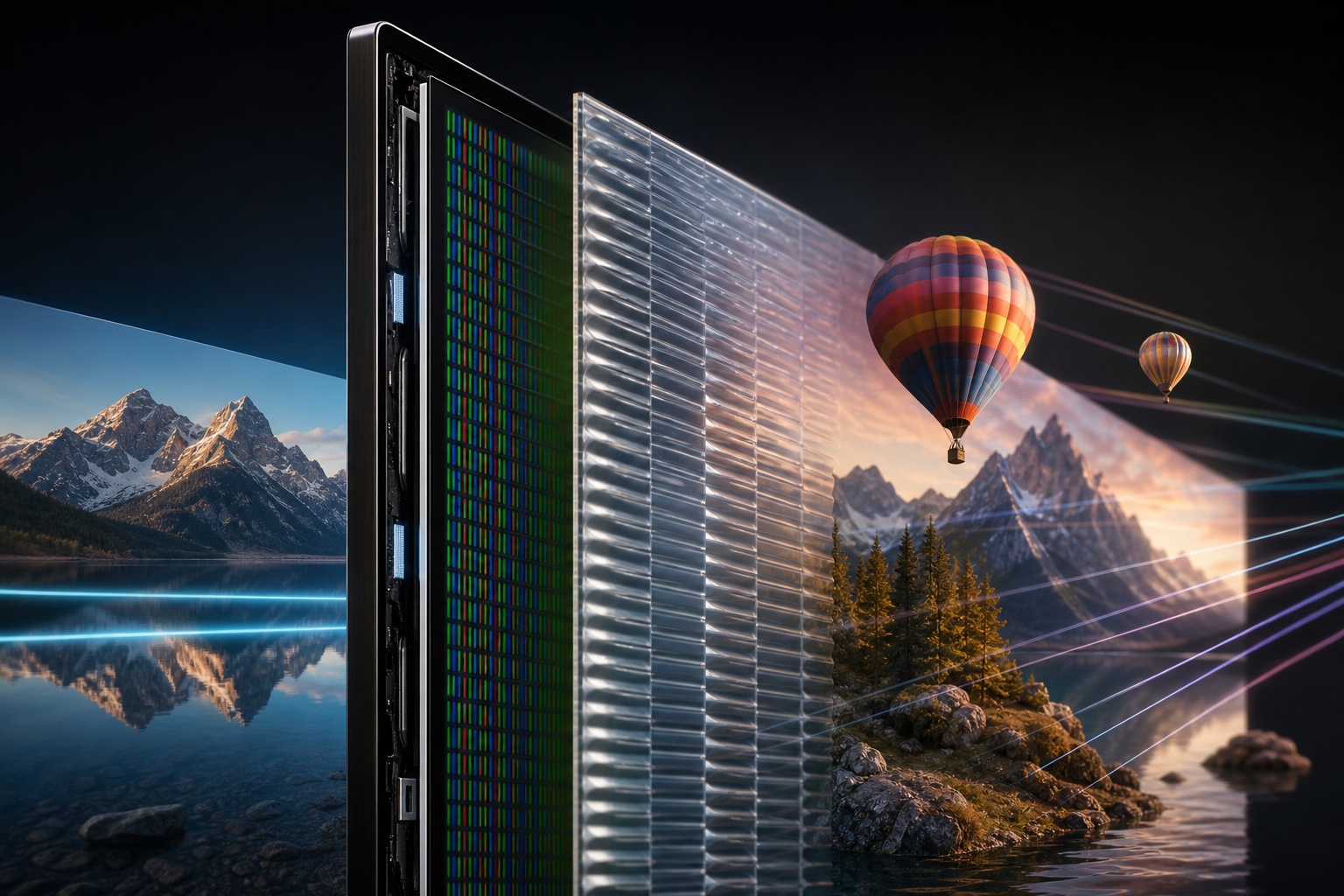
The central component of the design is a metasurface lenticular lens, abbreviated as MLL. In the system described, its focusing behavior depends on the polarization of the incident light. Changing the polarization conditions makes it possible to switch the optical function required to display either a flat or three-dimensional image.
The term “light-field” refers here to the 3D mode, in which the optical system separates image information according to the viewing direction. This allows the user to see different views of the scene without needing stereoscopic glasses. The publication concerns a full-color display, meaning that the demonstration was not limited to a single color of light.
The researchers fabricated an MLL with an active area of 25 cm² and combined it with an OLED panel. The resulting prototype displayed both 2D and 3D images. Switching was controlled by voltage, while the distinction between the optical functions was based on polarization-dependent focusing.
Fact confirmed by the publication: the same type of optical layer was used in the demonstration of both modes. Interpretation: this is significant from the perspective of designing multifunctional devices because a three-dimensional display does not have to be treated exclusively as a design intended for a single type of content.
Why is switching between 2D and 3D important?
Three-dimensional and flat content have different optical requirements. The 3D light-field mode requires directional separation of views. In 2D mode, however, the same screen is expected to operate like a conventional display and should not continuously impose a presentation method designed for a three-dimensional image.
Switchability therefore addresses a practical problem: a device can display different types of content without physically removing the component responsible for the 3D effect. In the study, this function was achieved by controlling polarization and changing the focusing behavior of the MLL. The demonstration of voltage-controlled switching shows that changing modes can be part of the system's operation rather than requiring manual reconfiguration of the optics.
This does not automatically mean that every image parameter remains identical in both modes. Among other things, the supplied material does not specify the resolution perceived by the viewer, the number of views, or brightness characteristics. There is therefore no basis for assessing the overall image quality or comparing the prototype with specific consumer displays solely on the basis of its switchability.
100° field of view: an important result, but not a complete assessment of the display
The research demonstration achieved a field of view of 100°. This parameter describes the angular range within which the three-dimensional presentation produced by the system can be viewed. A wide field of view is important for freedom of observation: a 3D solution should not require the viewer to keep their head in only one very narrow position.
However, this result should be considered separately from other display characteristics. The field of view does not in itself indicate the number of available perspectives, the sharpness of individual views, the smoothness of transitions as the viewer moves, or the uniformity of the image across the entire surface. These parameters should not be inferred if they are not included in the supplied data.
Verified result: the prototype achieved a 100° field of view. Editorial conclusion: the result indicates that the researchers did not limit the demonstration to 2D/3D switching alone, but also addressed one of the key issues in autostereoscopic displays: the range of viewing directions.
What does a 1.2 mm-thick optical profile mean?
The optical element described has a profile thickness of 1.2 mm. This is a significant design feature because the layer responsible for the lenticular function remains flat and thin compared with the overall dimensions of the demonstration setup.
However, this parameter should not be interpreted as the thickness of the complete display. The prototype also included an OLED panel and the other components needed for operation and control. The 1.2 mm value refers to the optical profile described in the study, not to a finished monitor, television, or mobile device.
Similarly, the active area of 25 cm² characterizes the fabricated MLL, but does not yet indicate the display diagonals to which the technology can be directly scaled. The source material provides no data on the production of larger formats, process efficiency, or the repeatability of such elements. Any claim about imminent use in large displays would therefore be premature.
The metasurface lenticular lens as part of a system
The name of the solution may suggest that the metalens alone is the most important component. However, the demonstration shows a system comprising at least two cooperating parts: an image source in the form of an OLED panel and the MLL, which controls the optical presentation method. This is supplemented by a voltage-controlled switching mechanism and the use of polarization.
This means that the result should not be reduced to a single material applied to any display. A specific research configuration has been confirmed. The supplied information does not demonstrate compatibility with other types of panels or specify the conditions necessary to adapt the solution to existing devices.
From the perspective of 3D hardware development, the integration of functions is of interest. A device does not have to be classified solely as a “2D display” or a “3D display” if its optics can change how they operate. Such a concept may make it easier for conventional screen content and three-dimensional content to coexist on a single platform. However, this is a direction suggested by the demonstration, not a confirmed product plan.
What does the study not yet prove?
Publication in a peer-reviewed journal and the prototype's measurable parameters distinguish this work from a general technological vision. However, they do not eliminate the difference between a demonstrator and hardware intended for users.
Based on the available data, the following issues cannot be resolved:
- how the solution performs when the display area is increased;
- what the perceived resolution is in 3D mode;
- how many distinct three-dimensional views the system can display;
- how switching affects image brightness, contrast, and uniformity;
- what the costs and requirements of mass production would be;
- whether and when the technology might reach a retail device.
These are not criticisms of the demonstration itself. They merely show the boundary between what has been verified and the questions that will be important at subsequent stages of development. Samsung Research's material also presents the collaboration with POSTECH and the use of a metasurface lenticular lens, but it does not turn the study into a commercial announcement.
Significance for future 3D hardware
The most important result is not a single figure, but the combination of several features in one prototype: full color, 2D and 3D modes, polarization-dependent focusing, voltage-controlled switching, a 100° field of view, and an optical profile of 1.2 mm. Each of these elements describes a different aspect of the device's operation.
For users, the potentially most important feature would be the ability to use a three-dimensional image only when needed, without giving up the conventional 2D mode. For designers, meanwhile, the attempt to integrate both presentation methods into a thin optical layer working with an OLED panel is significant.
However, this remains a research platform. The parameters needed for a complete assessment of image quality, scalability, and production readiness are not known. The most justified conclusion is therefore a cautious one: Samsung Research and POSTECH have confirmed the operation of a full-color, switchable light-field display with a metasurface lenticular lens, but the supplied materials do not describe the path from this demonstration to a consumer product.
Summary
The study published in Nature presents a specific way to combine a flat 2D image with a glasses-free 3D light-field mode. The key component is an MLL whose focusing changes depending on the polarization of light. The prototype with an OLED panel operated in both modes, was switched by voltage, and achieved a 100° field of view.
The 1.2 mm-thick optical profile and active area of 25 cm² show the physical scale of the demonstrator, but they are not parameters of a finished device. This distinction is crucial when assessing new 3D technologies: the publication provides strong proof of concept, not a guarantee of rapid commercialization.