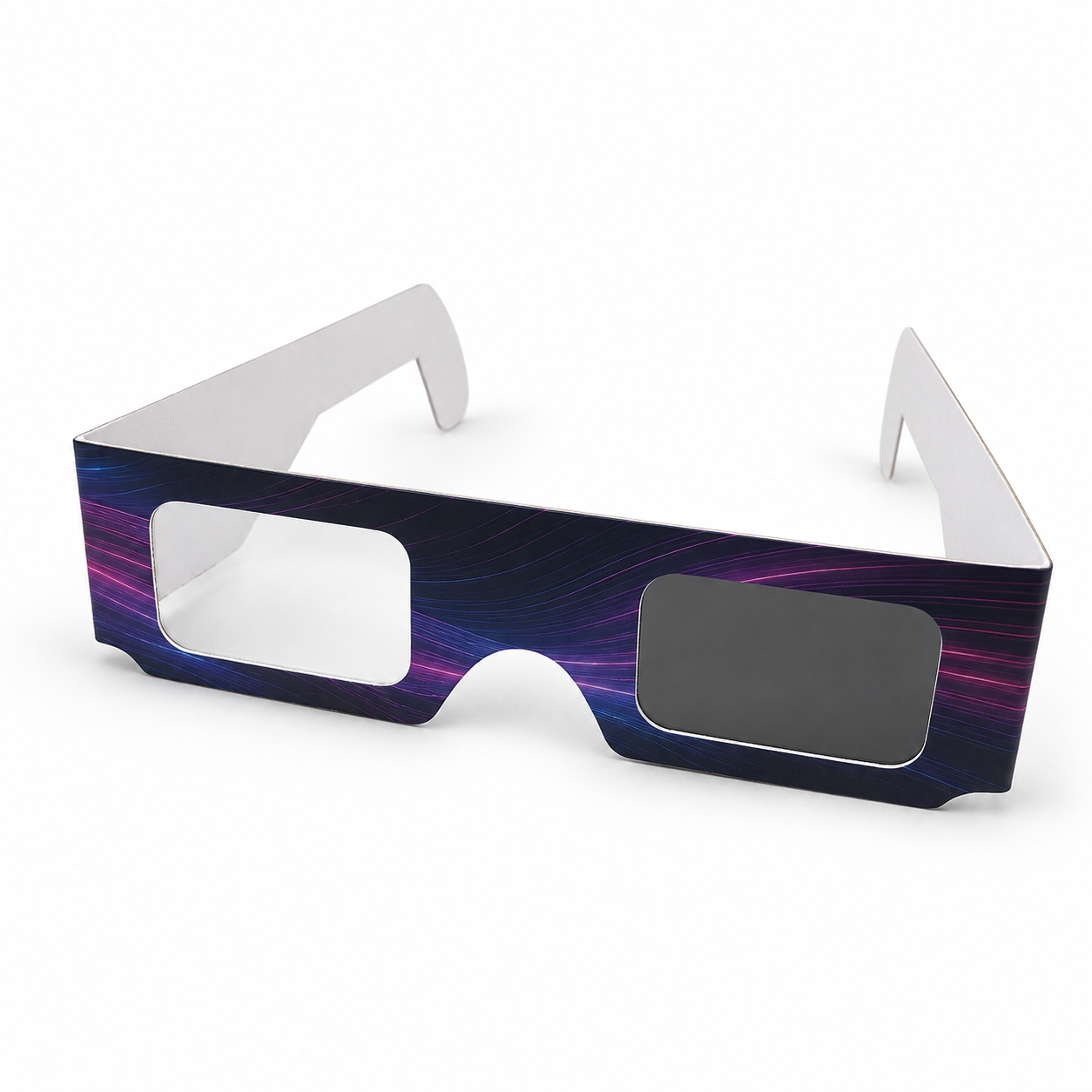
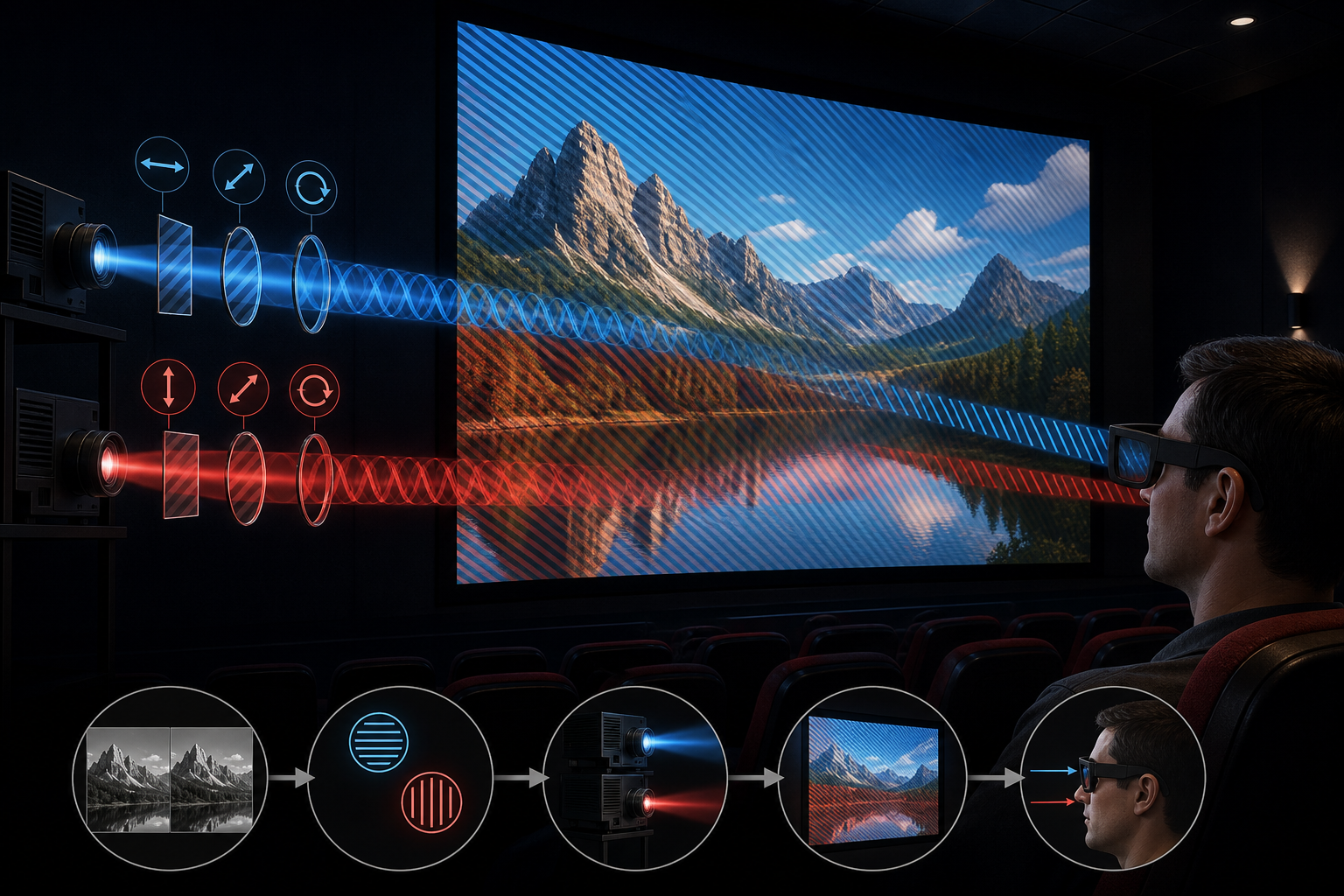
A 3D cinema screen displays two slightly different views of the same scene: one intended for the left eye and the other for the right. The images can overlap on the same surface, yet the glasses allow each eye to receive the correct view. Different polarization states of light serve as invisible “addresses” assigned to the two images.
The filter in the glasses does not create depth by itself. It is merely the final component in a longer chain that includes preparing the stereo pair, projection, giving the images the appropriate polarization, and reflecting light from a screen that must not destroy this distinction.
Two images are the starting point, not a side effect
The basis of stereoscopic projection is a stereo pair, meaning two views depicting a scene from slightly different positions. One corresponds to the perspective of the left eye and the other to that of the right. The task of the projection system is therefore not to generate space from a single flat image, but to deliver the prepared views to the appropriate eyes.
If the two images were simply superimposed on the screen without a separation mechanism, each eye would see both simultaneously. Polarization solves this problem by marking the light streams in a way that can be recognized by the filters in the glasses.
In a passive polarization system, the left and right images are polarized differently. One lens of the glasses transmits the state assigned to the left image, while the other transmits the state corresponding to the right image. As a result, the viewer looks at a single screen, but their eyes receive different visual information.
Polarization as an optical transmission channel
In this application, polarization can be treated as a property of light used to separate two channels. The images still use the same area of the screen, so it does not need to be physically divided into left and right sections. The separation occurs within the optical path.
The complete chain can be presented in five stages:
- The system receives the two views of the stereo pair.
- Each view is assigned a different polarization state.
- Both images are directed onto the same projection surface.
- The screen reflects the light while preserving the polarization distinction.
- The filters in the glasses transmit the appropriate channel to each eye.
Cooperation between all components is crucial. Compatible glasses are not enough if the images have not first been properly polarized. Correct polarization at the projector is likewise insufficient if the projection surface does not preserve it after reflection.
Linear and circular polarization
Materials concerning 3D projection use two terms: linear polarization and circular polarization. Both describe methods of preparing light so that it can subsequently be separated by matching filters.
An educational demonstration setup described by Optica used linear polarizers and quarter-wave plates in front of the projector lenses. This combination makes it possible to obtain two opposite states of circular polarization. Each projector handled one image, and the two views were superimposed on a silver screen.
In such an optical path, a quarter-wave plate is an optical component that works together with a linear polarizer. Their combination makes it possible to prepare light with opposite handedness for the two channels. The glasses must have filters corresponding to the states used during projection.
In practice, therefore, it is not enough to know generally that the glasses are “polarized.” The projector-side system, screen, and glasses form a compatible set. Filters designed for a different method of encoding light do not automatically become the correct receiver for a given image.
Two projectors: the clearest model of operation
A dual-projector setup clearly demonstrates the principle of separation. One projector displays the view for the left eye, while the other displays the view for the right. Components that give the light opposite polarization states are placed in front of their lenses. The two images are precisely superimposed on the screen.
From the observer’s perspective, two separate projection areas are not created. The screen displays a shared composition of both views. Only the glasses perform the selection: the left filter transmits one channel and the right filter the other.
The advantage of this description is its clarity—two sources correspond to two views and operate simultaneously. This does not mean, however, that every auditorium using polarized glasses must have two projectors. The same basic image-separation function can also be implemented in a sequential system.
One projector and sequential projection
In sequential projection, the views do not have to come from two independent projectors at the same moment. A single system can display images in rapid sequence while changing their polarization state. The glasses remain passive: they do not switch electronically but continuously filter the light according to their intended function.
Cinema operator Cinemark describes RealD presentations as using projection at 144 frames per second, polarization filters, and circularly polarized glasses. In this solution, rapid projection and optical encoding of the views work together to deliver two channels to a single screen.
The figure of 144 frames per second describes the operation of the projection system specified for RealD presentations. It should not be used independently to derive the parameters of the source material or equated with the number of distinct stereoscopic moments recorded in the film. From the perspective of the operating principle, what matters is that successive images are presented rapidly and receive the correct polarization encoding.
Cell and external polarizing wheel
Documentation for a Christie cinema projector distinguishes, among other options, a configuration with a polarizing cell for RealD and a solution with an external polarizing wheel for MasterImage. These are different ways of incorporating the polarizing component into the projection path.
In both cases, the objective remains the same: successive views must receive the correct polarization state before the light reaches the screen. The documentation also states that both the RealD and MasterImage configurations require a silver screen.
The use of different components shows that the term “polarization-based cinema” describes the principle of separation rather than one identical set of equipment. A particular installation may use a different polarizing mechanism while retaining the same general path: two views, two light states, a polarization-preserving surface, and passive glasses.
Why is a suitable screen necessary?
In such a system, the screen is not a neutral background. After leaving the projection system, the light must be reflected in a way that preserves the information subsequently used by the glasses. Barco’s specification for passive 3D projection indicates the need to use a non-depolarizing screen. A silver screen appears in both the demonstration setup described above and the cinema configurations.
If reflection eliminated the distinction between polarization states, the filters in the glasses would no longer have two correctly marked channels to separate. This follows directly from the structure of the optical path: the screen is located between the polarizing system and the glasses, so it must pass on the property on which the selection is based.
This is precisely why polarization-based 3D cannot be reduced to wearing the appropriate glasses during an arbitrary projection. The projection surface is a functional part of the system, just like the filters positioned at the projector.
What do passive glasses actually do?
Polarized glasses do not analyze the digital image, communicate with the projector, or generate additional frames. Their operation is optical. The two filters perform different selection tasks: each transmits the state of light intended for a given eye.
The term passive distinguishes this method of operation from solutions in which the glasses are an active, switched component of the system. In the polarization-based optical path discussed here, the essential work involved in marking the channels takes place before the light reaches the viewer. The glasses perform the final selection.
This is also important for understanding the image seen without glasses. Because both views are directed onto the screen, unprotected eyes do not separate them according to the assigned polarization. The filters are therefore not an accessory that improves the appearance of the projection, but a component required to direct the correct view to the correct eye.
Two variants, one principle
The difference between the projection methods described can be summarized as follows:
- Dual-projector setup: each projector handles one view, and the two appropriately polarized images are superimposed on the screen.
- Sequential setup: the views are displayed rapidly in succession, and the system gives them the corresponding polarization states.
- Shared component: the screen must preserve polarization, while the two filters in the glasses separate the channels for the left and right eyes.
From the viewer’s perspective, the optical result is based on the same rule. Each eye must receive only the image intended for it. The difference mainly concerns how the images are emitted and where in the optical path they acquire the appropriate polarization.
The key components of the system
Polarization-based 3D cinema works not because of a single filter, but because the entire chain is compatible. It requires two correctly prepared views, a mechanism for giving them opposite polarization states, a screen that preserves this property of light, and glasses with matching filters.
Two projectors can deliver both images simultaneously. A digital system, meanwhile, can present them sequentially, as illustrated by the described RealD projection at 144 frames per second. Solutions using a polarizing cell or wheel differ in design but serve the same purpose.
The simplest answer to the question of how two images fit on one screen is therefore this: they occupy the same surface, but the light from each has a different optical “address.” Only the filters in the glasses convert this distinction into a separate view for the left and right eyes.