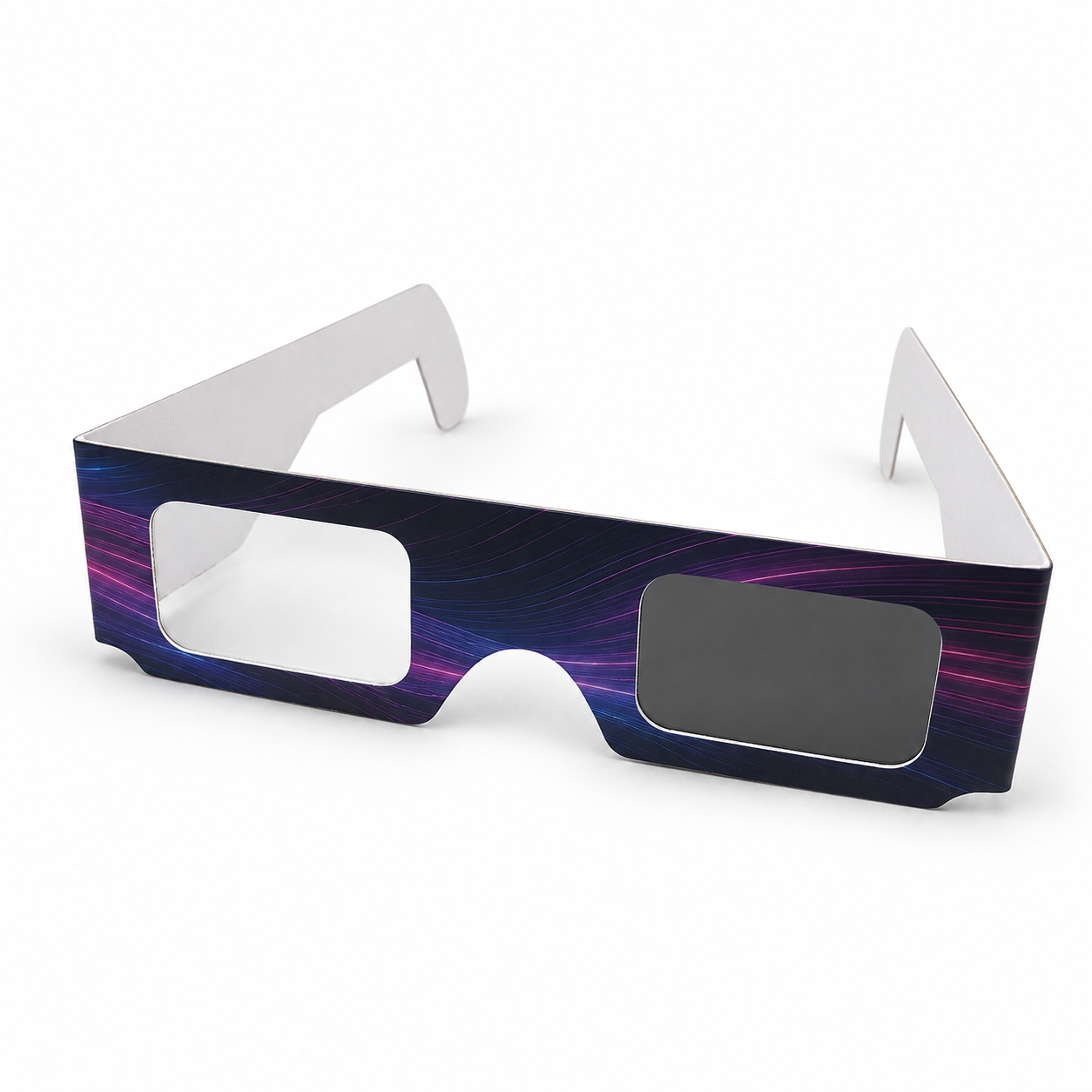
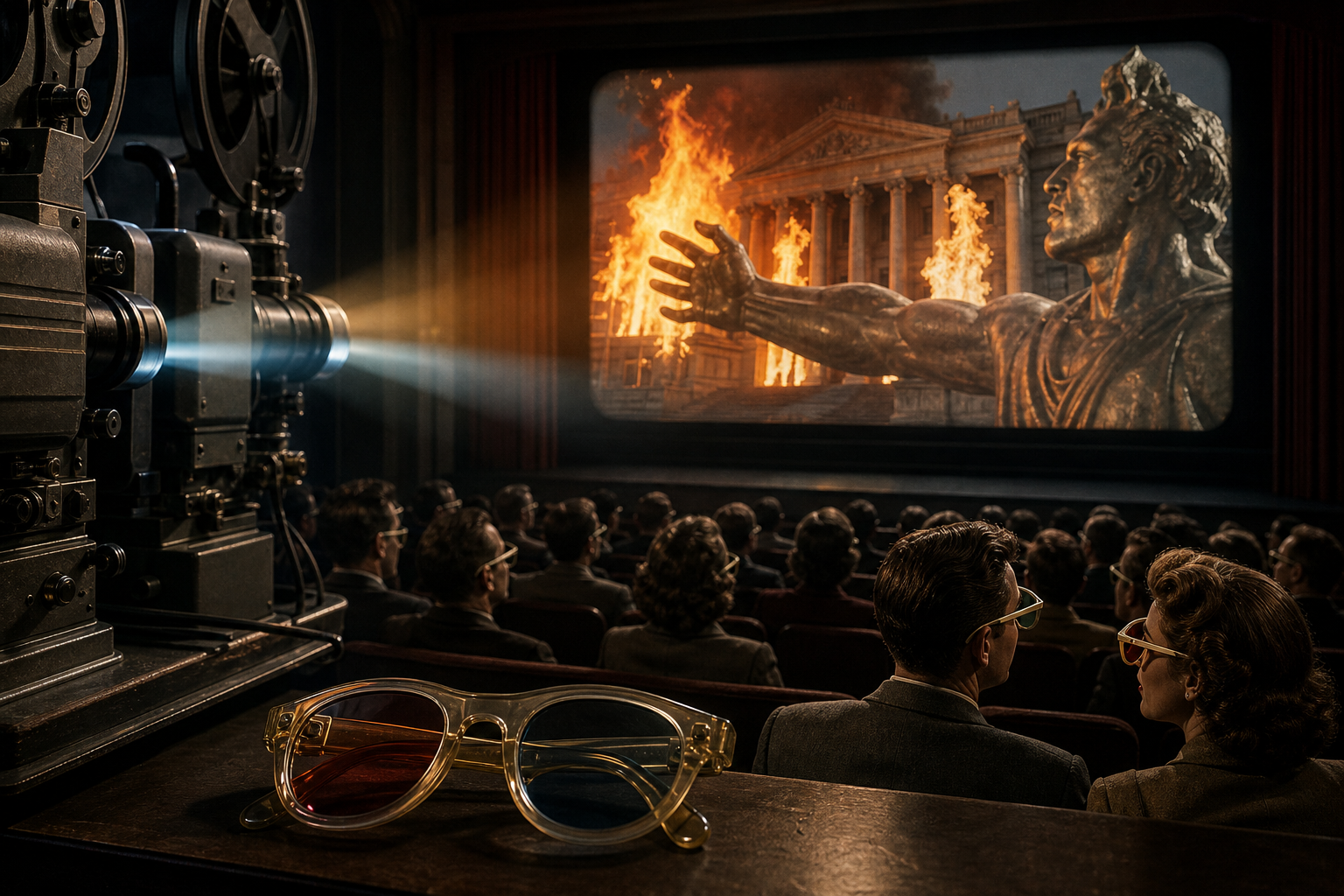
When contemporary popular culture evokes 1950s 3D cinema, it often shows audiences wearing paper glasses with red and blue filters. It is a recognizable symbol, but an incomplete depiction of the technology used during the boom of that period. One of the most important examples is “House of Wax” from 1953: the film was presented using two synchronized 35 mm projectors and polarized glasses.
The glasses were not merely an amusing accessory or a prop in an advertising campaign. They were the final component of a system that began in the projection booth. Without properly preparing the two images and separating them for the left and right eyes, the intended impression of depth could not have been created.
Why did viewers need glasses?
Stereoscopic projection is based on a pair of images depicting a scene from slightly different viewpoints. One image is intended for the left eye and the other for the right. If each eye receives the correct view, the brain can combine the two impressions and interpret the differences between them as depth.
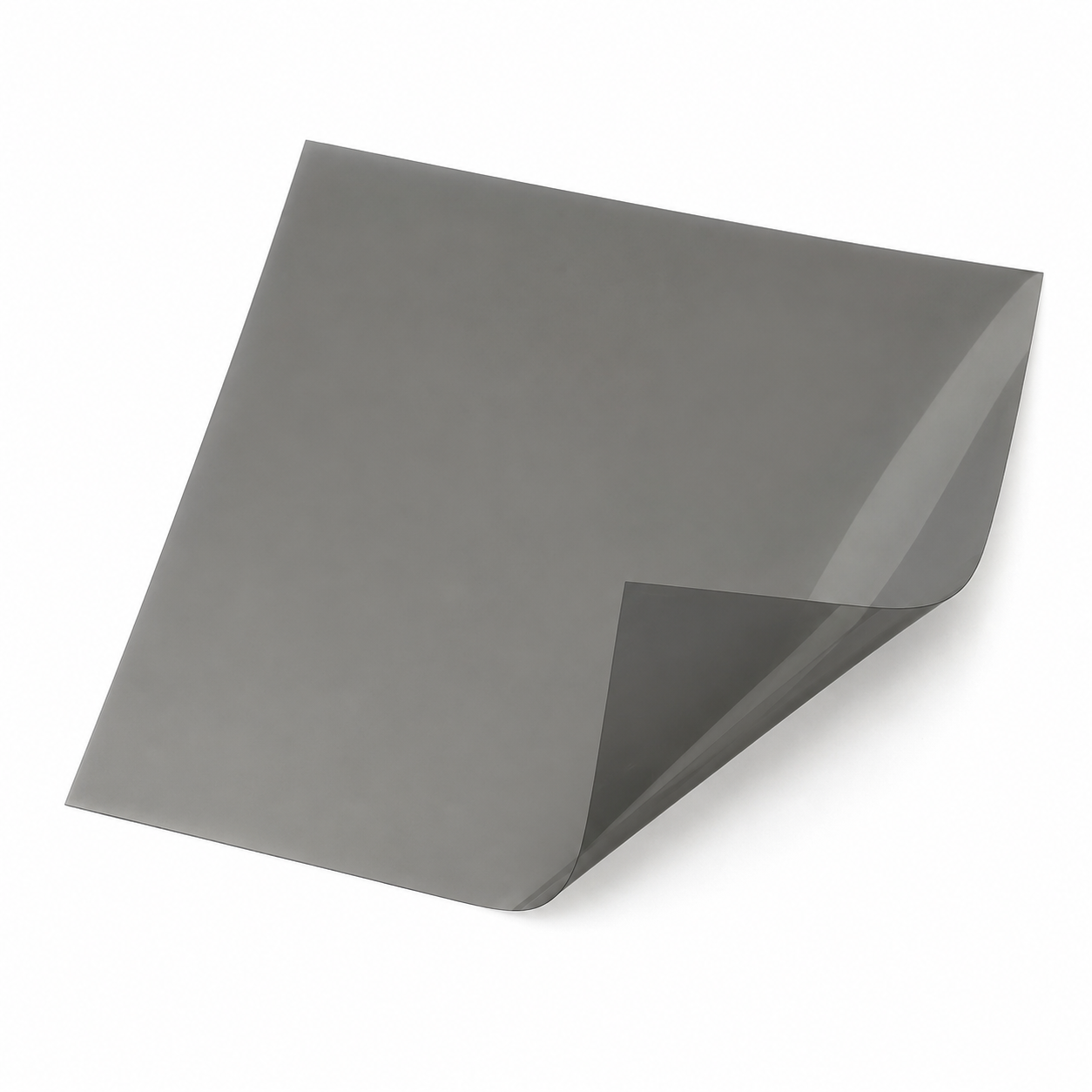
The problem is that both images must be shown on the same screen and then directed to the appropriate eyes. In a polarization system, this function was performed by filters used during projection and by the glasses worn by the audience. Each lens transmitted the image intended for one eye.
The glasses were therefore a kind of personal image separator. They did not create depth on their own or turn just any film into 3D. They worked in conjunction with appropriately prepared material and projection equipment. This is an important distinction: historical three-dimensional cinema was not a single gadget, but a complete technical chain.
“House of Wax” and the dual-projection system
“House of Wax” is a good starting point for understanding this chain. Archival technical descriptions identify the use of two synchronized 35 mm projectors. Each participated in displaying one half of the stereoscopic pair, while polarization was used to separate the views.
The term “synchronized” is significant here. Viewers were not watching two independent screenings or images placed side by side. The two projection paths operated as a single system and simultaneously delivered the views needed to produce the stereoscopic effect. In the auditorium, they were correctly separated only through the glasses.
A Library of Congress study describes the solution used for this film as a system employing polarizing filters and lenses. This makes it possible to distinguish the historical presentation method of “House of Wax” from the later, very strong association of the entire era with anaglyphs.
Natural Vision, associated with the film’s presentation, should therefore be regarded as a projection system rather than the name of a particular model of glasses. The frames held by the viewer were the visible part of the technology, but the effect also relied on two film strips, a pair of projectors and polarizing optical elements.
Polarization instead of red-and-blue filters
Anaglyph and polarization systems serve the same general purpose: delivering a different component of the stereoscopic pair to each eye. However, they do so using different methods. In an anaglyph, separation is achieved using colors, with the red-and-blue arrangement being its most recognizable historical variant. Polarization encodes the two images using properties of light recognized by the appropriate filters.
The difference was particularly important for color film. According to the 3-D Film Archive, anaglyphs reduce the quality of color reproduction, while polarized projection preserves a full-color image and provides higher-quality stereoscopy. This does not mean that anaglyphs were not part of cinema history. It does mean, however, that they should not automatically displace other methods used in the 1950s from our memory.
The Library of Congress notes that earlier stereoscopic films from major studios were distributed in the red-and-blue anaglyph format. This technology was therefore a genuine stage in the development of 3D presentation. “House of Wax,” however, used polarization, which meant that color did not have to serve as the primary channel separating the views for the two eyes.
Two technologies, not one image of the era
It is therefore safest to speak of the coexistence of different presentation methods rather than the complete displacement of one technique by another. Anaglyphs appeared in the history of stereoscopic film, but major releases during the 1952–1955 boom could use polarization systems. The appearance of a surviving print or a contemporary screening does not always reveal how audiences watched the film during its original theatrical distribution.
This is confirmed by a Museum of the Moving Image program devoted to rare 3D materials. The museum noted that anaglyph versions of three films from the 1950s had been prepared specifically for gallery presentation. Their original theatrical releases, however, were shown in high-quality polarized 3D.
This distinction matters not only to historians. If an early film is presented in anaglyph today, this does not necessarily prove that its first screening looked the same. The format of the available version may be the result of a later adaptation to different exhibition conditions.
Glasses as part of organizing a screening
Polarized glasses not only had to be designed, but also supplied to every viewer. The AFI records a specific example from the Downtown Paramount theater in Los Angeles: audiences attending “House of Wax” received special Polaroid glasses that cost the theater ten cents per pair.
This seemingly minor detail reveals the material aspect of a 3D screening. Every seat in the auditorium required an additional optical component. The glasses were both part of the apparatus and an object handed to the audience. From the viewer’s perspective, they were the most immediate sign that this was a screening unlike a standard projection.
Their presence can also be interpreted as a kind of agreement between the theater and the viewer. The theater prepared two correctly separated images, and the viewer had to put on the supplied filter to see the intended result. This interpretation does not alter the technical fact: the glasses worked only as part of a larger system.
Why, then, has the red-and-blue icon endured?
The available materials do not make it possible to identify a single documented reason why this symbol became so firmly established. However, one can observe a mechanism that encouraged a simplified memory of the era. Anaglyphs did indeed exist, and later versions of some films from the 1950s were prepared in this form. As a result, the method used for subsequent presentations may have become identified with the original theatrical experience.
Moreover, red and blue filters are an instantly recognizable visual symbol. The appearance of polarized glasses alone does not explain their operating principle as clearly. This, however, is an interpretation of the iconography, not an account of the origins of the cultural myth confirmed by the institutions cited.
It is therefore worth exercising caution when viewing posters, illustrations and contemporary reconstructions. Glasses with colored filters may communicate “3D” in general, but they do not always faithfully represent the projection system used for a particular film.
What do the glasses tell us about the golden age of 3D cinema?
The 1952–1955 3D boom was not simply a matter of adding a basic effect to conventional projection. The example of “House of Wax” demonstrates the relationship between stereoscopic material, two synchronized 35 mm projectors, polarizing filters and the audience’s glasses. Removing any one of these elements meant departing from the presentation method for which the film had been prepared.
The most important correction to the popular perception is therefore simple: audiences in the 1950s did indeed wear glasses, but they did not have to be red-and-blue glasses. Polarization was used at major theatrical screenings because it enabled the stereoscopic pair to be separated while preserving a full-color image.
Colored glasses have remained a striking icon of early 3D. The history of the technology, however, proves more interesting than the icon: what audiences wore on their faces was merely the visible endpoint of a precisely organized projection system.