Autostereoscopy, the presentation of stereoscopic images without glasses, poses a particular challenge for designers: the screen must deliver the appropriate views to the left and right eyes even though the observer's position may change. With the original Nintendo 3DS, this meant having to remain within a relatively limited viewing zone. The New Nintendo 3DS was intended to mitigate this inconvenience with a solution called Super-Stable 3D.
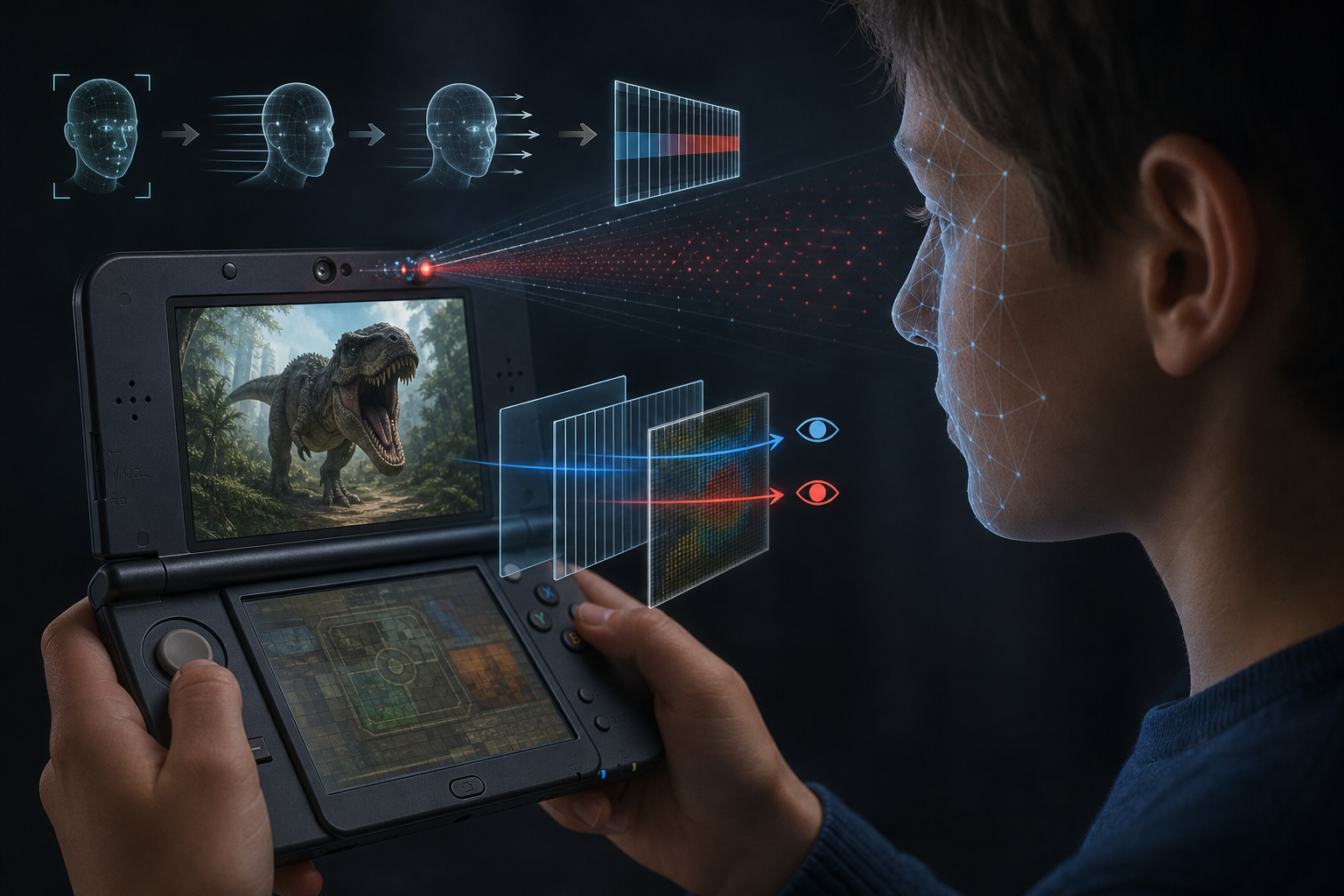
The most important change was not simply the addition of a camera. The system created a feedback loop: it detected the face, assessed its position, predicted movement, and then adjusted the dynamic parallax barrier accordingly. This marked a shift from a system that required the user to adapt to the screen toward a screen that adapted to the user.
From a Fixed Viewing Zone to Active Correction
A parallax barrier is an optical element that directs the image intended for each eye toward the appropriate area in front of the display. In practice, this means that there are positions from which the views are separated correctly, as well as positions in which the stereoscopic effect may become unstable.
With the older 3DS design, the user had to keep the device and their head in the correct position relative to each other. The problem was therefore not achieving the impression of depth itself, but maintaining the conditions required to view it during normal movement. Even a small change in angle or position could move the eyes outside the correct viewing zone.
According to Nintendo's official documentation, the face recognition used in New Nintendo 3DS models made it possible to maintain the 3D effect even when viewing the device from an upright position or at an angle. Nintendo Europe R&D described the result as a viewing range significantly wider than that of the original Nintendo 3DS. However, the materials do not provide specific angular values, so this expansion should not be presented as an unlimited field of view.
How Super-Stable 3D Worked
The New Nintendo 3DS debuted in Japan in October 2014 with a screen described by the manufacturer as Super-Stable 3D. According to the technical description from Nintendo Europe R&D, the system used a dynamic parallax barrier adjusted on the basis of face tracking by the inner camera and an infrared LED.
Three interdependent stages of operation can be distinguished:
- User detection. The inner camera observed the face, while the infrared LED supported the system's operation.
- Movement assessment and prediction. The software processed the available data so that it could also respond to faster changes in position.
- Optical adjustment. The dynamic parallax barrier was adjusted so that the correct viewing zone followed the position of the face.
This division is a useful explanatory model, but it should not be used as a basis for inferring undisclosed design parameters. The supplied materials do not specify, among other things, the update frequency, system latency, tracking resolution, or exact construction of the optical layer. What is known, however, is that the adjustment was not static: it was based on continuous observation of the user.
Why Face Detection Alone Is Not Enough
Detecting a face describes its position at a particular moment, but the user's movement continues. If the barrier responded only to successive, separate measurements, the correction could lag behind faster changes in position. Nintendo Europe R&D indicates that the system's response to such movement involved machine learning, adaptive prediction, and sensor fusion.
In this context, adaptive prediction means attempting to account for continued movement rather than relying solely on the most recently recorded position. Sensor fusion refers to combining available data to obtain a useful assessment of the situation. However, the source package does not list all the signals used by the system, so there is no basis for assigning specific roles to individual sensors.
Precise terminology is equally important. Official materials refer to tracking and recognition of the face. This should not automatically be replaced with the term “eye tracking,” which would imply a more precise and differently defined measurement. The key to the device's operation was obtaining enough information to move the viewing zone appropriately.
What Actually Changed for the User
In the original approach, the stability of the effect depended primarily on maintaining the correct relationship between the screen and the user's head. With Super-Stable 3D, the device took over part of this task. The camera and algorithms tracked changes in position, while the optical barrier was adjusted according to the measurement results.
This does not mean that positioning requirements disappeared. It is more accurate to say that the system increased tolerance for movement and changes in viewing angle. Nintendo's official support documentation specifically emphasizes the ability to maintain the 3D image when viewing at an angle or with the device held vertically. This is a practical difference: the user does not have to maintain a single static position as rigorously.
From a technical perspective, Super-Stable 3D did not change the fundamental purpose of autostereoscopy. The objective was still to present depth without requiring glasses. What changed was the way in which viewing conditions were maintained. Instead of relying solely on the face remaining in the designated position, the device attempted to adapt the barrier's operation to it.
Tracking Conditions and Limitations
Active correction depends on the quality of the input information. Nintendo's calibration instructions require the Super-Stable 3D feature to detect a face. The manufacturer also recommends not covering the user's facial features or the inner camera. These are not merely servicing tips, but also direct information about the limitations of the method.
If the camera cannot observe the user correctly, the system loses the basis needed to adjust the barrier. For this reason, the dynamic solution should not be regarded as completely independent of how the device is used. The face must still be visible and the camera unobstructed, while operation remains tied to the capabilities of the recognition system.
The manufacturer's materials also do not support the conclusion that the 3D image becomes correct from every direction. They refer to a significantly wider viewing range and the ability to maintain the effect when the position and angle change, not to viewers being arranged arbitrarily around the screen. This is an important distinction, particularly when comparing Super-Stable 3D with other types of glasses-free displays.
Calibration as Part of the Optical System
The presence of a calibration procedure shows that 3D stabilization was a function that required the user, camera, image processing, and barrier to work together correctly. Calibration was therefore not merely a cosmetic setting. Its success depended on detecting the face, and the instructions emphasized keeping facial features and the camera lens visible.
If problems with the feature occur, the logical first step is therefore to check the conditions listed in the documentation: whether the inner camera is unobstructed and whether the system can recognize the face. The source package does not provide a basis for creating a more extensive list of troubleshooting tips, but these two requirements follow directly from the official procedure.
The Design's Significance for Autostereoscopy
A fact confirmed by Nintendo's materials is the use of a dynamic parallax barrier, face tracking by means of the inner camera and an infrared LED, and methods including machine learning, adaptive prediction, and sensor fusion. The expansion of the usable viewing range compared with the original 3DS is also confirmed.
A technical interpretation, however, is the conclusion that the solution's most important feature was closing the system into a feedback loop. The camera provided information about the user, processing made it possible to assess changes in their position, and the optical element responded to the result. None of these components considered separately describes the full innovation.
The New Nintendo 3DS is therefore an interesting example of the transition from a passive optical constraint to a system that responds to the observer. It did not eliminate all the conditions inherent in parallax-barrier autostereoscopy, but it transferred part of the responsibility for maintaining the stereoscopic image from the user to the device.
Summary
Super-Stable 3D was not simply a matter of adding face recognition to an existing screen. Its essence was linking observation of the user with dynamic control of the parallax barrier. The inner camera, infrared light, prediction, and data processing made it possible to expand the practical viewing range of the 3D image.
The solution remained dependent on face detection and an unobstructed camera, so it did not provide unlimited freedom of viewing. However, it demonstrated an important direction in the development of autostereoscopy: instead of requiring the viewer to remain in a single “sweet spot,” the display can actively attempt to maintain the correct viewing window during movement.