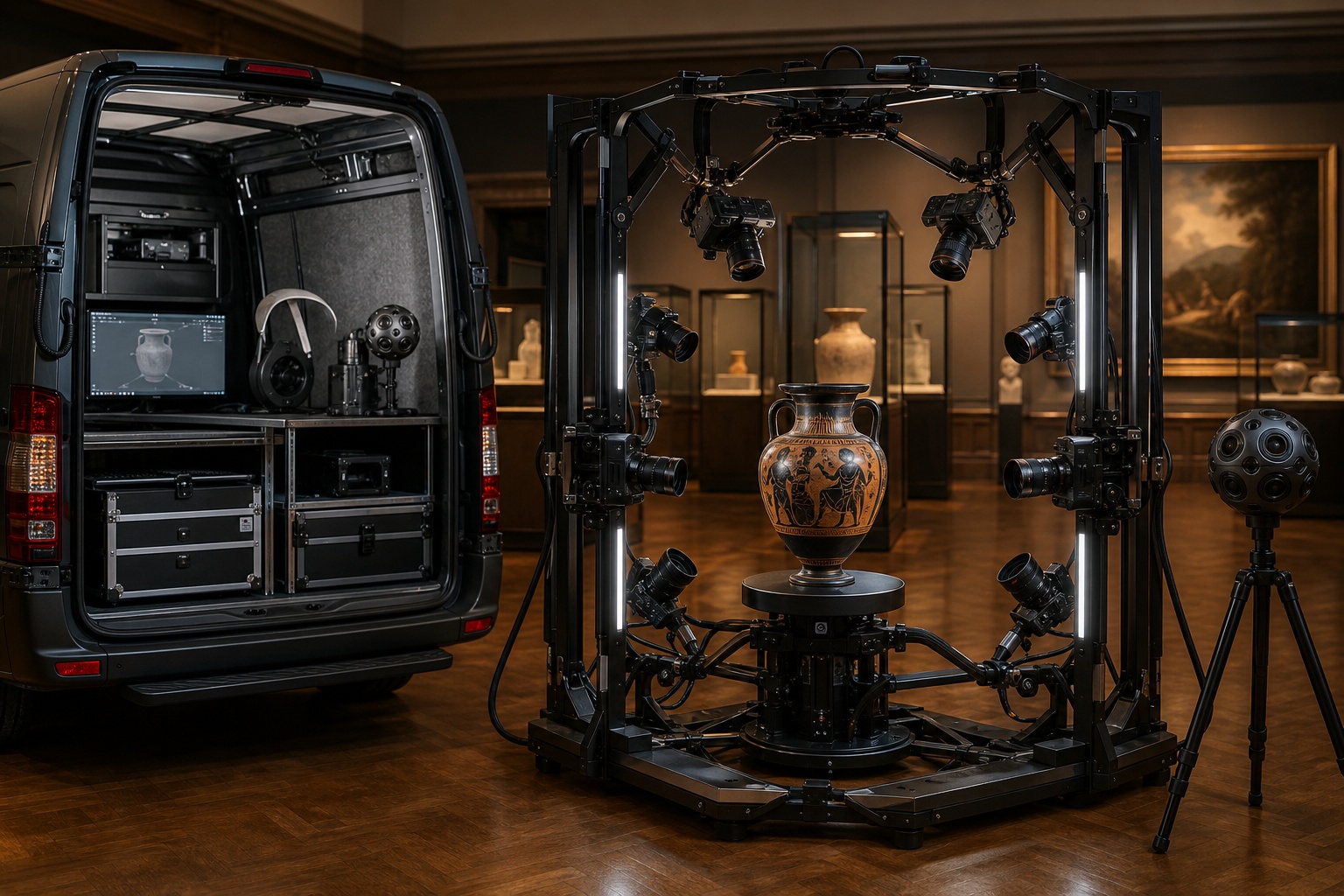
Museum photogrammetry is usually associated with a controlled workstation to which the object being photographed must be brought. The Mobile 3D Artefact Digitisation Lab reverses this relationship: the equipment is intended to travel to the collections. The infrastructure being developed in Australia combines automated, robotic multi-camera photogrammetry with 3D sound recording, and its prototype can be transported in a small van.
The project is interesting not because it proposes yet another standalone 3D camera, but because it encompasses the entire capture process. Mobility, eight cameras, automated movement and image acquisition, and preparation of material for spatial presentation all come together in a single system. The first peer-reviewed validation indicates favourable results for the number of images and scanning time compared with static laboratory configurations. This does not mean, however, that all the project’s ambitious goals have already been achieved.
What exactly has been built?
The Mobile 3D Artefact Digitisation Lab is an infrastructure project funded by the Australian Research Council and led by Queensland University of Technology. Official documentation describes it as a mobile solution for automated, robotic multi-camera photogrammetry, combined with 3D sound recording capabilities.
Queensland Museum has presented a prototype rig known as “Mo-Pho”. The structure has eight cameras and is compact enough to be transported in a small van. In 2025, the system was used to scan museum objects. During work at the Australian Museum, Gaussian splat rendering was also used to capture details of selected mineralogical specimens.
This information makes it possible to describe the basic features of the workstation, but it does not disclose all the parameters needed to reproduce it precisely. The available material contains no data on camera models, lenses, resolution, synchronisation method, lighting or movement trajectory. The project should therefore not be treated as a ready-made set of construction instructions for building your own rig.
Multi-camera photogrammetry instead of a single camera
Object photogrammetry uses a series of photographs taken from different directions to create a spatial representation of an object. The key is not simply to take a large number of shots, but to acquire material that can describe the object from multiple sides.
In a traditional workflow, an operator may move a single camera around the exhibit or rotate the object at the workstation. A multi-camera rig introduces a different workflow: several cameras become part of a single capture infrastructure. Mo-Pho has eight of them, while robotics are intended to automate the capture process.
However, it is not known whether all the cameras take photographs simultaneously or exactly how the successive sequences are performed. It can be stated, however, that the structure was designed for the systematic acquisition of multiple images, rather than for manually photographing each object according to an individually improvised scheme.
Why does automation matter?
In museum applications, the scale of collections is a challenge. A single model can be carefully prepared by hand, but the same method may not work well for a larger number of artefacts. Automation is valuable when it reduces the number of repetitive tasks, standardises session workflows and shortens the time for which the workstation is occupied.
The grant documentation sets a target of reducing artefact digitisation time by at least a factor of ten. This is a project goal, not a confirmed implementation outcome. The peer-reviewed article published in September 2026 presents only an early validation. The indicators described in it suggest an advantage over static laboratory configurations in terms of the number of images and scanning time, but the supplied material does not contain numerical values that would make it possible to assess the scale of this difference independently.
Mobility changes digitisation logistics
The laboratory’s most distinctive feature is the ability to transport the equipment to the location where the collections are stored. This is an important difference from a fixed studio, even if both solutions are based on photogrammetry.
From a technical perspective, mobility is not merely a matter of adding wheels or making the structure smaller. The entire setup must be compact enough to be transported, set up on site and used for repeatable capture. It has been confirmed that the Mo-Pho prototype can be transported in a small van and has been used with museum collections, including at the Australian Museum.
The practical benefit of this architecture comes from moving the process to the collection. This makes it possible to consider digitising objects where they are stored instead of organising sessions exclusively in a permanent laboratory. However, the source material does not provide procedures for transporting exhibits, conservation safety or the workstation’s space requirements. These are therefore matters that each museum would still have to assess independently.
From a series of photographs to Gaussian splats
The multi-camera rig is responsible for data acquisition, but it is not the end of the process. The collected images must be processed into a form that allows the object to be presented spatially. Gaussian splat rendering was used in a pilot involving selected mineralogical specimens.
In the context of the project described here, it is important to distinguish between two stages: capture using cameras and rendering, meaning the preparation and display of a spatial representation based on the acquired data. The use of Gaussian splats shows that the laboratory is not limited to merely creating a photographic archive. The material is also intended to support the creation of 3D presentation formats.
However, no rendering parameters or comparisons with other methods of representing objects have been provided. The available information therefore does not establish that Gaussian splats are the right solution for every type of exhibit. The mineralogical pilot confirms the use of the method in a specific case, not its universal superiority.
3D sound broadens the project’s scope
The official description of the infrastructure includes 3D sound recording. This extends the concept beyond the visual digitisation of a single object. Spatial imagery can convey the appearance of an exhibit, while spatial sound can become part of an immersive presentation of cultural heritage.
However, caution is needed when assessing the maturity of both elements. The information provided describes the eight-camera prototype and its work with museum objects in greater detail than the results of sound recording. Combining photogrammetry with 3D audio is a confirmed premise of the infrastructure, but the material does not present the results of an audio pilot or the method used to synchronise it with the visual representation.
How can a similar process be planned in an institution?
Mo-Pho is not a publicly documented kit that can be copied independently, but its design highlights several questions useful when planning museum digitisation. The list below is an editorial interpretation of the project’s scope, not a procedure published by its creators.
- Determine the working location. A decision must be made as to whether objects can be brought to a permanent studio or whether the infrastructure should travel to the collection.
- Separate capture from presentation. The number of photographs taken is not yet a measure of the quality of the final experience. Data capture and the method used to render it must be planned separately.
- Identify repetitive tasks. Robotics are most justified where successive sessions can be automated without losing control over the material.
- Verify performance through measurements. The stated goal of reducing time must be distinguished from a result demonstrated in tests. Data on scanning time and the number of images are required.
- Match the format to the exhibit. The use of Gaussian splats for mineralogical specimens is an example, but not proof that an identical process will be suitable for the entire collection.
- Plan the target medium. If the result is intended to be an immersive presentation, the requirements concern not only imaging the object, but also rendering, the viewing method and possible 3D sound.
What does the early validation confirm?
The strongest basis for assessing the project is the combination of three types of information. The Australian Research Council record defines the infrastructure’s functions and goals. Queensland Museum documents the existence and practical use of the eight-camera prototype. The peer-reviewed publication, meanwhile, presents an early validation of mobile, robotic multi-camera photogrammetry.
Taken together, the materials confirm that the project has progressed beyond the concept stage: the rig was built, transported and used to scan museum objects. There are also initial indicators suggesting benefits over static laboratory workstations. However, the supplied material still does not contain a complete set of results that would make it possible to compare model quality, reproduction accuracy, costs, workstation setup time and the total workload after photography has been completed.
Between promise and operational infrastructure
The Mobile 3D Artefact Digitisation Lab demonstrates a direction for the development of museum 3D imaging: from a manual session involving a single object to a mobile process encompassing automation, multiple cameras and the preparation of immersive content. The essence of the project is not any one component, but their integration into a transportable workstation.
At the current stage, it is possible to speak of a working prototype and an initial validation, but not of a conclusively proven advantage in every application. The goal of reducing digitisation time by at least a factor of ten remains an assumption set out in the project documentation. The most important practical lesson is more measured: in large collections, repeatability, logistics and the duration of the entire process become just as important as the quality of an individual model. The mobile, robotic rig is an attempt to address precisely these challenges.