The word “hologram” is sometimes applied to almost any image that appears three-dimensional: a stage projection, an animation viewed without glasses, a shiny print, or a photograph that changes with the viewing angle. From the standpoint of optics, this broadening of the term is misleading. Not every 3D effect is holography, even if it shows depth or different views of an object.
The most important difference does not concern the appearance of the medium or the strength of the illusion. It arises from the way light is recorded and reproduced. Conventional photography records its intensity. A classical hologram, by contrast, preserves the information needed to reconstruct both the amplitude and the phase of a light wave. It is therefore not so much another type of flat image as a recording that makes it possible to reproduce a specific optical field.
Photography records intensity, but not the complete wave
Light can be described as a wave. Its amplitude is related to the recorded intensity, while its phase defines the position of a given portion within the wave cycle relative to other portions. Two waves may have similar amplitudes while differing in phase. This difference matters when they overlap.
In ordinary photography, phase information is lost. The recorded image indicates how much light reached individual areas of the material or detector, but it does not preserve complete information about the wave. A photograph can, of course, contain numerous depth cues: perspective, object scale, occlusion of more distant elements by nearer ones, or depth of field. Nevertheless, these remain a representation of a scene viewed from a fixed point.
Holography has a different objective. Its purpose is to preserve information about the wave scattered by the object, known as the object wave. This does not mean that the recording material simply measures phase in the same way that photography measures intensity. Phase information must be converted into a recordable pattern of intensity variations. This is achieved through interference.
Interference: how phase enters the recording
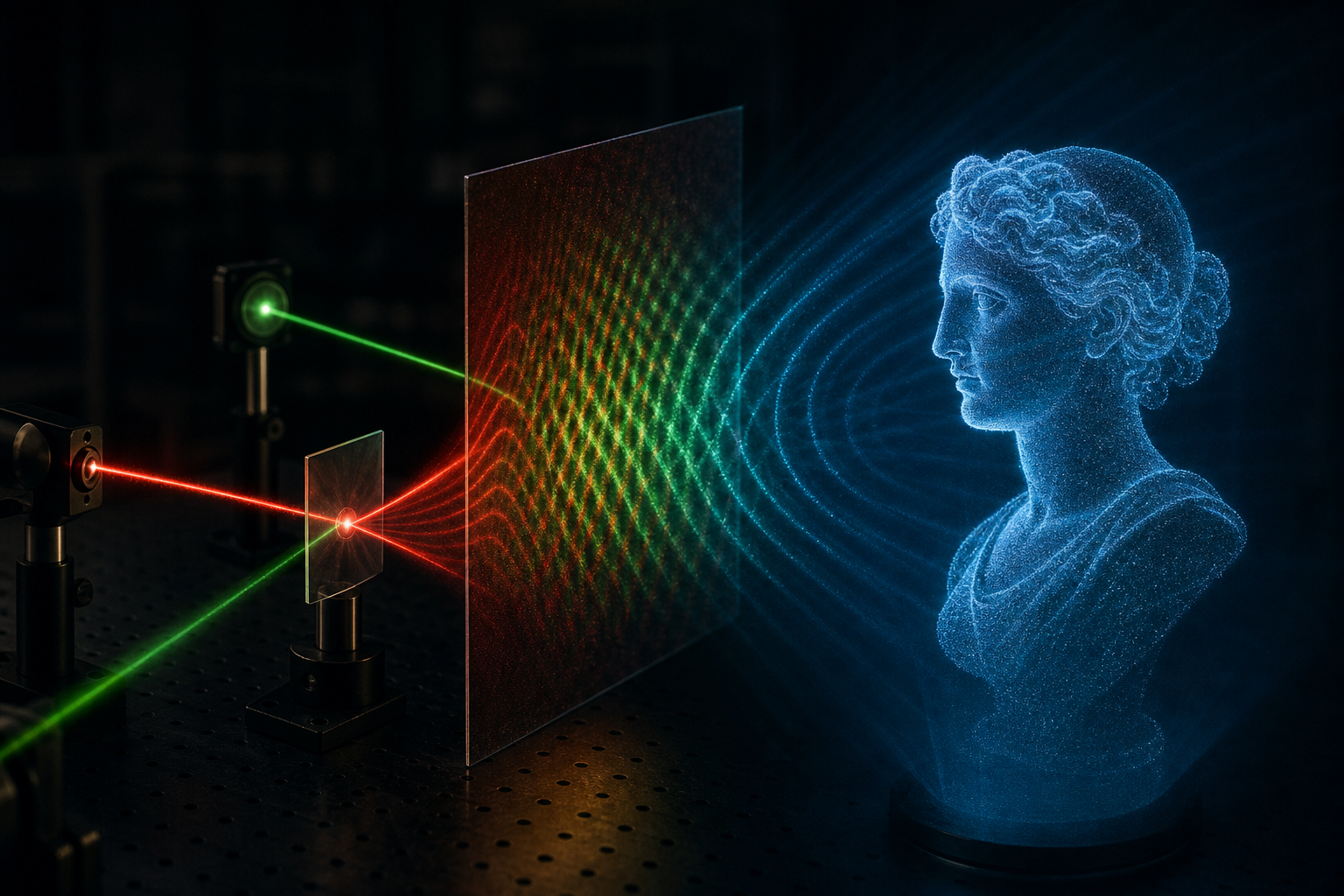
In a classical holographic setup, two waves meet on the recording material. The first is the object wave, meaning the light scattered by the depicted object. The second is the reference wave. Their superposition creates an interference pattern.
Interference means that the result of waves meeting depends on their relative phase. In some places the waves reinforce each other, while in others they weaken each other. The resulting fringe pattern can be recorded as variations in intensity. In this way, information about the phase relationship is encoded in a structure that can be captured by the recording material.
This distinction is important: a hologram does not store phase as a separate, directly visible layer. It records the result of interference between the object wave and a suitably introduced reference wave. The fringe pattern may not resemble the photographed object because its purpose is not to create a recognizable miniature of the scene. It is intended to function optically during subsequent reconstruction.
The reference wave is not an addition to the image
Without the reference wave, the material would record the intensity distribution of the object wave, but it would not preserve information about its phase in the same form. The reference wave creates a comparison framework. Relative to it, the phase differences of the object wave are converted into interference fringes.
In practice, this means that a hologram is the result of a relationship between two waves, not merely a trace of light originating from the object. This fact distinguishes classical holographic recording from photography and from a 3D image composed solely of several prepared views.
Diffraction: the recording must act on light again
Recording the fringes is only the first half of the process. The second is reconstruction. When suitably illuminated, the recorded structure acts diffractively, meaning that it changes how the incident wave propagates. As a result, the object wave can be reconstructed.
The observer therefore does not merely look at a surface covered with lighter and darker lines. They receive light shaped by the recording in a manner corresponding to the information previously carried by the wave from the object. It is the reconstruction of the wave, rather than the appearance of the medium itself, that forms the physical core of holography.
This can be expressed as a short chain of cause and effect:
- the object scatters light, creating an object wave,
- the object wave meets the reference wave on the recording material,
- interference converts amplitude and phase relationships into a fringe pattern,
- the illuminated recording acts diffractively,
- diffraction reconstructs the wave that provides the observer with spatial information.
In ordinary photography, the final product is an intensity distribution intended for viewing. In holography, the recording is also an optical element that participates in reconstruction. This difference explains why merely displaying a flat animation with a three-dimensional appearance does not make it a hologram.
Where parallax comes from
Parallax is the change in the observed arrangement of elements in a scene caused by a change in the observer’s position. When we look from a different location, nearer and more distant elements should be arranged slightly differently relative to one another. This is an important spatial cue.
Reconstruction of the object wave can provide information that depends on the viewing direction. When the observer moves their head, they receive different rays and, with them, an appropriately changed view. A hologram therefore does not have to present a single perspective frozen on a surface. The viewer can explore the spatial structure of the scene by changing position.
However, this should not be taken to mean that every object called a hologram offers continuous parallax in every direction. The range of available information depends on how the recording was created. A particularly important borderline case is the holographic stereogram.
Holographic stereogram: holography from a set of views
A holographic stereogram can be created from a limited number of parallax views. Individual images are directed toward different viewing directions, so a person changing position sees successive perspectives. The result can provide a distinct impression of depth and parallax.
However, this is not the same as a hologram that records a continuous optical field originating from a real object. The starting point remains a finite set of views. The difference may be subtle to the viewer, but it is technically significant: in one case, the reconstructed information is derived from a continuous wave field; in the other, it has been constructed from discrete directional images.
A holographic stereogram therefore occupies a position between classical multiview stereoscopy and holography understood as a recording of an optical field. It uses a holographic mechanism to direct light, but derives its spatial content from a prepared set of perspectives.
Stereo pair, multiview image, and hologram
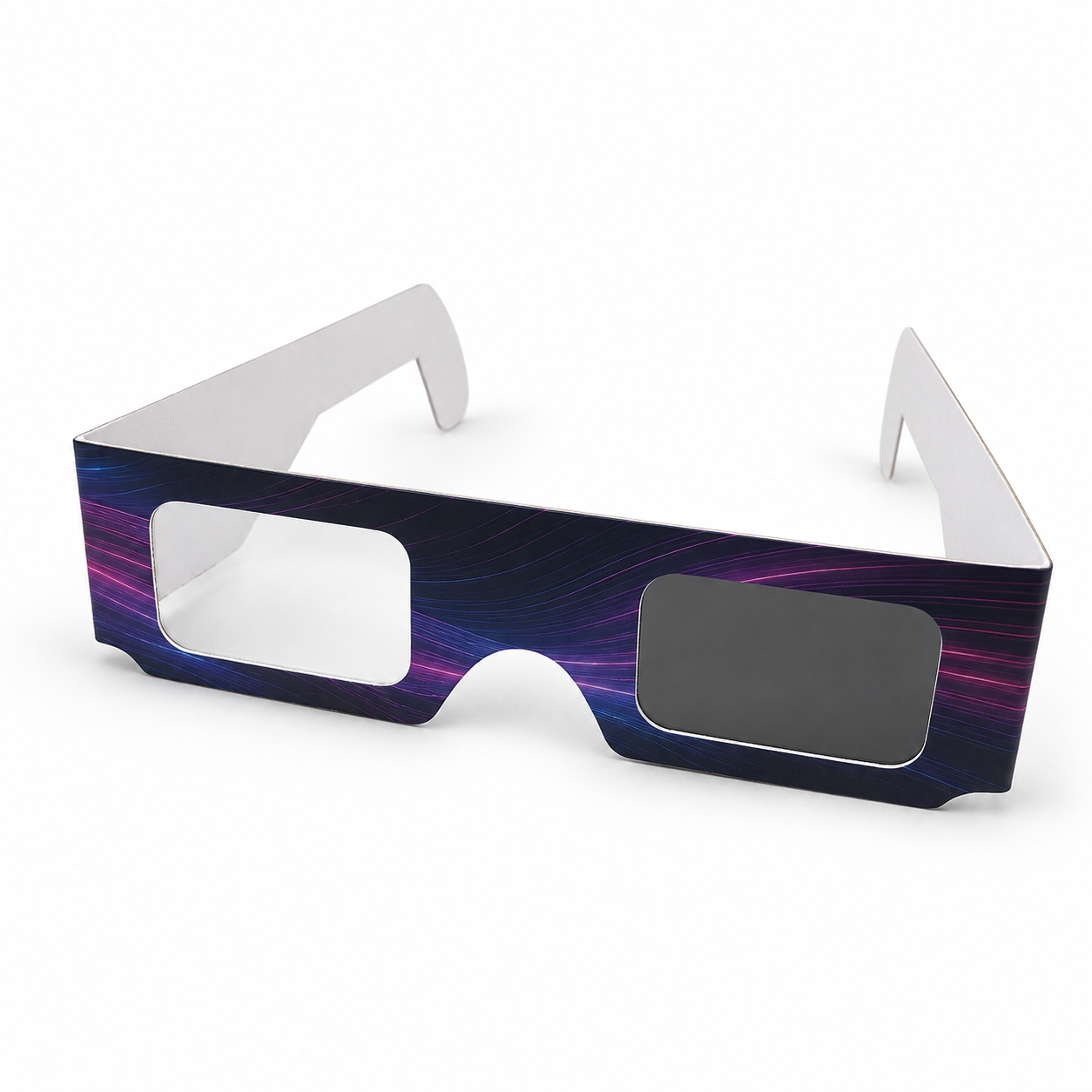
A classical stereo pair provides two views of a scene. Separating them appropriately for the eyes makes it possible to use the difference between the images as a depth cue. A multiview image extends this principle by offering more perspectives intended for different viewing directions.
In both cases, the basic material consists of prepared views. The system must decide which one to direct toward the observer. Holography, by contrast, uses a recording that enables a light wave to be shaped through diffraction. The difference therefore does not come down to the number of images. It concerns the level at which light is represented.
- Photography records an intensity distribution for a specific view.
- A stereo pair uses two prepared views of a scene.
- A multiview image provides a limited set of perspectives dependent on the viewing direction.
- A holographic stereogram directs a finite set of views using a holographic recording.
- A classical hologram encodes the information needed to reconstruct the object wave.
This classification describes operating principles, not the subjective quality of the effect. An image based on several views may look convincing, while a hologram viewed under unsuitable conditions may not reveal all of its spatial information. The viewer’s impression does not, however, change the physical method used to create the image.
From optical recording to computer-generated holograms
The history of holography’s development is not limited to directly recording interference between waves originating from a physical object. Contemporary work also includes the digital generation of holograms. In this approach, the required pattern can be calculated computationally instead of being produced solely during the optical recording of a scene.
Changing the method of creation does not eliminate the fundamental criterion. A computer-generated hologram must still control light in order to reconstruct the desired amplitude and phase information. Computation replaces or supplements the physical recording stage, but it does not reduce holography to displaying two flat images.
Research into hologram generation also shows why the term has a precise meaning in digital systems. The problem is not merely to draw an image that appears three-dimensional. It is necessary to determine a recording capable of shaping the wave appropriately through diffraction.
How to recognize misuse of the word “hologram”
Without technical documentation, it is not always possible to determine how a particular presentation works. However, two basic questions can be asked. First: does the system reconstruct a light wave using a recording that acts diffractively? Second: does the spatial information arise from the amplitude and phase of the field, or merely from displaying one or more previously prepared views?
If the effect is limited to a flat image, projection, or animation that appears to float in space, depth alone is not enough to call it holography in the optical sense. Similarly, the ability to view several directional images may indicate a multiview solution or a holographic stereogram, but it does not in itself prove that a continuous optical field has been recorded.
This does not mean that non-holographic technologies are less valuable. They simply perform a different task and use different mechanisms. Precise terminology helps compare their capabilities without conflating wave reconstruction, stereoscopy, and projection effects.
The most important difference lies in the light
A hologram is not an ordinary 3D image because its essence is not merely the representation of a solid object or the provision of two perspectives. Classical recording uses interference between the object and reference waves to encode amplitude and phase information. During reconstruction, the structure acts diffractively and reconstructs the wave, enabling the observer to receive views that depend on their position.
Stereoscopy, multiview systems, and holographic stereograms can provide similar depth cues, but the terms are not interchangeable. The best criterion for distinguishing them is not whether the image “looks 3D,” but what exactly has been recorded and how the light is reconstructed.