The United States Library of Congress holds one of the largest collections of stereograms produced in the 19th and early 20th centuries. You can view many of these materials in our archive.
Taking a close look at some of these documents—which are so valuable today—one can quickly conclude that, firstly, stereograms were an extremely popular propaganda medium, while viewing 3D photographs through stereoscopes was a common form of entertainment comparable to today’s Netflix :)
Stereoscopic materials of varying quality were produced in enormous quantities. Publishers competed to offer impressive landscapes and scenes from the farthest corners of the world, nude erotica, as well as... fabricated battle scenes.
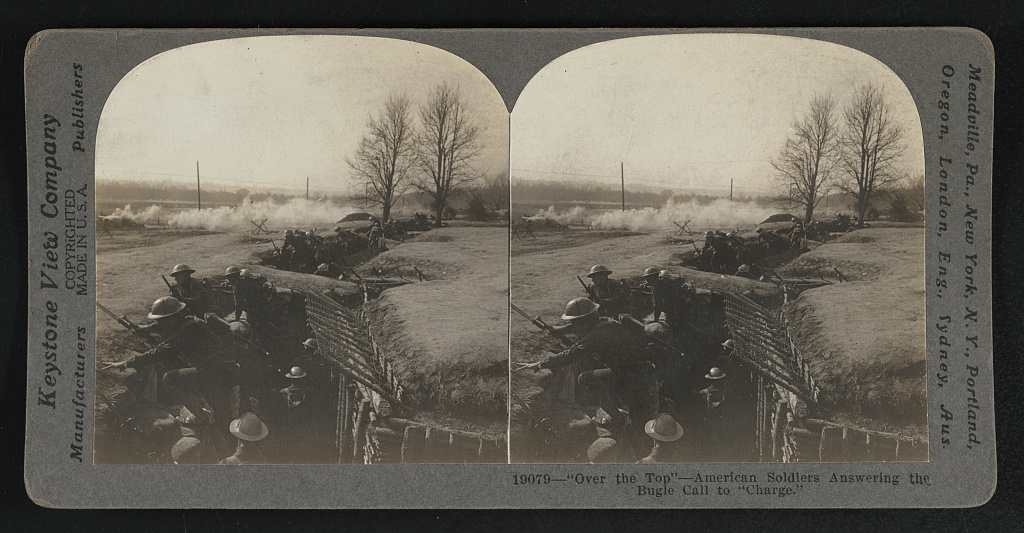
One example is this stereogram
The publisher euphemistically titled the stereogram:
"Over the top" - American soldiers answering the bugle call to "charge"
(“At the edge of the trench” – American soldiers responding to a bugle call ordering them to attack). The scene is intended to evoke the fierce trench warfare on the French front during World War I. Meanwhile... this particular stereogram does not depict any real battle or authentic fighting on the front line. Although the caption issued by the Keystone View Company describes a scene of American soldiers launching an attack in response to a bugle call (“Over the top”), it is actually a staged, posed photograph taken in the United States for propaganda and educational purposes. This is demonstrated by key historical facts and details visible on the card: Origin of the photograph: The photograph was taken at a training camp in the USA (probably at Fort Meade or another training facility), where clean demonstration trenches were built to imitate conditions in France. Lack of battlefield authenticity: In real battles during World War I, no one gave the order to attack (“Over the top”) using a signal bugle, because it would have been completely inaudible amid the roar of artillery explosions (officers’ whistles were used instead). Official archival data: In the official collections of the United States Library of Congress, where the same negative is held (Keystone serial number: 19079), the photograph is cataloged simply as a general illustrative photograph showing soldiers leaving the trenches. It is not assigned any specific geographical location in France or the name of any military operation. Publishers such as Keystone mass-produced this type of posed image because dynamically photographing a real assault amid clouds of gas and under machine-gun fire was technically impossible using the heavy stereoscopic cameras of the time.Thanks to modern AI techniques, we can use this stereogram to reconstruct quite faithfully what this scene actually looked like—we present it in the digital stereogram below.
(Darek K)