
| Year / era | Person / event | What happened | Significance in the history of 3D |
|---|---|---|---|
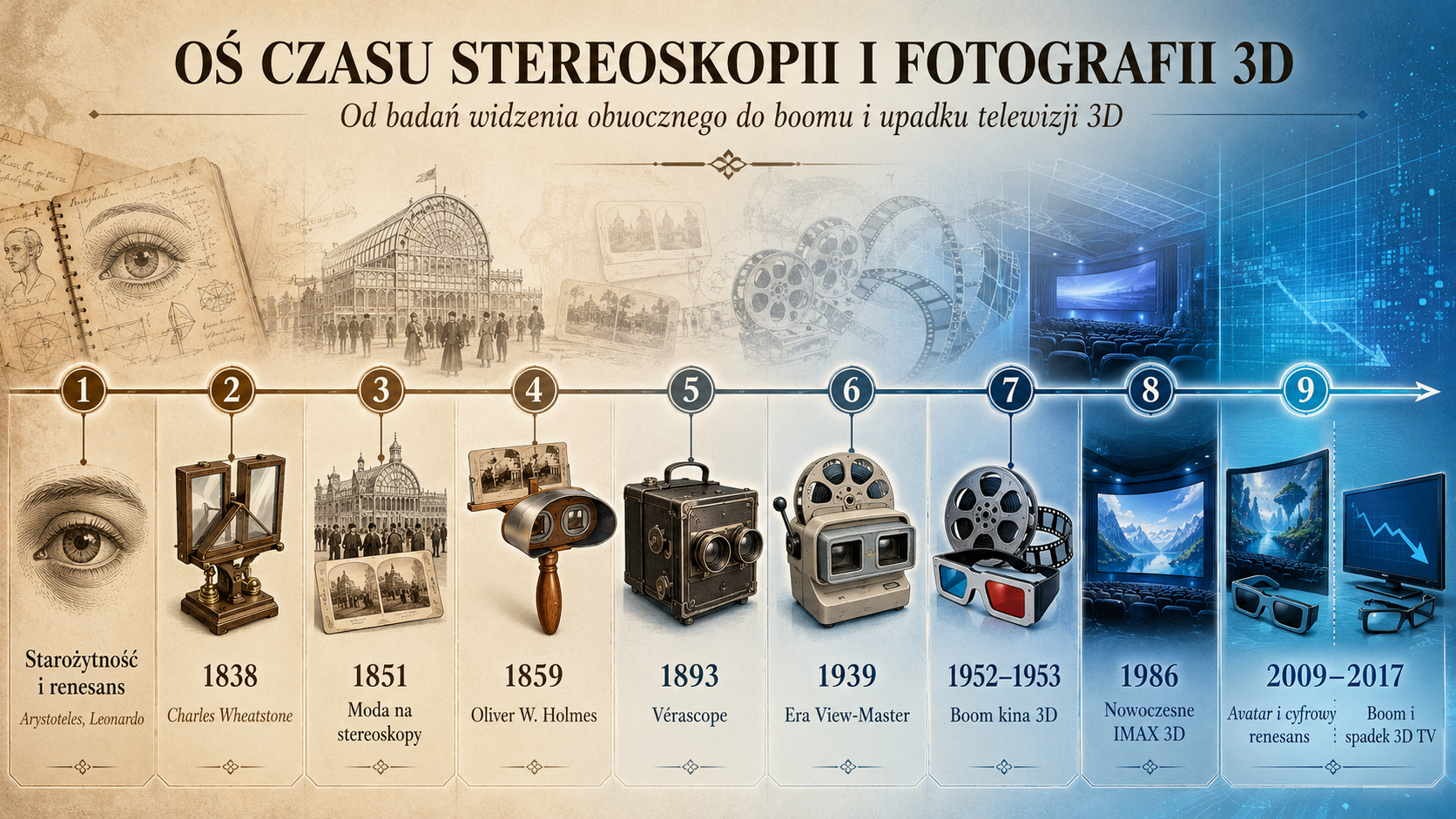
| Prehistory – antiquity | Early methods of depicting depth | Paleolithic paintings already made use of object occlusion, while later art employed chiaroscuro and other monocular depth cues. This was not yet stereoscopy. | For thousands of years, humans have tried to depict space on a flat surface. |
| 4th century BCE | Aristotle | He analyzed vision with two eyes and phenomena associated with double vision. | Some of the earliest surviving reflections on binocular vision. |
| c. 100–170 CE | Claudius Ptolemy | He conducted experimental research into the correspondence between the visual directions of both eyes. | An important step toward a scientific description of binocular vision. |
| 1492–1513 | Leonardo da Vinci | He observed that the left and right eyes view a scene from slightly different positions. He also described situations in which part of an object is visible to one eye but obscured from the other—a phenomenon now known, among other terms, as “da Vinci stereopsis.” | Leonardo came very close to identifying the physiological foundations of stereoscopy, although he did not construct a stereoscopic imaging system. |
| c. 1600 | Jacopo Chimenti da Empoli | Two almost identical drawings by the artist were later regarded by David Brewster as a possible stereoscopic pair. Modern research, however, has not confirmed a convincing stereoscopic effect. | An interesting but controversial “prehistory of the stereogram.” |
| 1830s | Charles Wheatstone | He experimented with devices that presented a separate image to each eye. Examples of stereoscopes were being made for him even before the official publication. | The technical foundation of modern stereoscopy emerges. |
| June 21, 1838 | Charles Wheatstone – reflecting stereoscope | Wheatstone presents the Royal Society with his paper Contributions to the Physiology of Vision and a stereoscope that uses mirrors. Two appropriately prepared drawings were perceived as a single three-dimensional object. | The conventional date marking the birth of stereoscopy. For this reason, Stereoscopy Day is celebrated on June 21. |
| 1839 | Daguerre and Talbot – the birth of practical photography | Almost simultaneously with the invention of the stereoscope, a breakthrough occurs in the recording of photographic images. | The combination of photography and stereoscopy proved crucial—manually drawing two perfectly matching perspectives was no longer necessary. |
| 1840 | William Henry Fox Talbot + Wheatstone | Wheatstone asked Talbot to take pairs of photographs at Lacock Abbey intended for stereoscopic viewing. | Some of the earliest experiments in stereoscopic photography, only a year after photography was publicly announced. |
| 1849 | Sir David Brewster | He constructs a much smaller lens-and-prism stereoscope—the so-called Brewster lenticular stereoscope. | The stereoscope ceases to be a large laboratory instrument and can become a consumer product. |
| 1850 | Jules Duboscq | The Parisian optician recognizes the potential of Brewster's design and begins manufacturing it. | The beginning of the stereoscope's large-scale commercialization. |
| 1851 | Great Exhibition, Crystal Palace, London | Stereoscopes and stereoscopic daguerreotypes were presented to the public. The Library of Congress identifies this exhibition as the first public display of stereo daguerreotypes. | The first great stereoscope craze begins. |
| 1851–1855 | Thomas Richard Williams | He creates stereoscopic daguerreotypes, portraits, still lifes and genre scenes; later, among other works, the famous series Scenes in Our Village. | One of the first artists to treat stereophotography not only as documentation but also as an artistic medium. |
| 1850s | Lady Mary Rosse | Among other subjects, she takes stereoscopic photographs of the famous “Leviathan of Parsonstown” telescope. | One of the notable female pioneers of stereophotography and an example of its use in scientific documentation. |
| 1853 | Wilhelm Rollmann | He proposes separating images intended for the left and right eyes using colors and corresponding filters. | The beginning of the technological path leading to anaglyphs and red-blue/cyan 3D glasses. |
| 1854 | London Stereoscopic Company | One of the most important companies in the history of stereophotography is established. By 1856, it was advertising a collection of more than 10,000 stereoscopic views; its 1858 catalog reportedly included more than 100,000 stereoscopic photographs. | Stereo becomes the first truly mass photographic medium. |
| 1856–1859 | Francis Frith | During expeditions to Egypt and the Middle East, he takes a large number of stereoscopic photographs of monuments and landscapes. | The stereoscope begins to serve as a form of “virtual tourism.” Europeans can view Egypt in three dimensions without leaving their drawing rooms. |
| 1858 | Joseph-Charles d'Almeida | He demonstrates the projection of two images through red and green filters, viewed through corresponding glasses. | One of the direct predecessors of projected anaglyph cinema. |
| 1858–1861 | William England | He photographs Ireland, France, the USA, Canada and Niagara Falls for the London Stereoscopic Company. His views of America were distributed widely throughout Europe. | Stereophotography becomes a global travel medium. |
| 1859 | Oliver Wendell Holmes | He designs a very simple handheld stereoscope. He does not patent the design, allowing a vast number of inexpensive “Holmes stereoscope” variants to be produced. | It radically lowers the barrier to entry into the world of 3D photography. |
| 1861–1865 | American Civil War | Thousands of stereoscopic photographs are produced: camps, fortifications, soldiers, as well as the dead on battlefields. | One of the first major historical events documented in 3D on a mass scale. |
| 1860–1864 | Carleton Watkins | In Yosemite, he produces around 100 stereographic views alongside monumental photographic plates. | Stereo begins to play an important role in landscape photography and in exploring the American West. |
| 1868–1870s | Eadweard Muybridge | He produces stereographs of Yosemite and other areas of the American West; some are sold by San Francisco photographic companies. | Before Muybridge became famous for his motion studies, he was also a significant landscape stereographer. |
| 1867–1874 | Timothy H. O'Sullivan | He documents geographical expeditions across the American West; numerous stereocards from his expeditions survive. | An example of stereoscopy at the intersection of art, science, cartography and documentation. |
| c. 1870–1920 | Golden age of the stereocard | The Library of Congress describes this period as the time of stereographs' greatest popularity. People collected images of travel, events, landscapes, industry, disasters and famous people. | The stereoscope performs the function later taken over by cinema and television: it is a window on the world in the drawing room. |
| 1882 | Elmer and Bert Underwood – Underwood & Underwood | The company begins by distributing stereocards and later organizes its own production. In 1901, it produces around 25,000 stereocards per day. | Stereography reaches the scale of a media industry. |
| 1891 | Louis Ducos du Hauron | He develops a printing method in which the images for the left and right eyes are superimposed in different colors. The term anaglyph becomes widespread. | A single 3D image can be printed instead of two separate photographs. |
| 1892 | Benneville Lloyd Singley – Keystone View Company | A company that would later become a giant of stereophotography is established. By 1905, Keystone was the world's largest stereographic company and offered thousands of views. | The second great pillar of industrial stereography alongside Underwood & Underwood. |
| 1893 | Jules Richard – Vérascope | Richard patents the Vérascope, a compact metal stereoscopic camera. He later also creates the Taxiphote—a parlor device for viewing stereoscopic transparencies. | 3D photography becomes considerably easier for advanced amateurs. |
| c. 1900 | Stereoscopic clubs | The first organizations bringing together stereophotographers are established. At the same time, cinema and postcards begin to draw audiences away from stereocards. | The first great wave of stereo begins to shift from mass entertainment to an enthusiast hobby. |
| 1907 | Auguste and Louis Lumière – Autochrome | The first practical color photography process enters the market. Stereoscopic autochromes are also produced, combining depth with natural color. | For the first time, a home stereoscope can show the world in both three dimensions and color. |
| 1910s–1920s | Decline of the stereocard | Cinema, the illustrated press and postcards become more convenient mass media. | The first major collapse of the 3D market. Stereoscopy does not disappear, however. |
| 1922 | Harry K. Fairall – The Power of Love | The first feature-length stereoscopic film shown to a commercial audience. It used a red-green anaglyph system. Edwin S. Porter had previously conducted 3D projection experiments in 1915. | The birth of feature-length 3D cinema. |
| 1928 | John Logie Baird – stereoscopic television | Baird demonstrates stereoscopic television—a primitive but functional concept for transmitting three-dimensional images. | 3D television was not born after Avatar. It was demonstrated more than 80 years earlier. |
| 1939 | William Gruber, Harold Graves – View-Master | View-Master is unveiled at the World's Fair in New York. It was initially conceived more as an educational and travel tool, only later becoming an icon of children's entertainment. | One of the most enduring forms of mass stereoscopy in the 20th century. |
| 1947 | Seton Rochwite – Stereo Realist | The David White company's Stereo Realist—a 35 mm camera producing stereoscopic slides—enters the market. | The beginning of the great amateur boom in color stereophotography in the 1950s. |
| 1951 | Norman McLaren and the Festival of Britain | McLaren co-creates experimental 3D films presented during London's Festival of Britain. | Stereo is treated as a potentially fully fledged artistic language of film. |
| 1952 | Bwana Devil | The Hollywood film's success triggers a major wave of 3D productions. | Hollywood seeks a technology that will keep audiences in cinemas during an era of rapid television expansion. |
| 1953 | House of Wax, Kiss Me Kate, Hondo | Major studios invest in stereoscopic productions, most often using polarization rather than traditional anaglyphs. | Hollywood's first major “3D boom.” |
| 1954–1955 | Collapse of the first cinema boom | Hitchcock's Dial M for Murder is shot in 3D, but by the time of its release many cinemas are already showing the flat version. Stereoscopic projection is expensive and troublesome, while CinemaScope provides a wide, spectacular image without glasses. | A classic pattern repeated later: enormous interest → overproduction → audience fatigue → 3D's return to a niche. |
| 1960s–1970s | Salvador Dalí | Dalí takes an intense interest in stereoscopy, holography and anaglyphs. In the 1970s, he creates, among other works, a series of paired paintings painted from two viewpoints. | One of the most important examples of the deliberate use of stereoscopy in fine-art painting. |
| 1970–1985 | Second revival of 3D cinema | 3D returns mainly as an attraction in horror films, action films and exploitation productions. | Stereo experiences another wave, but it is still often treated more as a special effect than as a cinematic language. |
| 1986 | Transitions – Colin Low, Tony Ianzelo, Ernest McNabb | The National Film Board of Canada and IMAX create the first IMAX 3D film for Expo 86. Due to the size of the cameras, a mirror system and highly precise synchronization were required. | The era of large-format, very high-quality stereoscopic cinema begins. |
| 1986–2008 | IMAX 3D era | 3D becomes an attractive feature of science cinemas, museums, theme parks and IMAX. | It gradually prepares audiences and the industry for the digital 3D renaissance. |
| 2000–2008 | Digital projection | Digital technology eliminates many problems associated with traditional two-strip projection: synchronization, print wear and brightness differences. Systems such as RealD rapidly increase the number of screens. | An infrastructure emerges that enables a scale analog 3D cinema could not achieve. |
| December 2009 | James Cameron – Avatar | Avatar was made using the Fusion 3-D Camera system developed by Cameron and Vince Pace. The system enabled precise control of camera spacing and convergence. | The film becomes a turning point. Cambridge identifies 2009 as the beginning of the digital 3D cinema era, when studios began mass-producing stereoscopic films following the success of Avatar. |
| January 2010 | CES – explosion of 3D TV | Samsung, Panasonic, Sony, Toshiba and other manufacturers unveil televisions, Blu-ray players and 3D devices. IEEE described 3D as the central theme of CES 2010. | The success of Avatar is treated as proof that consumers also want 3D at home. |
| 2010 | Samsung, Panasonic, Sony – 3D televisions; ESPN 3D | Consumer stereoscopic televisions enter the market. In June, ESPN launches the ESPN 3D channel for the World Cup in South Africa. | The peak of the industry's conviction that 3D will be the next television standard after HD. |
| 2011–2012 | BBC, Sky, sports and the Olympic Games | The BBC tests 3D, including broadcasts from the London Olympic Games; sports seem a natural candidate for stereoscopic television. | The last major attempt to build a regular market for 3D television content. |
| 2013 | The 3D TV bubble bursts | ESPN announces that it will shut down ESPN 3D due to limited adoption. The BBC also ends its experiments, citing low audience interest. | The industry receives a clear signal: viewers like 3D as a cinematic event, but not necessarily as an everyday way of watching television. |
| 2014 | Low market penetration | Ofcom research found a 3D-ready television in only 9% of households in the UK and 8% in the USA; even in Germany, the figure was 17%. Ofcom also noted the withdrawal of the BBC and ESPN, as well as growing interest in 4K/8K. | Instead of 3D, image resolution begins to become the new selling point. |
| 2017 | Sony and LG abandon 3D TV | The last major manufacturers remove the 3D feature from new television lines. LG explains the decision by citing very low actual use of the feature and greater consumer interest in HDR. | The practical end of the consumer stereoscopic television boom that began after Avatar. |
| 2020s | 3D remains but changes medium | 3D cinema still exists, but it ceases to be a mandatory element of every blockbuster. At the same time, Wheatstone's fundamental principle lives on in VR, AR and XR headsets. | Stereoscopy has not died—it has moved from the television screen directly in front of the user's eyes. |
History of Stereoscopy and 3D Imaging – Timeline
An overview of the most important events related to capturing and presenting images in three dimensions using a variety of techniques.
From article to practice
Try this topic in practice
Open the relevant 3D LAB tool or explore products related to the technique discussed in this article.
3D LAB
Related tools
3D Shop
Related products
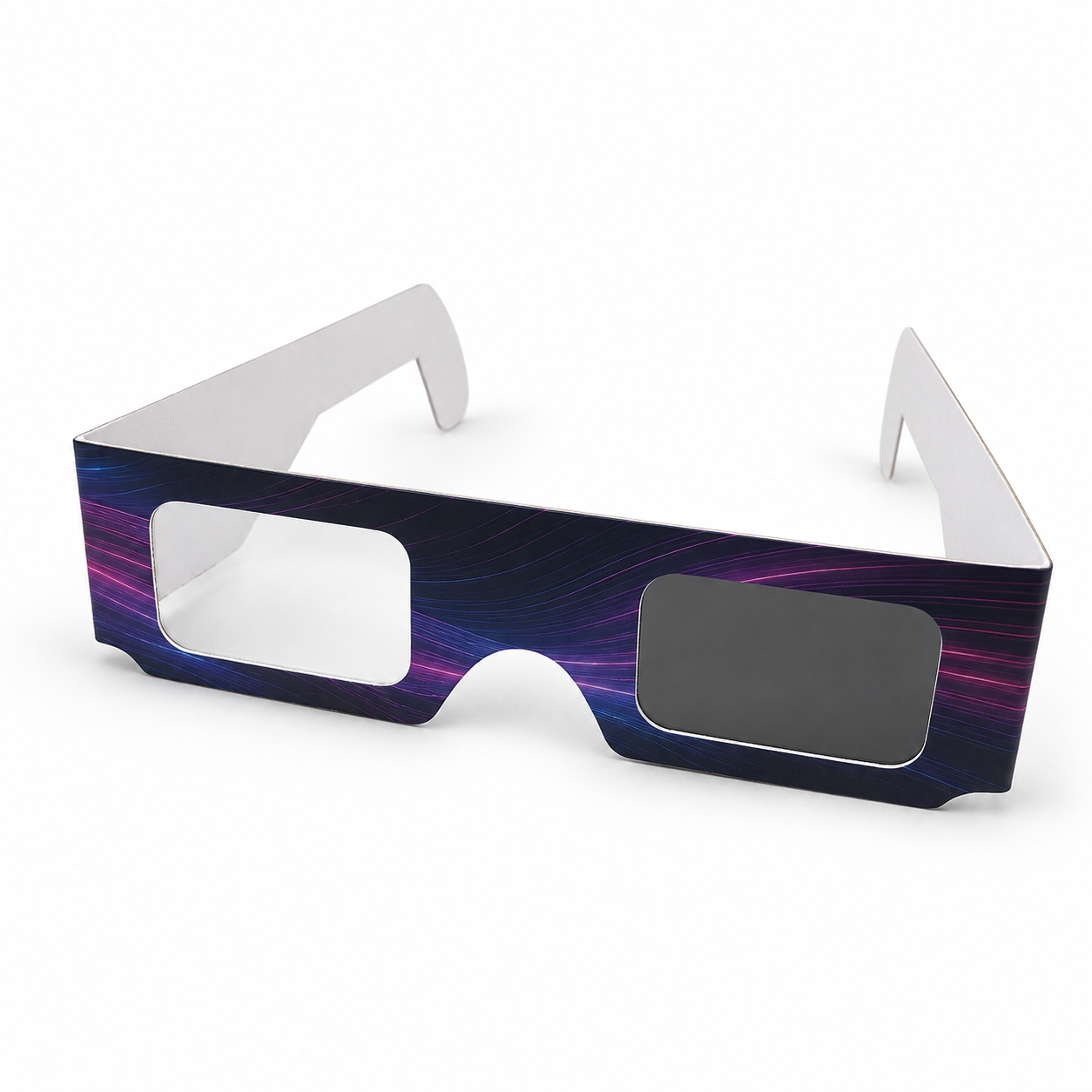
Cardboard 3D Glasses with the Pulfrich Effect
Cardboard glasses in various color versions: plain white or with custom printing. Pulfrich glasses...
from
30,00
PLN
View product →

Self-adhesive A4 vertical 60 LPI lenticular sheet
Self-adhesive A4 vertical 60 LPI 3D sheet
from
28,00
PLN
View product →

A5 vertical 60 LPI self-adhesive lenticular sheet
A5 vertical 60 LPI self-adhesive 3D lenticular sheet
from
14,00
PLN
View product →
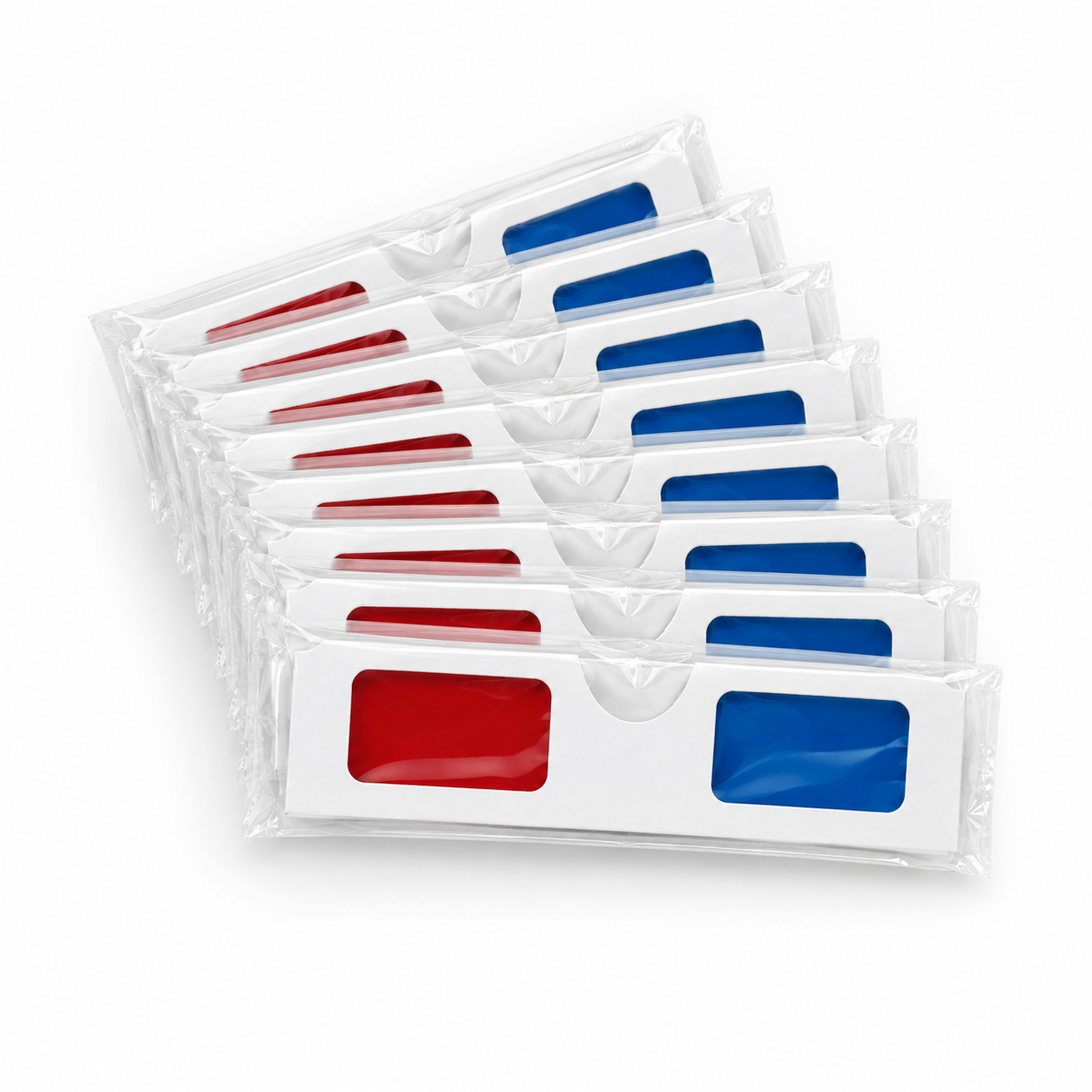
Cardboard anaglyph glasses in cellophane
Cardboard anaglyph glasses (red-blue). Left eye: red; right eye: blue
from
20,00
PLN
View product →