Before cinema appeared, the world could be viewed in 3D
Stereoscopy emerged even before the birth of mass photography, but the real breakthrough came in the mid-19th century. The Great Exhibition in London in 1851 attracted enormous interest, and it was there that Queen Victoria also encountered the stereoscope. Devices that made it possible to view pairs of photographs as a single three-dimensional image soon began appearing in middle-class parlors.
This was no short-lived novelty. An entire industry emerged: photographers traveling around the world, printing houses, laboratories, stereoscope manufacturers, publishers, networks of sales representatives and enormous catalogs of photographs.
One of the first giants was the London Stereoscopic Company, founded in 1854. The company's advertising slogan was roughly “a stereoscope in every home.” In its first few years alone, the company sold around half a million stereoscopes. It boasted a catalog containing more than 100,000 views, and in 1862 alone it reportedly sold around one million stereoscopic photographs. Historians point out, however, that the claimed figure of 100,000 different titles may have been partly a marketing exaggeration. This does not change the overall picture: in the Victorian era, stereoscopy was a fully fledged mass medium.
In the United States, the market developed even further. By the turn of the 20th century, the best-known names appearing on stereo cards already belonged to large photographic companies.
| Manufacturer | Scale of operations |
|---|---|
| London Stereoscopic Company | more than 500,000 stereoscopes sold in its first few years; catalog advertised as containing more than 100,000 views |
| Kilburn Brothers / B.W. Kilburn | around 3,000 stereo cards per day; thousands of original subjects |
| Underwood & Underwood | approx. 25,000 cards per day in 1901; 30,000–40,000 different titles |
| H.C. White Company | factory capable of producing approx. 15,000 stereo cards per day; approx. 13,000 titles |
| Keystone View Company | already offering approx. 20,000 views in 1905; eventually the market's largest player and owner of former competitors' archives |
Smithsonian data reveal a scale that is difficult to imagine today: in 1901, Underwood & Underwood published around 25,000 stereo cards per day, and its catalog contained 30,000–40,000 titles. The company employed its own photographers, purchased the archives of other publishers and sold stereograms through an extensive network of representatives.
Another company, the H.C. White Company, had operated a factory since 1907 with a production capacity of around 15,000 stereoviews per day. Its catalog contained around 13,000 titles, including approximately 40 themed sets.
Kilburn Brothers, active in New Hampshire since the 1860s, achieved an average output of around 3,000 cards per day. Their photographers initially documented New England and later events and places around the world.
This was therefore not photography “for a handful of enthusiasts.” The stereo card was one of the first global image products.
The photographic internet of the 19th century
Why was stereoscopy so successful?
It is important to remember that people at the time had no television, internet, YouTube or even cinema in its modern sense. For someone living in a small American or European town, the opportunity to see the interior of a Canadian mine, the pyramids, the streets of Jerusalem or the Alps was extraordinary.
And the stereoscope added one more element: depth.
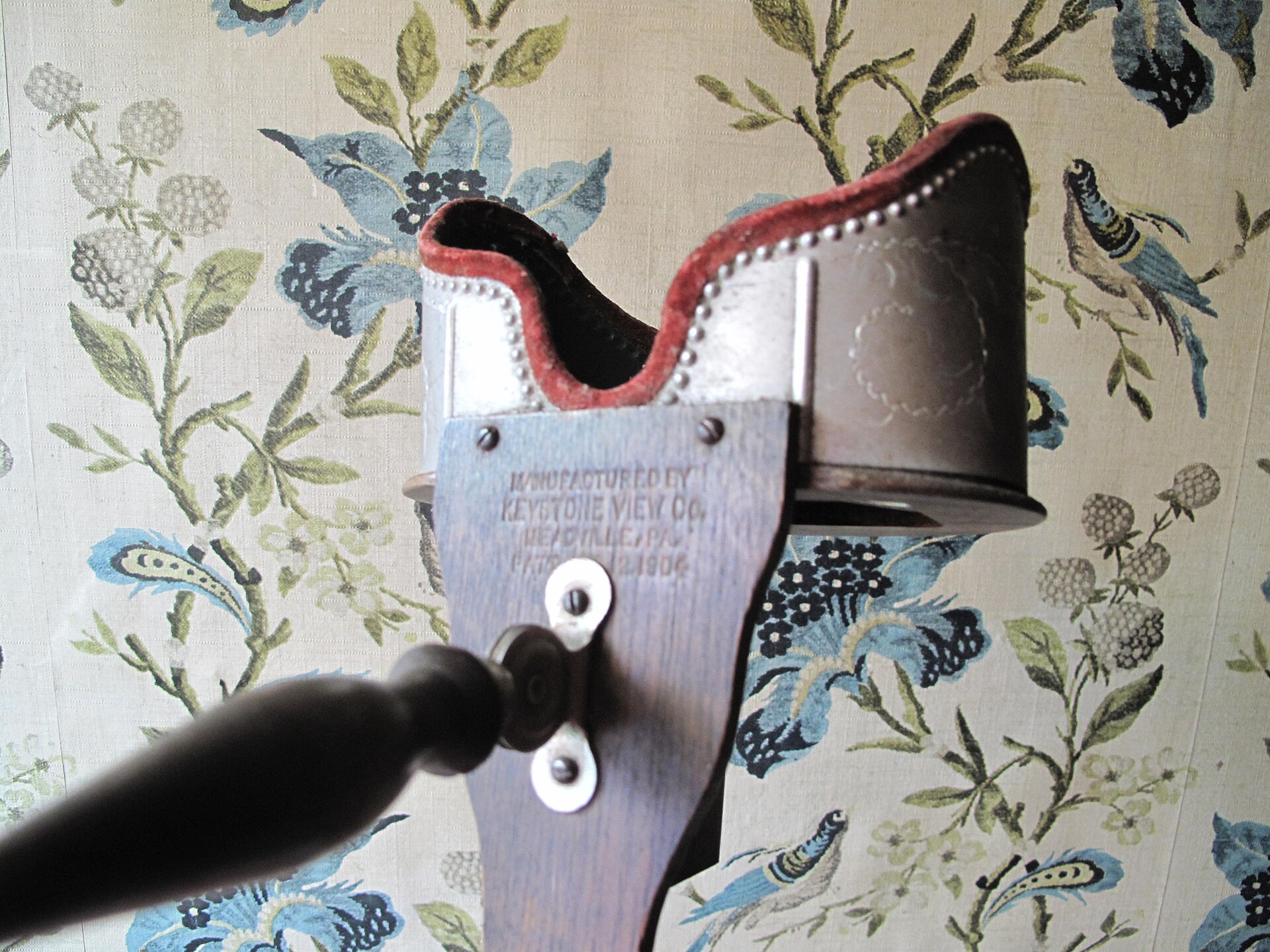
When the viewer put their eyes to the eyepiece, two slightly different photographs merged into a single image. Buildings no longer looked like a flat photograph. People stood in front of one another, streets extended into the distance and mountains receded toward the horizon.
In a sense, this was a 19th-century form of “teleportation.”
Some companies understood this perfectly. Underwood & Underwood even offered a Travel System—sets of stereo cards devoted to individual countries and regions, accompanied by a map and guidebook. Descriptions were printed on the backs of the cards, sometimes in several languages. Stereoscopy thus began to combine entertainment with education.
And then Keystone appeared
The story of the Keystone View Company begins in Meadville, Pennsylvania.
Its founder, Benneville Lloyd Singley, had previously worked as a stereogram salesman. According to a later history of the company, his fascination with three-dimensional photography supposedly began after viewing a stereogram depicting two silver foxes.
The true beginning of the company, however, came with a disaster.
In 1892, the swollen French Creek flooded Meadville. Singley photographed the effects of the flood, prepared prints from around thirty negatives, mounted pairs of photographs on cards and labeled them Keystone View Company.
This marked the beginning of the company that, a dozen or so years later, would become the world's largest stereoscopic company.
Its pace of growth was impressive. By around 1895, Keystone already had approximately 700 different views, and from 1898 it also manufactured stereoscopes.
By 1905, its range included around 20,000 different images. Production took place in Meadville, but the company had offices in New York, St. Louis, San Francisco, Portland, Chicago, Toronto and London, among other cities. Keystone photographers and salespeople operated around the world. That same year, the business was already being described as the world's largest stereographic company.
More than landscapes
What is particularly fascinating is what was photographed.
Keystone stereo cards naturally include tourist destinations, monuments and natural wonders. But they also show mines, factories, agriculture, ports, railways, schools, street life, technological processes, the military and political events.
In 1916, for example, Keystone published a stereogram depicting workers making jewelry in Providence. The original card measured around 9 × 18 cm—a format highly characteristic of American stereoscopy. The Library of Congress marks this material as “No known restrictions on publication”.
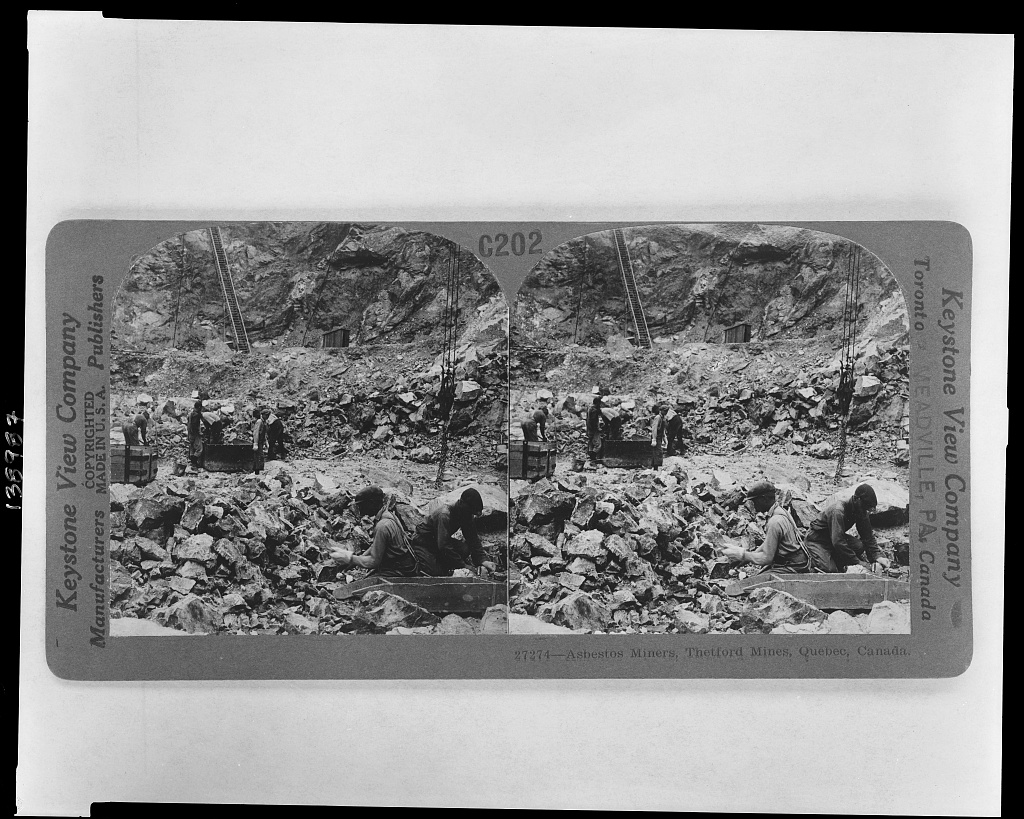
Examples of the world documented stereoscopically by Keystone: miners in Quebec, work on a sugarcane plantation and a vast American military camp in France. Source: Library of Congress.
It is precisely this documentary character that makes stereograms more than collectors' curiosities today. They constitute an enormous archive of life at the turn of the 20th century.
School in three dimensions
One of Keystone's most important business ideas was to treat stereoscopy as an educational tool.
The company prepared sets devoted to geography, history, natural sciences, industry, architecture and social sciences. The stereograms were accompanied by descriptions, teachers' guides, stereoscopes and sometimes slides intended for projection to the entire class.
Large school sets were even stored in special wooden cabinets made by Keystone.
The Library of Congress holds, among other items, a World Tour set dating from around 1930, containing 600 stereoviews and a nearly 600-page book describing the places shown. In other words, a student could take a “journey around the world” without leaving the classroom.
The enormous guide to the educational Keystone 600 Set has survived to this day. Its introduction already emphasized that stereoscopy was intended to develop observation, memory and the ability to describe what a child saw.
Keystone begins buying its competitors
Over time, the stereogram market began to consolidate.
Keystone did not merely take its own photographs. It also acquired negatives and rights belonging to former competitors.
Its archives came to include materials from B.W. Kilburn, H.C. White and Underwood & Underwood, among others. The Smithsonian confirms that Underwood sold some of its materials to Keystone as early as 1912, and in 1921–1923 transferred its remaining stereographic holdings and rights to its competitor. H.C. White ceased operations in 1915, and its negatives also went to Keystone.
As a result, Keystone became something of a central archive of the golden age of stereoscopy.
By the mid-1930s, according to contemporary figures, the company may have held as many as approximately two million stereoscopic negatives. However, this number should not be equated with the number of different photographs published—the archives contained successive versions, materials acquired from other companies and production negatives.
An interesting trace of these acquisitions can be found directly on the cards. In Keystone's numbering system, the letter V indicated material originating from the Underwood & Underwood archive, while W indicated material from H.C. White.
War also entered the stereoscope
Stereoscopy also documented armed conflicts.
Keystone created exceptionally extensive sets devoted to World War I. Surviving collections show trenches, artillery, soldiers, field hospitals, transport, military camps and battle sites.
Xavier University of Louisiana holds a set of nearly 300 stereoviews relating to World War I, describing it as the most comprehensive wartime set of its kind published by Keystone. By the 1920s, Keystone was effectively the last major global publisher of traditional stereo cards.
This also serves as a reminder of the enormous role this medium played at the time. For a viewer sitting several thousand kilometers from Europe, the stereoscope made it possible to almost “look” across the Atlantic.
When the fashion passes, the technology remains
With the development of cinema, the illustrated press, radio and later television, the importance of home stereo cards began to decline.
Keystone, however, found an entirely new application for stereoscopy.
In the 1930s, the company developed a division devoted to binocular vision testing. Stereoscopes and special cards began to be used in optometry, stereoscopic vision exercises and tests intended for drivers and pilots, among others.
The Smithsonian identifies 1939 as the point at which the company fundamentally moved away from the traditional mass production of new stereograms in favor of optometric applications. Other archives show, however, that stereoscopic sets, devices and photographs continued to be offered under the Keystone brand for many subsequent years. The company employed a stereoscopic photographer until at least the mid-1950s.
In 1963, the company was purchased by Mast Development Company, and the Meadville plant ultimately closed in 1972.
350,000 fragments of the world
What is most remarkable, however, is that a vast portion of this legacy has survived.
The Keystone archive was transferred to the University of California, Riverside. Today's Keystone-Mast Collection at the California Museum of Photography is described as the world's largest collection of stereoscopic photography.
According to UCR ARTS, it contains around 350,000 stereoscopic prints and negatives made between the late 19th and mid-20th centuries.
It is a photographic time capsule of extraordinary value.
Factories and mines. Great cities and small villages. The rich and the poor. Wars, inventions, exotic journeys, schools, families, industry, agriculture and ordinary everyday life.
And all of it photographed not to see a flat picture, but to see depth.
Is stereoscopy dead? Not necessarily
The history of the Keystone View Company perfectly illustrates something that is easy to forget today: the fascination with 3D imagery did not begin with digital cinema, 3D television or VR headsets.
It is almost two centuries old.
Only the tools change.
The old stereo card gave way to slides, the stereoscopic camera, the anaglyph, lenticular imaging, autostereoscopic displays and virtual reality. Yet the principle remains remarkably similar: deliver two slightly different images to the left and right eyes, and the brain will do the rest.
And perhaps that is why old Keystone stereograms viewed through a stereoscope today can still evoke exactly the same feeling that delighted people one hundred or one hundred and fifty years ago:
suddenly, the photograph is no longer flat.
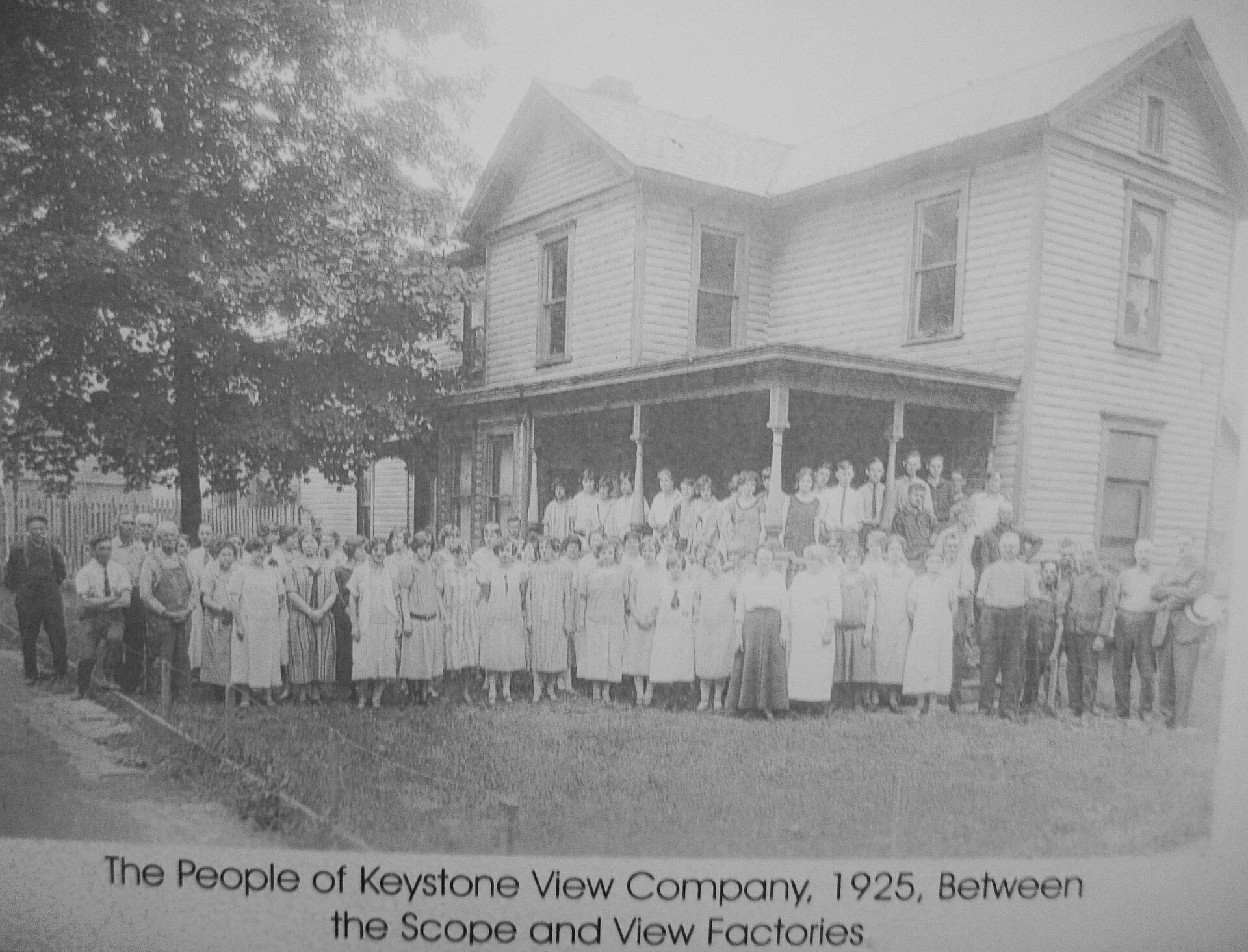
Photograph showing the scale of the company: a 1925 photograph of Keystone View Company employees. Commons marks it as being in the public domain in the USA;
Keystone View Company employees – Wikimedia Commons
Example of an original stereo card: “Skilled workers manufacturing jewelry, Providence, R.I.,” Keystone View Company, 1916. The Library of Congress states “No known restrictions on publication.”
Original Keystone stereo card at the Library of Congress
Example of stereoscopy being used to document industry: asbestos miners in Thetford Mines, Canada, Keystone, 1923.
Asbestos miners – Library of Congress