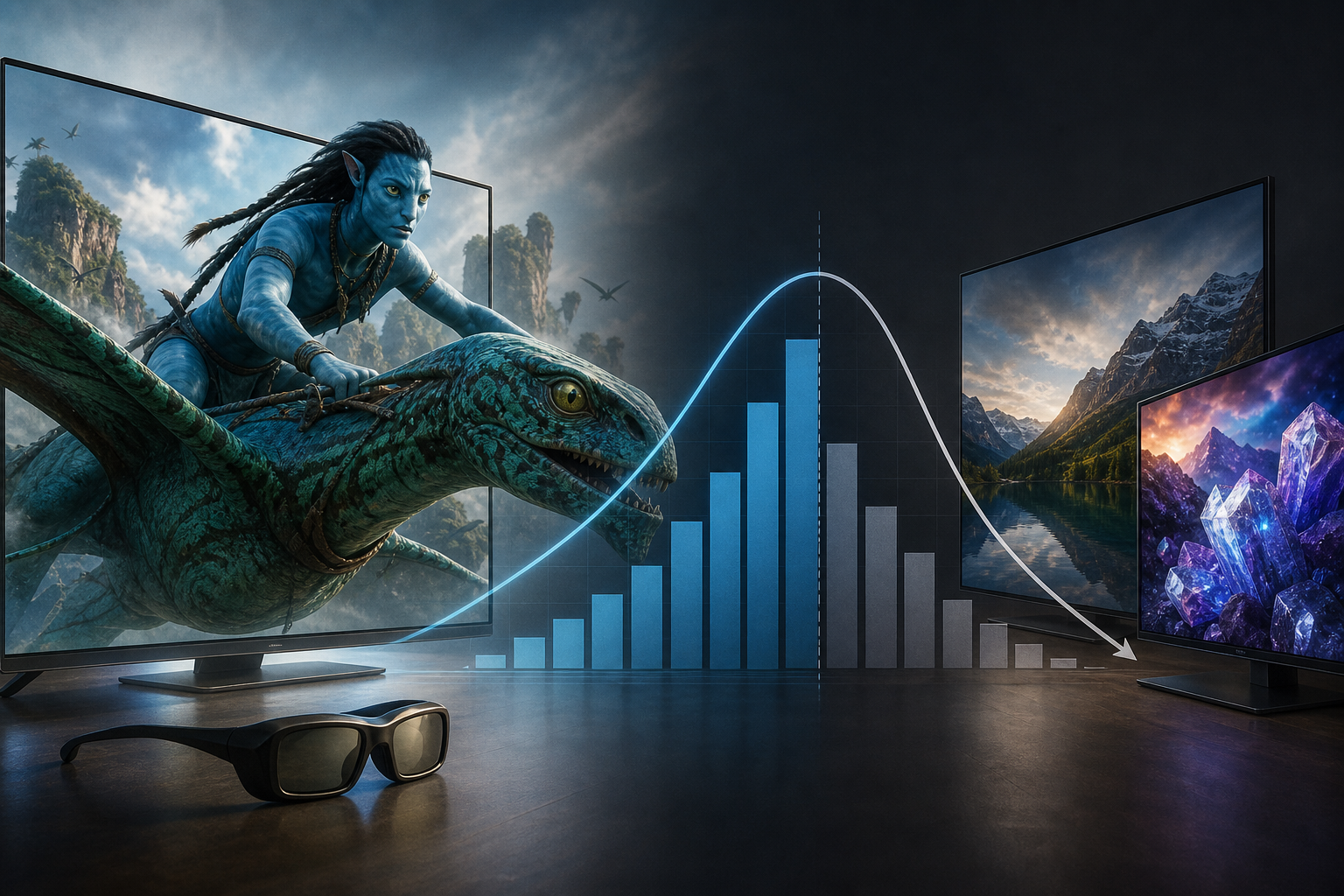
At the end of 2009, 3D once again became the focus of mainstream public attention. The theatrical success of “Avatar” created the impression that stereoscopic imagery could move beyond movie theaters and become another standard element of home entertainment. At the beginning of the following decade, manufacturers therefore began introducing 3D support across a wide range of TVs.
Enthusiasm quickly translated into forecasts measured in millions of devices. Actual results, however, proved more modest than expected, and by the middle of the decade the industry’s attention had shifted to 4K and HDR. This was not simply a case of a technology appearing and immediately disappearing. 3D TVs did reach the market, but the mere availability of the feature did not mean that viewers wanted to use it regularly.
Theatrical momentum and the promise of 3D in the living room
An Engadget retrospective links the expansion of 3D TVs to the success of 2009’s “Avatar.” Following this event, support for stereoscopic imagery began appearing in most TVs offered by manufacturers in the early 2010s. It was therefore more than a one-off experiment intended for a small group of enthusiasts.
This is an important distinction. 3D did not have to be the only reason for purchasing a particular model. It could be included as one of its features, alongside the display’s other capabilities. The growing number of TVs supporting stereoscopy therefore reflected manufacturers’ decisions about the features included in their product ranges, but it did not automatically answer the question of how often the feature was subsequently used.
At the beginning of the boom, however, it was easy to interpret the widespread presence of 3D as a sign of lasting change. Cinema provided a spectacular impetus, manufacturers prepared the devices, and analysts began describing the potential scale of the future market. All three elements reinforced the belief that home 3D was the next stage in the development of television.
Forecasts that created the atmosphere of a boom
In April 2010, WitsView predicted that shipments of 3D TVs would reach 10 million units in 2011. The forecast also projected market penetration of approximately 10 percent in 2012 and 20 percent in 2015. It envisioned a rapid transition from novelty to a solution present in a significant share of devices sold.
These figures should be read according to their original meaning. Shipments refer to devices sent to the market, while penetration indicates the share of a particular solution within the reference base adopted by analysts. Neither term is equivalent to users regularly watching stereoscopic content.
A forecast is not a result either. It is a scenario prepared on the basis of the information available at a given time. During a period of intense interest in a technology, it may influence the decisions of manufacturers and retailers, but it does not guarantee that consumers will behave as predicted.
This is precisely why the history of 3D TV is a good example of the distinction between three levels of the market:
- announcements and forecasts, which describe the expected development of the situation,
- hardware availability, meaning the number of models or devices equipped with a given feature,
- actual use, which cannot be inferred solely from shipments or a TV’s specifications.
These levels are sometimes combined in the narrative surrounding a new technology. If manufacturers add 3D to many models, it may appear that the market has already accepted the solution. In reality, the decision to include a feature in a TV may precede confirmed demand.
Initial results fall short of forecasts
Data from the Consumer Electronics Association show how quickly the gap between expectations and results became apparent. The organization’s earlier forecast called for 2.1 million 3D displays in the United States in 2010. A later estimate of US 3D TV sales in the same year amounted to 1.1 million units.
The difference is one million devices, and the later estimate represents just over half of the earlier figure. Caution is required, however: in the cited materials, the earlier figure refers to “3D displays,” while the later one was described as sales of 3D TVs. Despite this difference in terminology, the comparison documents a clear reduction in expectations for the US market.
This does not mean that 1.1 million devices sold was a negligible figure. It does show, however, that the wave of interest following the theatrical success was not enough to fulfill earlier predictions. The market existed, but it developed more slowly than expected during the initial period of enthusiasm.
Buying a TV is not a vote for 3D
When interpreting these data, it is important to remember that a TV is a multifunctional device. If 3D support was included in most models from the beginning of the decade, some customers may have purchased compatible hardware for other reasons. Sales statistics for 3D TVs therefore do not, by themselves, indicate how many buyers chose a device primarily for stereoscopy or how often they later watched stereoscopic imagery.
This is one of the most important conclusions from this history. Adding a feature to the specifications can increase the number of compatible devices without creating an equally large group of active users. From the manufacturer’s perspective, the technology is present on the market. From the viewer’s perspective, it may remain an extra used only occasionally or not at all.
The material provided does not make it possible to quantify how often home 3D was used. Nor does it provide grounds for attributing the market’s retreat to any single specific cause. It can, however, be safely concluded that hardware compatibility and actual interest should not be treated as the same metric.
From 3D to 4K and HDR
According to the Engadget retrospective, by 2015 the television industry had turned its attention to 4K and HDR, while 3D was no longer present in the mass-market home segment. This shift closes the most important chapter in the brief history of the boom: from the widespread implementation of the feature at the beginning of the decade to the loss of its central place in manufacturers’ messaging.
4K and HDR are not the same kind of solution as stereoscopy, so this shift should not be presented as a straightforward technical contest. What matters above all is the order of priorities. The TV market constantly needs features that help distinguish newer models. When 3D failed to meet earlier expectations, industry messaging focused on other image characteristics.
Based on the available data, it is possible to speak of an expectations bubble, although this term requires clarification. It does not suggest that the technology was fictitious or that 3D TVs never went on sale. Rather, it describes the rapid growth of forecasts and the prevalence of the feature, followed by an equally rapid shift in industry interest toward a different direction.
Why theatrical success does not guarantee success at home
The documented sequence of events is clear: the success of “Avatar” in 2009, the expansion of 3D support in TVs at the beginning of the following decade, high forecasts in 2010, a result in the US market that fell short of earlier expectations, and then the shift toward 4K and HDR by 2015.
However, this is not enough to create a complete list of the reasons for the retreat. The data provided include no price comparison, research on frequency of use or information about the amount of available content. Attributing a decisive role to any of these factors would therefore go beyond the confirmed information.
What can be identified is a mechanism directly visible in the figures and chronology: theatrical interest was treated as a signal of future demand for home devices, and predictions ran ahead of confirmed consumer behavior. When the results failed to match the forecasts, manufacturers found new areas in which to develop their product ranges.
Movie theaters and the home living room are also two different contexts of use. The mere fact that viewers choose a particular way of presenting a film in a theater does not prove that they will want to reproduce it regularly at home. The history of 3D TVs shows that the transition between these environments does not happen automatically.
A lesson for future imaging technologies
The fate of 3D TV remains a relevant warning against evaluating technologies solely on the basis of the atmosphere surrounding their launch. Millions of forecast shipments, a growing number of compatible models and strong pop-culture momentum can create an image of inevitable success. Only later data reveal whether the feature actually became part of everyday habits.
When analyzing similar trends, it is therefore worth asking a few simple questions:
- Is the figure being reported a forecast, a shipment to sales channels or a sale to end users?
- Did the buyer purchase the device because of the promoted feature, or was it included as an extra?
- Is hardware compatibility supported by information about regular use?
- Is the manufacturer still developing the solution, or has it shifted its messaging to other features?
The boom in 3D TVs was not merely a media illusion: the devices became widely available, and the market achieved genuine scale. At the same time, its development failed to meet some early expectations. By the middle of the decade, 3D had lost its position as a mass-marketed feature, giving way to 4K and HDR.
This period is best described not as a complete failure of stereoscopy, but as an overly rapid transition from theatrical success to the assumption that similar enthusiasm would automatically carry over into homes. The technology was available. Turning it into a lasting viewer habit proved far more difficult.