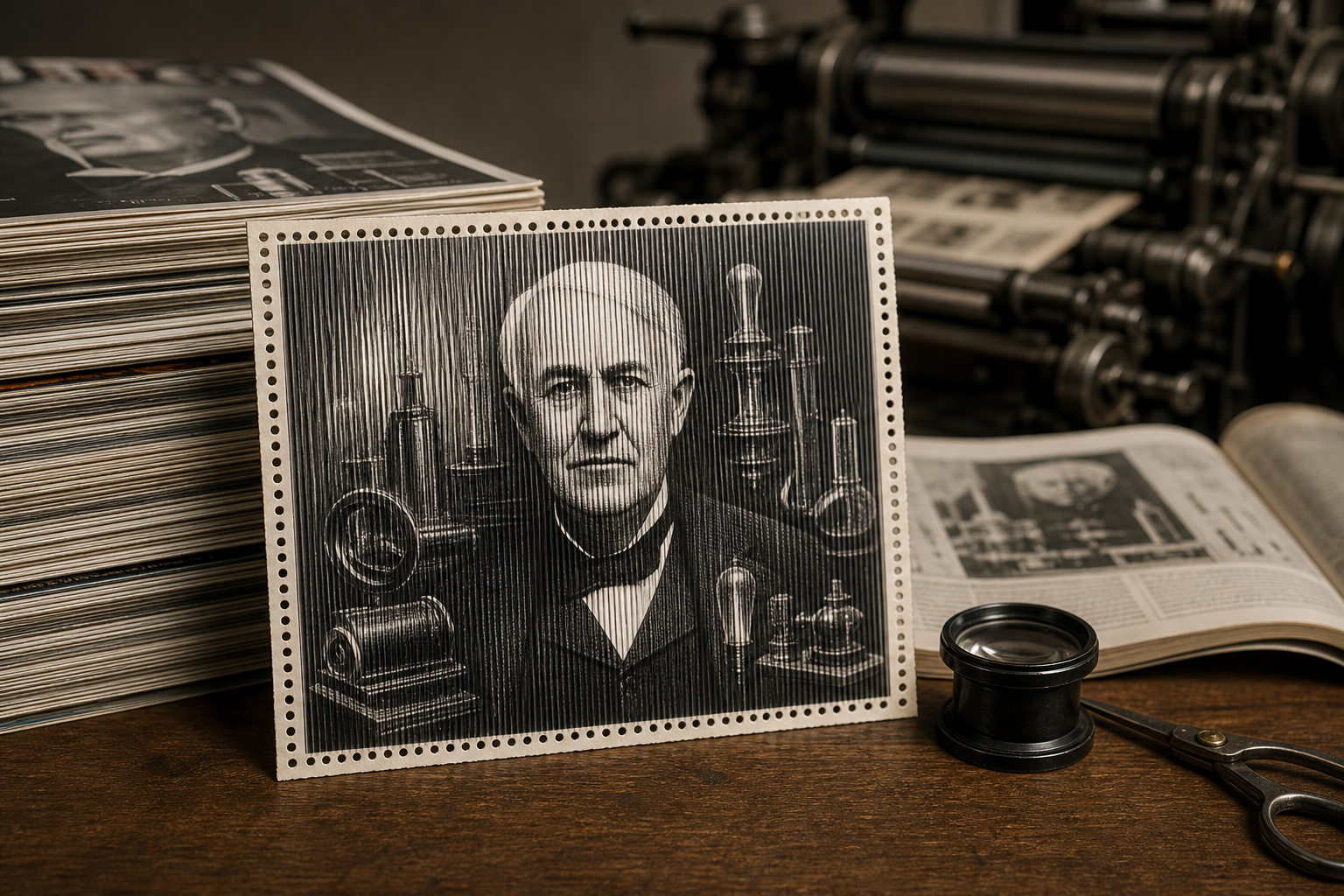
The history of lenticular printing is not solely a history of optical inventions. Equally important were the occasions when the technology was successfully adapted to the production of a typical mass-produced item. One of the best-documented examples is the Xograph published on February 25, 1964, in the American magazine “Look.” A black-and-white image of a bust of Thomas Edison appeared in an issue produced in a run of eight million copies.
This figure gives the project particular significance. It was no longer a one-off experiment, a prototype, or a small series of advertising materials. The three-dimensional image had to be produced on a scale appropriate to a major magazine, then bound and delivered to readers as part of a regular issue. Just a few weeks later, on April 7, “Look” published a second Xograph—this time in color.
What Was Xograph?
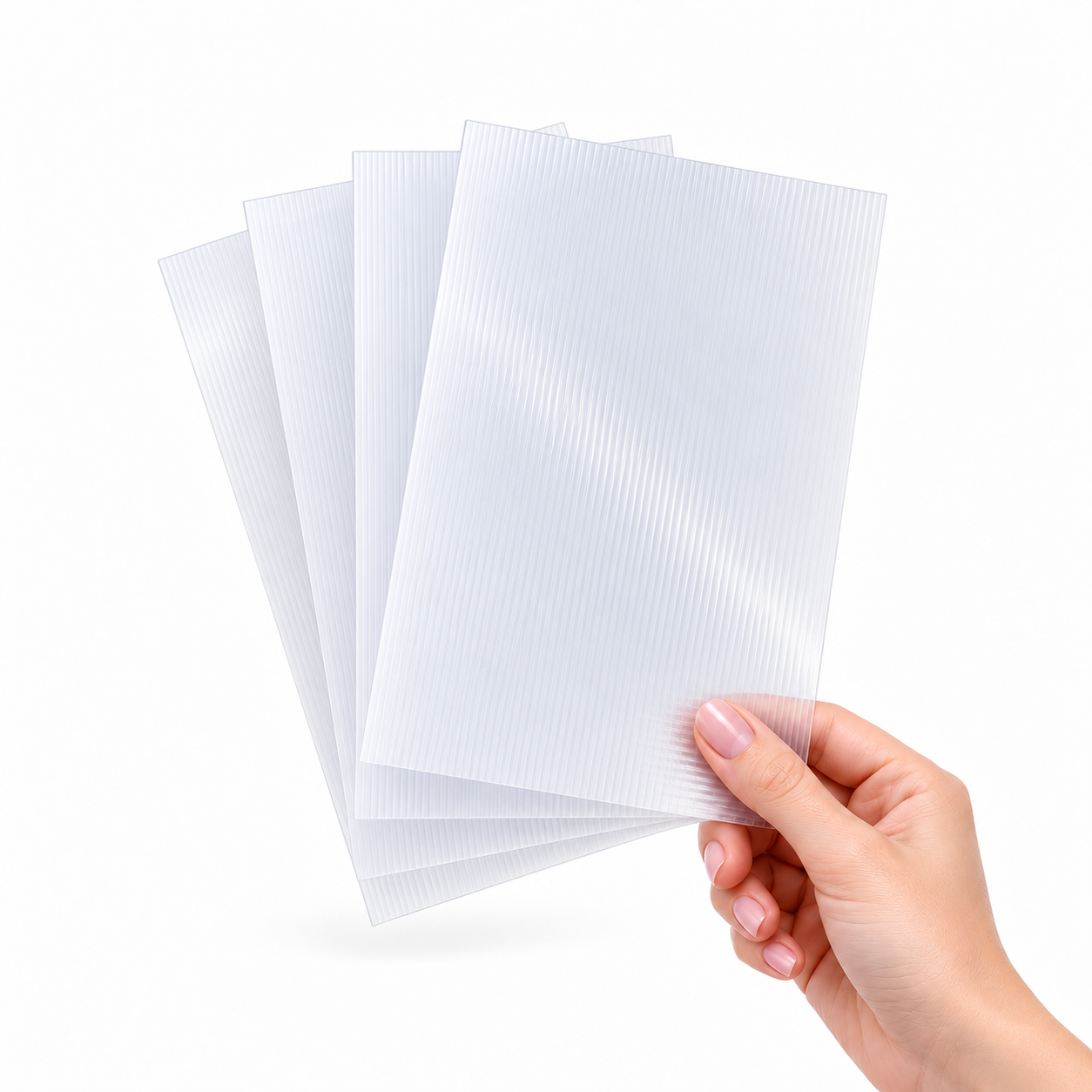
The name Xograph referred to a process used to produce printed lenticular images. In historical materials, the technology also appears in the context of the parallax panoramagram. The image was viewed through a thin lenticular screen, an optical layer composed of elements that directed appropriately prepared sections of the image to the eyes.
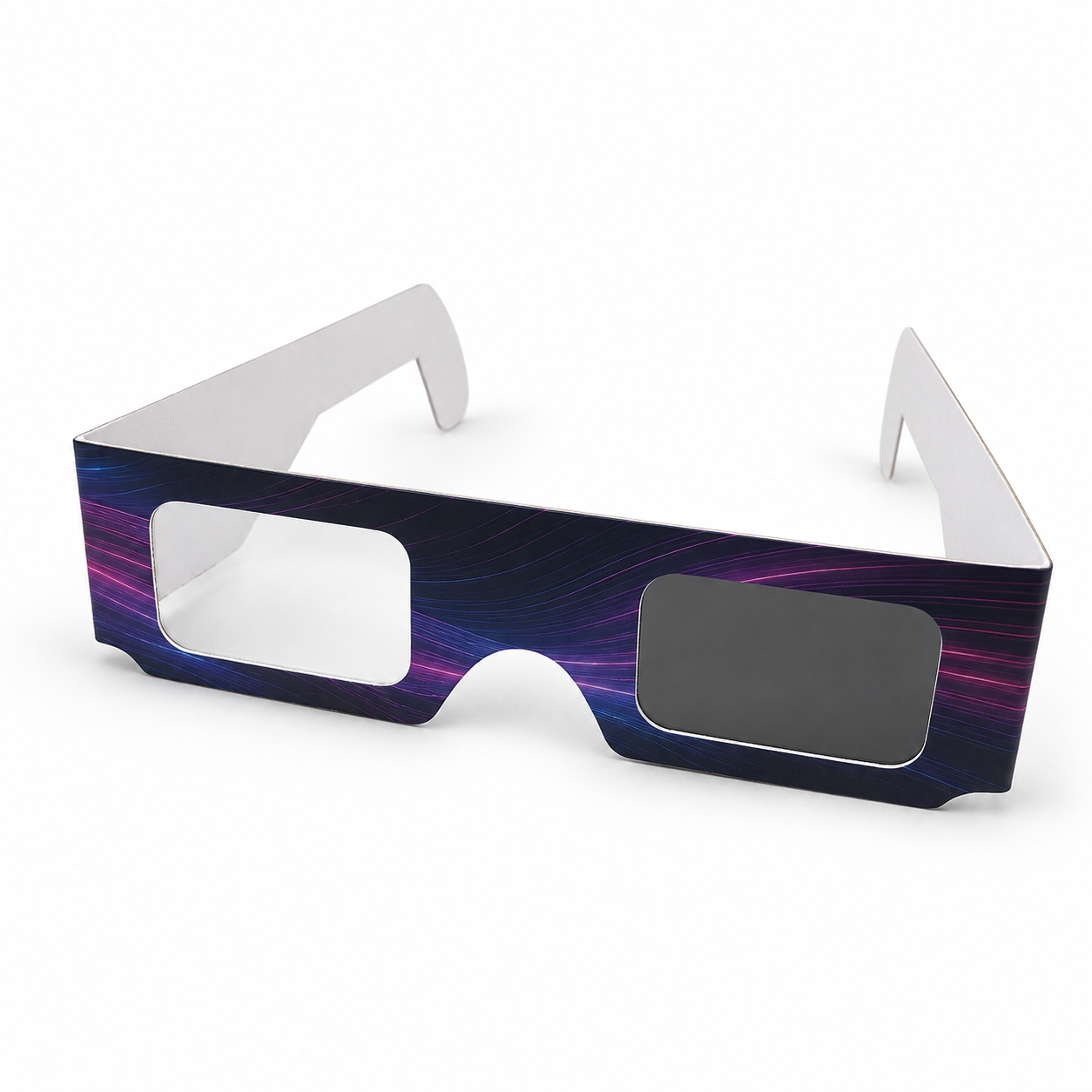
Unlike stereoscopy requiring a separate stereoscope or glasses, the finished insert contained both the image and the necessary optical screen. This allowed the effect to be made available without providing the reader with an additional viewer. From the publisher’s perspective, however, this meant that photography, composite image preparation, printing, and the lenticular layer had to be combined into a single product suitable for binding into a magazine.
The concept of a lenticular image itself should not be equated with its mass implementation. Developing the optical technique was only one stage. Xograph had to be adapted to industrial realities: thin materials, the printing of large numbers of consistent copies, and the deadlines governing magazine production.
Edison as the Subject of the First Insert
The February 25, 1964, issue of “Look” included a small, black-and-white 3D photograph depicting a bust of Thomas Edison. The figure was surrounded by his inventions. The choice of subject was well suited to the insert’s demonstrative nature: the new method of presenting an image was associated with a person widely identified with inventive activity.
The insert was not treated like an ordinary illustration on a page. It was bound in with perforations that allowed the reader to detach the image from the magazine and keep it. This detail shows that the project involved more than merely creating a three-dimensional effect. Decisions also had to be made about how the unusual element would be incorporated into the publication and how the recipient would use it.
The perforations gave the Xograph a dual character. It was part of an issue of “Look,” but at the same time it was a separate object intended to be removed. This can be interpreted as an attempt to reconcile mass distribution with a collector-oriented mode of reception. However, this is a conclusion drawn from the insert’s construction, not a declaration by its creators preserved in the supplied materials.
Eight Million as a Production Challenge
According to the history published by Vari-Vue, eight million copies were produced for the February 25 issue. In the context of lenticular printing, this figure is more important than the size of the individual image itself. Each copy had to be suitable for integration into the magazine and pass through a process designed for a very large print run.
A study devoted to the history of lenticular photography links the development of Xograph to joint work by Eastman Kodak and Cowles Magazines and Broadcasting. Cowles was involved in magazine publishing, while the collaboration addressed issues at the intersection of imaging, materials, and publishing production.
The work focused on three areas:
- preparing thin lenticular screens suitable for this form of publication,
- printing composite images, including color versions,
- adapting the entire process to magazine production deadlines.
This list helps explain why the early history of commercial lenticular printing cannot be told solely as a history of advances in optics. Even a properly functioning image did not automatically become a magazine product. It had to be sufficiently thin, capable of being manufactured in vast quantities, and ready within the timeframe set by the publishing cycle.
From Black and White to Color
The second Xograph appeared in “Look” on April 7, 1964. Unlike the Edison insert, it was in color and depicted a model promoting Eastman’s Kodel fiber. The two publications were therefore separated by only a few weeks, but differed in subject matter and method of reproduction.
The first project was a historical and technical presentation associated with Edison. The second combined a lenticular image with the promotion of a commercial material. The sequence of these two publications can be read as a transition from demonstrating Xograph’s capabilities to using it in advertising communication. This does not mean that it was the first lenticular advertisement in history—the supplied sources do not support such a broad claim. It does, however, show that within the same magazine, the technology quickly found more than one application.
Color also posed a separate production challenge. Materials concerning the Kodak–Cowles collaboration list the printing of composite color images as one of the areas of work. The April insert was therefore not only a change of subject but also another stage in the practical use of the process.
The Magazine as Part of the Imaging System
The case of “Look” shows that the medium was not a neutral addition to the image. The insert had to work with the magazine’s binding, while the perforations allowed it to be separated from the rest of the issue. At the same time, its production was subject to a publishing schedule that could not be subordinated solely to the needs of an optical experiment.
From a technical perspective, the project therefore formed a larger system. It included preparing the photographs, processing the material into a composite image, producing a thin lenticular screen, printing, joining the layers, and incorporating the finished element into the magazine. The source package does not provide detailed parameters for these stages, so the exact production configuration cannot be reliably reconstructed. It can, however, be stated that the Kodak–Cowles work concerned both the image itself and its compatibility with the industrial pace of magazine publishing.
In this sense, Xograph was more than an attractive illustration. It was a test of coordination between several fields that all had to work simultaneously. The three-dimensional effect was the part of the venture visible to the reader, but the ability to deliver it to millions of recipients depended on the materials and organizational infrastructure behind it.
What Happened After the Two Issues of “Look”?
The history of the process did not end with the two inserts from 1964. The Jonathan Ross Holography Collection indicates that after the projects for “Look,” Xograph was used to produce a series of prints for “Venture” magazine and subsequently for the “Illustrated London News.”
This continuation is significant because it distinguishes a one-off demonstration from a process that found additional publishers. The supplied materials do not state the number of copies in these later series or their production parameters, so it should not be assumed that they matched the scale of eight million copies achieved by the first insert. Nevertheless, the continued use of the format confirms that Xograph did not remain merely an addition to two issues of “Look.”
The transition between magazine titles also indicates that the solution developed could be applied beyond the original project. This does not prove that the process was fully standardized, but it does demonstrate its ability to function in more than one publishing environment.
Why Does 1964 Remain Important?
The significance of the publications in “Look” does not lie in the idea that the lenticular image was suddenly invented in 1964. The source materials support a more cautious yet more interesting statement: this was an early and clearly documented case of the mass distribution of an autostereoscopic print with a popular magazine.
The first insert combined a black-and-white 3D image, a thin lenticular screen, detachable binding, and a print run measured in millions. The second demonstrated the use of color and a promotional application. Later projects for “Venture” and the “Illustrated London News” extended the presence of the process beyond the original publication.
From the perspective of the history of technology, the most important lesson is therefore this: the success of a three-dimensional image depends not only on the quality of the optical effect. Materials, reproduction, repeatability, binding, and timely product delivery are equally important. Xograph in “Look” became a significant episode precisely because all these elements had to be reconciled on a scale previously associated with ordinary magazine printing rather than with an unusual 3D insert.
Summary
The February 25, 1964, issue of “Look” contained a black-and-white Xograph depicting Thomas Edison and was produced in a run of eight million copies. The insert could be removed thanks to its perforations. On April 7, the magazine published a color version featuring a model promoting Kodel fiber.
Behind these images was the work of Eastman Kodak and Cowles Magazines and Broadcasting on thin lenticular screens, composite image printing, and adapting production to magazine deadlines. Later series for “Venture” and the “Illustrated London News” showed that the process had further applications. The history of Xograph is a reminder that the commercialization of stereoscopy begins where an optical solution can meet the demands of real-world production and distribution.