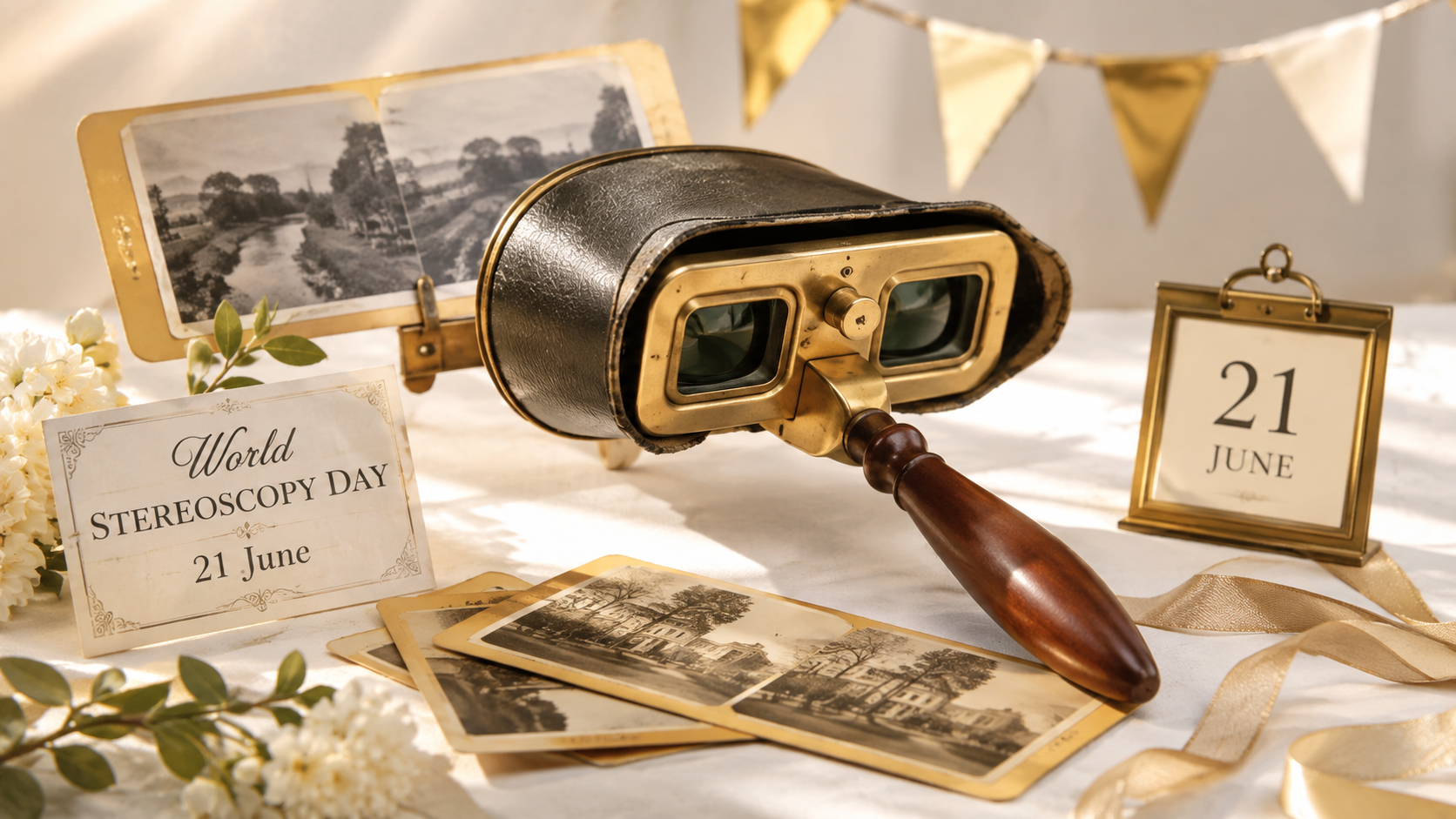
World Stereoscopy Day, celebrated on 21 June 2026, was not built around one location or a single main event. Its programme included events in Brazil, Austria, Spain, and the United Kingdom, as well as online activity. This arrangement offers a broader perspective on the celebrations: as a distributed network of initiatives combining the history of stereoscopic imaging, presentations of collections, lectures, and local meetings.
The significance of this programme does not stem solely from the number of points on the map. More important is the diversity of ways in which stereoscopy is presented. Historical images can reach audiences through an outdoor exhibition, research can be presented during an open online meeting, and a local initiative can become part of an international calendar. The common denominator remains the 3D image, but the routes through which it reaches audiences are clearly different.
A Date Referring to the History of Stereoscopy
The celebrations take place every year on 21 June. An independent account prepared for the 2026 edition links the choice of this date to Charles Wheatstone’s presentation before the Royal Society in 1838. This historical reference gives the event a clear point of orientation, although the contemporary programme is not limited to commemorating the beginnings of stereoscopy.
A fact confirmed by the programme is the date of the 2026 celebrations and their international and hybrid nature. An interpretation, however, is to view the entire undertaking as a bridge between the history of the medium and its present-day circulation. This conclusion follows from the combination of events: alongside presentations of archival materials, there were online meetings and activities organised in several countries.
In this case, the historical anniversary is useful for more than symbolic reasons. It provides a shared date for institutions, authors, and stereoscopy enthusiasts working in different locations. They do not have to prepare identical events or conform to a single format. They can use their own collections, specialisations, and local conditions while maintaining a connection with the broader programme.
A Programme Without a Single Centre
The official list of events included activities in Brazil, Austria, Spain, and the United Kingdom, as well as online offerings. This does not mean a single festival moving between countries. It is more accurate to speak of a shared programme framework encompassing initiatives of different scales and presentation methods.
For a field such as stereoscopy, this has practical significance. Communities interested in it do not need to be located in one city or centred exclusively around a major institution. The 2026 programme demonstrates a model in which a local event retains its own identity while becoming part of an international celebration.
However, the calendar alone should not be used to draw overly far-reaching conclusions about the size of the community or the number of participants. The information provided contains no attendance data or comparisons with previous editions. The geographical distribution of the programme and the presence of different formats can be confirmed, but their quantitative reach cannot be assessed on this basis.
The Archive Enters the Public Space
One clearly described item in the programme was an outdoor presentation by the Brian May Archive of Stereoscopy entitled Diableries: Stereoscopic Adventures in Hell. It formed part of the Festival La Gacilly-Baden programme, and the exhibition was scheduled to run until 11 October 2026.
This example is important for two reasons. First, it introduces materials associated with a stereoscopic archive into the celebrations. Second, it does not confine them to the format of a single meeting taking place specifically on 21 June. The presentation within the festival has a much longer schedule, allowing it to remain accessible after Stereoscopy Day itself has ended.
Confirmed facts include the title of the presentation, its connection to the Brian May Archive of Stereoscopy, its outdoor format, its place in the festival programme, and the exhibition’s closing date. An editorial interpretation is to regard it as an example of activating a collection, meaning the transfer of archival materials into a public cultural programme.
The outdoor format changes the context in which it is received. Stereoscopy is presented not only to people who had previously sought out a specialist lecture or a website devoted to 3D photography, but also to the festival audience. Based on the available data, it is not possible to describe the technical method used to present the images or the equipment required to view them. It can, however, be stated that archival stereoscopic subject matter was incorporated into a longer-running public exhibition.
The Internet as a Shared Meeting Space
Another clear element of the celebrations was the free online presentations announced by The Stereoscopy Blog. These included a meeting with Denis Pellerin devoted to Furne and Tournier, scheduled for 20 June, the day before the main date of the celebrations.
Online activity was therefore not merely an informational supplement to in-person events. It was one of the programme formats. Free access removes the barrier of purchasing a ticket, while the online format allows people to participate without travelling to one of the countries listed in the calendar. These are features of the organisation itself; however, the available materials do not specify the number or locations of the audience.
The meeting devoted to a specific historical subject also shows that a shared celebration does not have to consist solely of general introductory presentations about stereoscopy. It can include a specialist topic aimed at people interested in researching authors, collections, and the history of stereoscopic photography.
The information provided does not confirm that the presentations were recorded and made available for later viewing. Recordings should therefore not be presented as a lasting outcome of the celebrations. The published announcements and programme listing do, however, have lasting documentary value: they preserve information about the subjects, participants, and forms of activity, even if they do not replace the presentations themselves.
What Does the Programme Say About the Contemporary Popularisation of 3D?
Three complementary ways of popularising stereoscopy emerge from the programme of the 2026 edition.
- Interpreting heritage — historical materials and figures become the subjects of presentations, exhibitions, and lectures.
- Providing access beyond a narrow circle of specialists — this is supported by the public festival exhibition and the free online format.
- Connecting local initiatives — a shared calendar brings together events taking place in several countries and online.
This is a synthesis of confirmed elements of the programme, not a declaration by its organisers. The listing shows that an anniversary can be used simultaneously to recall history, present specialist knowledge, and increase the visibility of local initiatives. There is no need to reduce all activities to a single type of event.
The distribution of the celebrations over time is also noteworthy. The lecture was scheduled for 20 June, the main date was 21 June, while the exhibition in Baden was to remain accessible until 11 October. World Stereoscopy Day therefore functions as a focal point for attention, but some of the related activities extend beyond a single day.
Materials That Remain Useful After the Celebrations
A temporary event can leave behind several types of useful records. In the case of the 2026 edition, the most certain of these is the official programme listing. For audiences, it provides a map of institutions, subjects, and formats connected with the contemporary dissemination of stereoscopy. For a visual culture researcher, it may serve as a document showing how a historical medium now functions simultaneously in an archive, at a festival, and in online communication.
A second element with extended usefulness is the exhibition scheduled to run until October. It does not end with the anniversary date, giving audiences more time to encounter the presented material. The third is the webpages announcing the lectures. Even without confirmed recordings, they indicate specific directions for further exploration, such as the work of Furne and Tournier or the Diableries collection.
It is worth maintaining the distinction here between documentation and access to the full content. A description of an event is not equivalent to viewing the exhibition, and an announcement does not replace a lecture. Even so, an organised programme helps people find names, titles, and institutions that can lead to further learning.
A Community Built Through Different Formats
World Stereoscopy Day 2026 presents the community not as a uniform organisation, but as a network of people and institutions using different methods to present 3D images. Some work with collections and historical subjects, while others prepare public exhibitions or online lectures. A shared date allows these activities to become part of a broader narrative.
The most important confirmed picture of this edition remains its distributed nature: several countries, online activity, events before and after 21 June, and the combination of an exhibition with specialist presentations. We do not have data that would allow the programme’s effects to be measured, but its structure clearly illustrates how stereoscopy can be popularised today without making the entire initiative dependent on a single place and a single day.