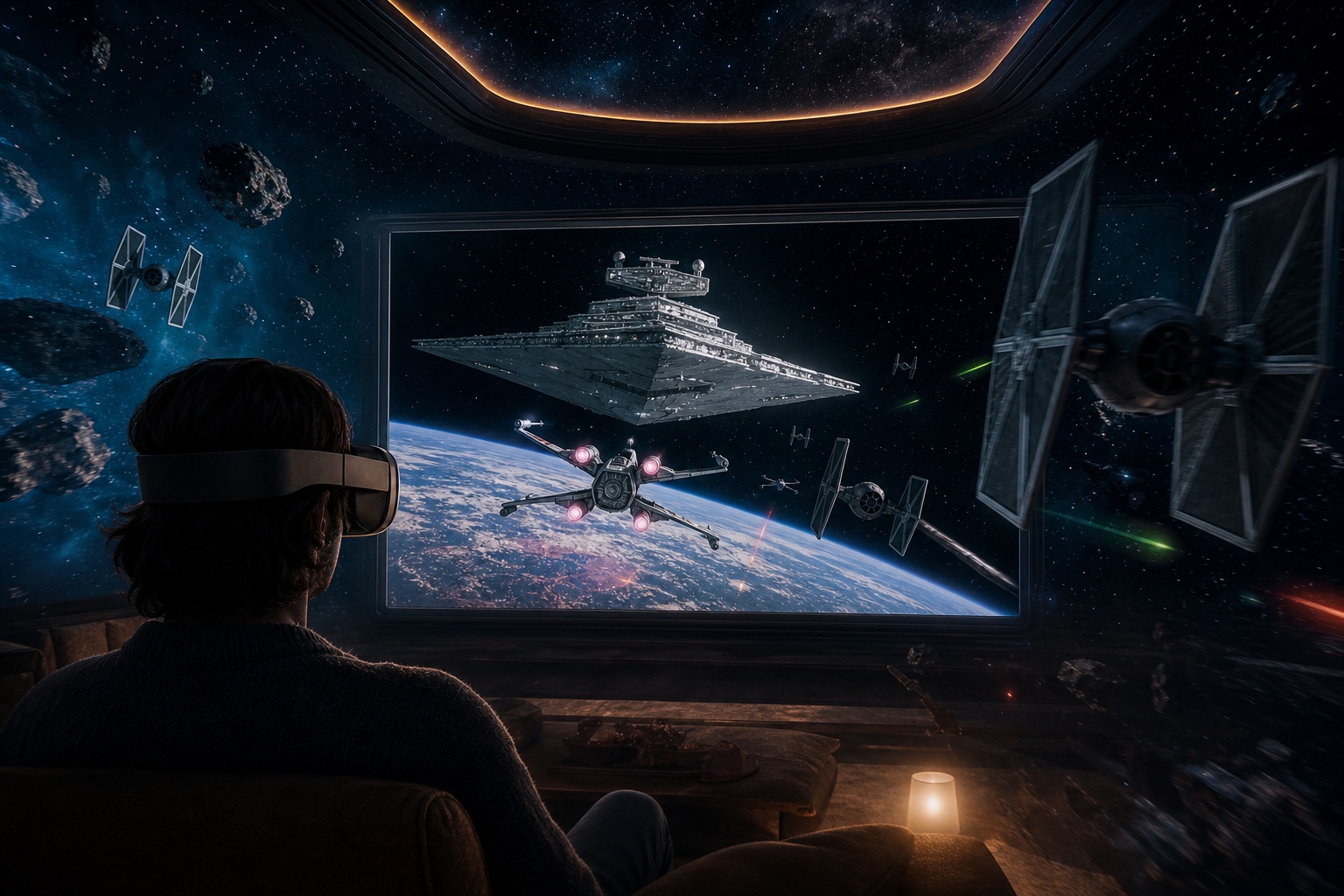
What will happen to cinema when the screen is no longer the only place where the image is presented, while the film itself remains confined within a traditional frame? The VR Enhanced solution announced by Industrial Light & Magic and Meta proposes exactly this arrangement: the viewer watches a familiar film, while selected elements of its scenes extend into the virtual environment beyond its rectangular frame.
Announced on September 23, 2026, the Disney Immersive Cinema by ILM project is set to include, among others, Star Wars: A New Hope and Avengers: Infinity War. The most important information, however, concerns not the titles themselves but the structure of the experience. According to ILM, the main version of the film is to remain unchanged. Spatial additions are to appear alongside the screen rather than replace the original image with a new VR version of the film.
The film remains a film; its surroundings change
Meta describes the planned versions of both productions as VR Enhanced. In this case, the term can be understood as a film enhanced for viewing in virtual reality. This does not automatically mean, however, that the entire production is transformed into a stereoscopic spectacle surrounding the viewer on all sides.
ILM’s description suggests a two-layer model. The first layer is the film itself, presented in its existing form. The second consists of environmental elements appearing beyond the boundaries of the traditional screen. At selected moments, the frame can therefore remain the central focus of the experience while the viewer’s surroundings become its visual extension.
This distinction matters. During a conventional screening, the screen’s rectangle clearly separates the world of the film from the auditorium. In Disney Immersive Cinema, this boundary is not meant to disappear completely, but it may periodically become less distinct. The on-screen image remains the basis of the narrative, while the space around it gains an additional function.
A verified element of the announcement is that the main version of the film will be preserved while selected components of scenes are added outside the image frame. There are no grounds, however, for describing the entire material on this basis as a full 180° or 360° film.
A third path between virtual cinema and immersive film
Conceptually, VR Enhanced occupies a place between two easily recognizable formats. On one side is an ordinary film viewed on a virtual screen. In that case, the VR environment primarily serves as a digital screening room. On the other side are materials recorded from the outset as wide-angle spatial experiences in which viewers are not limited to observing a single rectangular frame.
ILM’s proposal does not fully fit either of these variants. The screen still structures the viewing experience and preserves the film’s original editing, but it is no longer the only surface intended for the image. The VR space can be used selectively, only at moments designed as extensions of a scene.
From an editorial perspective, this is a more interesting distinction than the mere use of a headset. The display device does not determine the language of the medium. The same equipment can show a flat screen placed in a virtual room, a stereoscopic image, or material covering a wide field of view. The nature of the experience is determined by how the image is organized and by the relationship between the frame, space, and viewer.
What the announcement does not confirm
Based on the information provided, it should not be assumed that the entire film itself will gain stereoscopic depth. ILM’s description focuses on preserving the film and extending selected elements beyond the screen. Neither the extent of such interventions nor the rules by which particular moments will be selected have been disclosed.
It is therefore unknown whether the extensions will be present throughout longer sequences or appear only as brief accents. There are also no grounds for describing specific effects or scenes. At this stage, the principle of the format can be analyzed, but not its detailed artistic execution.
Why preserving the original frame matters
The declaration that the main version of the film will remain unchanged suggests a cautious approach to the existing work. Viewers are still to receive the film with its framing and editing intact, while the VR layer operates alongside it. This distinguishes an extension of the surroundings from rebuilding the entire production as a new spatial format.
Such a model may limit the conflict between two needs. The first is to preserve the film’s recognizable form. The second is to use the capabilities of a VR environment, which does not have to end precisely at the edges of the virtual screen. This is, however, an interpretation of the project’s premise rather than a confirmed assessment of the finished result.
Separating the layers may also help viewers maintain their orientation. The narrative continues to unfold within the central frame, while the surroundings play a supplementary role. The success of such a solution will depend on the balance: spatial additions should support the viewing experience if they are to be more than decoration, but they must not distract from information important to the plot. The official announcements do not yet make it possible to assess how ILM has addressed this issue.
Two projects and two different approaches to space
Alongside Disney Immersive Cinema, ILM announced the National Geographic: Beyond project. It is set to use stereoscopic 180° footage recorded in Africa. Comparing the two initiatives clearly shows that “cinema in VR” is not a single, strictly defined format.
In 180° material, space is contained within the recorded image itself. The term “stereoscopic” indicates that the material provides separate views for the left and right eyes, making it possible to create a sense of depth. The 180° value, meanwhile, describes a wide viewing area in front of the viewer. This is a different structure from a traditional film preserved on a screen and supplemented with environmental elements.
Based on the announcement, two ILM strategies can therefore be distinguished:
- extending an existing film — the main version remains unchanged, while selected elements extend beyond the screen frame;
- producing spatial material — a stereoscopic 180° image is part of the project’s fundamental form.
These are not competing names for the same solution. The first strategy builds the experience around a traditional frame, while the second uses material recorded as a wide, stereoscopic image field. Grouping them together under the general label of VR may obscure important technical and narrative differences.
Space as a new layer of staging
The most interesting questions concern not whether the image can appear beyond the screen, but what function it is meant to serve there. An extension can sustain the atmosphere of a scene, signal a change of location, or direct attention. It could also prove too intense and compete with the main frame. The announcement does not determine which path the creators will choose, but the very structure of the format requires them to make such decisions.
Traditional film controls the viewer’s gaze through frame composition and editing. In an environment surrounding the screen, some of that control may be weakened because viewers can also look to the sides. If important plot elements remain within the unchanged film, the environmental layer should be designed so that it does not introduce a competing center of attention. This is a conclusion arising from the announced division between film and surroundings, not a description of finished scenes.
The format also raises questions about rhythm. Constantly filling the space with additions could quickly make them less noticeable. Using them only at selected moments, on the other hand, makes it possible to treat movement beyond the screen as a staging device. ILM emphasizes this selectivity in the project’s general description, but without revealing the frequency or scale of the extensions.
Is this still 3D cinema?
It is safest to describe it as a hybrid of screen-based cinema and a VR experience. Simply placing a film in a virtual space does not prove that it has become a stereoscopic 3D production. In this project, the spatial character may result primarily from the relationship between the virtual screen and the elements surrounding it.
For viewers, the effect may be clearly spatial even though the main film retains its existing form. It is therefore worth distinguishing three issues: presence in a VR environment, stereoscopy of the main image, and the extent of the image surrounding the viewer. They are not synonymous and do not have to occur simultaneously.
The comparison with National Geographic: Beyond further reinforces this distinction. Its description explicitly mentions stereoscopy and 180° recording. In the case of the VR Enhanced films, however, the official announcement emphasizes that the film remains unchanged and that extensions appear beyond the screen.
What Disney Immersive Cinema is actually announcing
The ILM and Meta project does not herald the abandonment of the screen. On the contrary, it preserves it as the primary place where the narrative unfolds, while taking away its monopoly over the entire image of the experience. It is more of a layer surrounding the cinema experience than a complete transformation of the film into a 180° or 360° spectacle.
The ultimate value of VR Enhanced will depend on its execution, which cannot be assessed from the announcement alone. Even now, however, the project demonstrates a useful direction for thinking about older and existing films in VR: not every work has to be rebuilt from scratch for the space around the screen to become part of the viewing experience.
Key conclusion: Disney Immersive Cinema by ILM should be regarded as an announced format for extending selected moments of a film into the virtual environment. It does not confirm a full conversion of entire productions into stereoscopic immersive films. The parallel National Geographic: Beyond project represents a different category—stereoscopic material recorded in a 180° format.