The history of popular stereoscopy has not always survived in the form of complete manufacturers’ archives. It often has to be reconstructed from objects held in collections: viewers, packaging, sets of views and catalogue markings. In this research model, public reference lists that combine information from many scattered examples take on particular importance.
One example is the list of Vistascreen sets published by British Vintage Stereoscopy. As of 19 August 2026, it contained 335 entries. However, its authors describe it as an incomplete list of identified views. This is an important caveat: the figure of 335 describes the current state of documentation, not the confirmed size of the entire series.
What exactly does the Vistascreen list document?
In this case, the basic catalogue unit is a set of views, referred to in English as a view pack. The figure of 335 should therefore not automatically be interpreted as the number of individual photographs. The published list organises identified Vistascreen packs as separate reference entries.
This distinction matters to both collectors and historians. An individual photograph, a complete set of photographs and a commercial set with its own designation are not the same type of object. A catalogue of sets makes it possible to study how subjects were grouped and the range was organised, although it does not in itself answer every question about the contents of each pack.
The publication confirms the existence of 335 entries on the stated update date. Treating this figure as the final number of all sets issued would, however, be an interpretation. The declaration that the list is incomplete does not allow such a conclusion.
A “living catalogue” rather than a closed bibliography
A list developed by collectors differs in nature from a closed catalogue compiled from a complete archive. Its contents may change as further examples are identified, markings are compared and missing information is added. The update date is therefore part of the data, not merely a technical addition.
The term living catalogue aptly describes this way of working, but it does not automatically imply completeness or freedom from errors. Rather, it means that the list presents the current state of identification and may be corrected. Users should always record not only the number of entries, but also the date on which that figure was current.
British Vintage Stereoscopy began operating on International Stereoscopy Day, as recorded in the Stereoscopy Day 2026 programme. The launch date of the website does not, of course, determine the completeness of the collected material. It does, however, show that the project was consciously situated within the community concerned with the history of stereoscopic imaging.
Subjects recorded in the sets
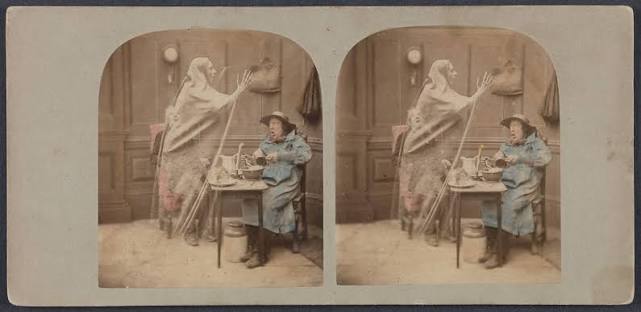
The scope of the list indicates that Vistascreen was not limited to a single type of image. The identified packs include, among other subjects, places, transport, animals, sport, religious themes, theatre and holiday resorts. Even at this level, the catalogue can serve as a map of the subjects represented in British popular stereoscopy.
This diversity is significant because it shifts attention beyond the most obvious association of stereoscopy with landscapes and sightseeing. Views of places are only one of several groups. The presence of transport, sport and theatre shows that three-dimensional images could be used to present very different areas of life and culture.
From the list alone, it can be established that the categories mentioned are represented. Without further analysis, however, it is not possible to determine which category predominated, how the proportions of subjects changed or which audiences the individual packs targeted. Such conclusions would require the consistent classification of all entries.
What can be studied once the subjects have been organised?
The catalogue provides a starting point for quantitative analysis, but does not replace it. A researcher can prepare a controlled vocabulary of categories and then assign individual entries to them. In doing so, it is necessary to decide whether a single set may belong to several groups. Material concerning a sporting event in a particular place may be associated with both sport and geography.
Only after such rules have been established can the sizes of the categories be compared cautiously. Without an explicit methodology, it is easy to mistake an intuitive impression for the result of analysis. The list provides the source data, but interpreting its thematic structure remains a separate stage of the work.
Numbering as a tool and a trap
Catalogue designations are particularly useful when identifying objects. They make it possible to distinguish sets with similar titles, compare examples from different collections and notice places for which a corresponding pack has not yet been found. A number, however, is only as strong as the reliability of the object or record from which it was read.
Gaps in the numbering require caution. An empty place should not automatically be called a “lost set.” It may represent an entry that has not yet been identified, an unused number, an earlier reading error or an element of a system whose rules have not yet been established. The material provided confirms the incomplete nature of the list, but does not determine the reasons for individual gaps.
Likewise, the proximity of numbers does not in itself necessarily prove a shared date, production run or publication sequence. Such a relationship would need to be confirmed by other information. Numbering is an excellent organising key, but it becomes a historical source only after critical analysis.
Documented, missing and unverified entries
To make a collectors’ catalogue clear, it is helpful to distinguish between three states of knowledge. They are not equivalent and should not be combined into a single figure without comment.
- A documented entry is a set identified from an available example or sufficiently unambiguous documentation. The published figure of 335 refers specifically to identified entries.
- A missing entry denotes a place where a researcher expects data but does not yet have a confirmed set. The absence itself does not prove that the pack in question was actually circulated.
- An entry requiring verification is based on information that cannot yet be regarded as conclusive. It may require comparison of markings, the title or other available evidence.
This distinction is a methodological proposal, not a claim that the Vistascreen list applies precisely these three labels to every entry. It does, however, help readers interpret its declared status correctly. “Incomplete” does not mean “unreliable”; it means that the boundaries of the identified material remain open and should be visible to the reader.
How can the catalogue be used in practice?
A collector can use the list primarily to identify and compare sets in their collection. The safest procedure is to record the designation, title and subject category exactly as they appear on the object under examination, and only then compare them with the list. This reduces the risk of matching an example to an expected entry based solely on similarity.
In research, it is worth following several simple principles:
- record the access date or version of the list, as it may continue to be developed;
- separate information read from the object from data taken from the catalogue;
- do not treat a gap in the numbering as evidence that an unknown edition existed;
- record uncertainty rather than filling in missing data with conjecture;
- apply consistent classification criteria when analysing subjects.
It would also be useful to record discrepancies between an example and its entry. In a living catalogue, a correction is not a failure of the project, but a natural result of better data becoming available. Entries known from incomplete information require particular attention, because repeating an unverified description in subsequent lists may create the appearance of independent confirmation.
Significance for the history of British stereoscopy
The list’s greatest value is not the figure itself, impressive though it may seem at first glance. Far more important is the collection of 335 identified entries in one place and the clear acknowledgement that the work is still in progress. This allows scattered collectors’ items to be considered as parts of a larger collection.
For research into post-war British stereoscopy, the catalogue can serve several functions: as an identification index, a map of subjects, a tool for comparing numbering and a record of areas requiring further investigation. It does not, however, replace analysis of the sets themselves or other historical materials. Nor should it be used to formulate precise chronological conclusions unless they are supported by additional data.
The value of such initiatives increases when their authors explicitly distinguish between facts, assumptions and gaps. Collectors give researchers access to examples that are not always held by a single institution. A public catalogue makes it possible to compare them, but it requires the same critical approach appropriate to any source developed in stages.
An open record of the state of knowledge
The Vistascreen list documenting 335 identified sets is above all a snapshot of the state of knowledge as of 19 August 2026. It shows a broad range of subjects—from places and transport to animals, sport, religion, theatre and leisure—while honestly remaining an incomplete list.
It is precisely the combination of a specific index with explicit information about its limitations that makes it a useful tool. Researchers receive not a finished, closed history of Vistascreen, but an organised starting point. Further discoveries may fill gaps, challenge earlier attributions or clarify the structure of the series. In the history of stereoscopy, this capacity for correction is an advantage—provided that every certainty and every doubt is clearly marked.