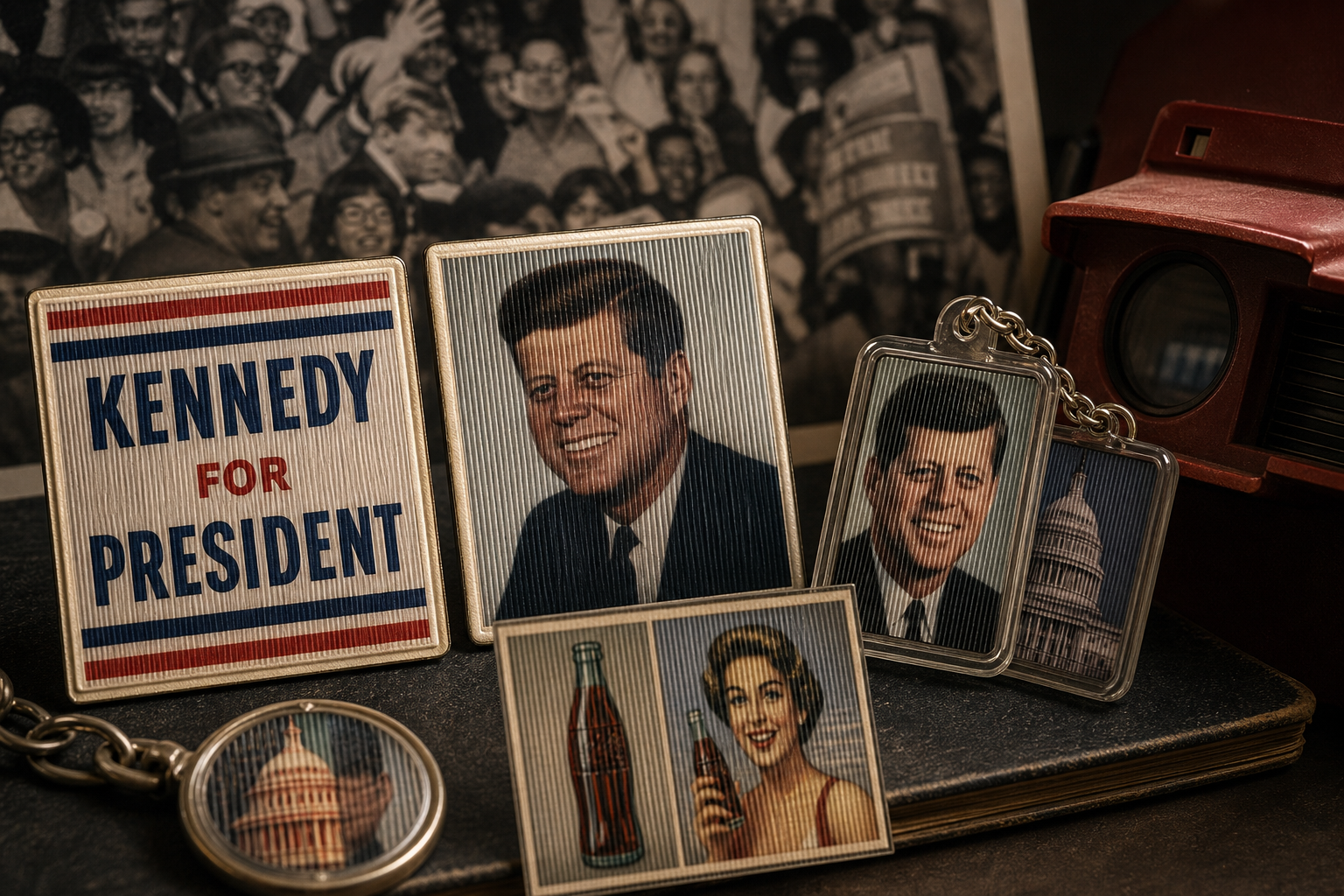
Popular “flicker pictures” are associated primarily with small gifts and toys. Surviving Vari-Vue objects, however, reveal a much broader range of applications. Images that changed when tilted appeared on campaign buttons, keychains, and miniature advertisements. The moving effect was therefore not merely decorative: it made it possible to place two successive messages on a small surface and engaged the viewer through a simple hand gesture.
Smithsonian catalog materials document specific examples of such objects from the 1960s. They are complemented by a later account of Vari-Vue’s activities published by the “Los Angeles Times,” according to which the company was particularly well known for political buttons and toys included with Cracker Jack, but also produced other formats—from decoder rings to billboard-sized displays. Together, these sources allow Vari-Vue to be viewed not only through the lens of nostalgia, but also as a manufacturer of unconventional information media.
An Image Activated by the Viewer
In the lenticular objects described, the change in the visible motif depends on the viewing angle. When the viewer tilts a button or moves a keychain, one design gives way to another. From the user’s perspective, this is a very simple interaction: it requires no power source, mechanical switch, or additional viewer. The movement of the object itself in relation to the eyes becomes the interface.
Museum documentation confirms the results of this action, but does not contain a complete description of the machinery or industrial process used to manufacture the objects discussed. It should therefore not be used as a basis for reconstructing the details of Vari-Vue’s production. It does, however, clearly demonstrate the communication principle: a small object shows more than one visual state, and the transition between them occurs through a change in viewing angle.
This distinguishes such an object from ordinary printing. A traditional button conveys the entire message at once. A lenticular version divides it into successive views. The first may arouse curiosity, while the second clarifies the meaning or presents another person. The “flicker” effect is therefore not merely a property of the image. It arises from the relationship between the graphic design, the object, the movement of the hand, and the viewer’s position.
Kennedy’s Campaign in Two Views
The Smithsonian holds a lenticular John F. Kennedy campaign button from 1960, made by Vari-Vue. When the object’s position changes, the visible design switches between the campaign slogan and the candidate’s portrait. Two fundamental components of political identity—text and portrait—were thus combined on one small surface.
This arrangement can be interpreted as a concise sequence. The viewer does not have to choose between reading the slogan and looking at the face—both elements are provided, though not necessarily at the same moment. The viewer discovers the second view by tilting the button. The museum description confirms the change in design; interpreting it as a way of gradually revealing the message is an inference based on the object’s construction.
A John F. Kennedy keychain cataloged by the Smithsonian also dates from the same period and was likewise made by Vari-Vue in Mount Vernon, New York. Its image switches between two designs as the object is moved. The use of the same idea in a keychain shows that the changing image was not limited to a button pinned to clothing.
The difference in format had practical significance. A campaign button is intended for display, whereas a keychain is a functional object that naturally moves in the hand. A feature requiring a change of angle could therefore reveal itself during ordinary use of the object. This is an observation about how the object is experienced, not confirmed information about the designers’ intentions.
Johnson and Humphrey: Portraits as a Short Sequence
Another documented example comes from the 1964 campaign. On the Johnson–Humphrey button, the lenticular portraits change when tilted. The back of the object bears the markings “Vari-Vue” and Pictorial Productions, Inc. of Mount Vernon, New York.
In this case, the changing image is used not for a transition between text and photograph, but to present two people. The small button does not have to divide its limited surface between two static portraits. Instead, it shows them in succession, depending on its position relative to the viewer. Movement functions as visual editing: one image replaces the other without a screen or conventional film animation.
Caution should be exercised when interpreting the inscriptions on the back. The documentation confirms that the names Vari-Vue and Pictorial Productions, Inc. appear on the object. It does not, however, provide sufficient grounds for describing the organizational relationship between these names in detail. What is certain is the location indicated on the back, the presence of both names, and the way the portraits change.
From Campaign Souvenir to Consumer Advertising
Politics was only one application of the format. The Smithsonian also catalogs a small Alka-Seltzer advertisement from the 1960s, described as a Vari-Vue “flicker ad.” The object confirms the use of a changing image in consumer communication. The same type of optical appeal that helped a campaign button stand out could be used to draw attention to a brand.
A miniature lenticular advertisement differs from an ordinary leaflet in the way viewers interact with it. To see the change, they must move the medium or look at it from a different angle. The message therefore does not end with the passive viewing of a graphic. The object encourages viewers to see what happens when it is tilted, thereby turning a brief exposure into a small visual experience.
This does not automatically mean that such a format was more effective than every static print. The available materials do not present audience research results or campaign-effectiveness data. It can, however, be stated that the Alka-Seltzer advertisement demonstrates commercial use of the effect, while the political souvenirs show its persuasive application. In both cases, the image change was part of the message rather than a separate technical demonstration.
One Concept, Many Formats
According to the “Los Angeles Times” article, Vari-Vue was particularly associated with political buttons and toys included with Cracker Jack. Its product range was said to include objects ranging from decoder rings to billboard-scale displays. This information indicates the considerable flexibility of the changing image: from an object held between the fingers to a message intended to be viewed from a greater distance.
Not all of the formats mentioned are described in detail in the museum records used for this analysis. The most that can therefore be said concerns the surviving buttons, keychain, and advertisement. These are the objects that show how a common idea was adapted to different situations:
- the 1960 Kennedy button combined a campaign slogan with the candidate’s portrait;
- the Kennedy keychain from around 1960 transferred two changing designs to an everyday object;
- the 1964 Johnson–Humphrey button switched between portraits of the two politicians;
- the Alka-Seltzer advertisement from the 1960s used the “flicker” format in consumer communication.
This overview reveals an important feature of the technology: it did not impose a single type of content. The successive views could consist of text and a portrait, two portraits, or elements of an advertisement. The means of activation—a change in angle—remained constant, while the function was adapted to the specific medium.
A Micromedium Before the Age of Personal Screens
The documented Vari-Vue products can be regarded as micromedia: small, self-contained objects conveying a brief visual sequence. They were not screens and did not display films, but they organized viewing over time. First one view appeared, followed—after movement—by another. The viewer controlled this change by hand.
The term “micromedium” is an interpretation, not a name found in the museum records. It does, however, help capture the role of objects that occupied a space between print, gadget, and simple optical animation. Their content was brief, but the presentation gave it dynamism. Instead of increasing the surface area, the designer could divide the message among different viewing angles.
The political examples are particularly clear in this respect. A button pinned to clothing declared support, while also demonstrating an optical effect. An advertisement could serve a similar dual function: communicating the name or motif of a product while attracting attention through the image change itself. The technique and the message were closely connected.
What the History of Vari-Vue Actually Documents
The surviving objects do not make it possible to reconstruct the company’s entire history or the detailed technology of its machinery. They do, however, provide strong material evidence of specific applications. Vari-Vue produced lenticular objects associated with election campaigns, small functional items, and advertising materials. The company’s name appears on objects from Mount Vernon, New York, while examples from the 1960s show several ways of composing a changing message.
The most interesting lesson offered by these objects concerns not the illusion itself, but its function. A “flicker picture” could entertain, but it could also present a candidate, combine a slogan with a portrait, or distinguish a product advertisement. Vari-Vue used a change in viewpoint as a simple narrative mechanism: one small medium, two views, and a viewer who activated the message through their own movement.