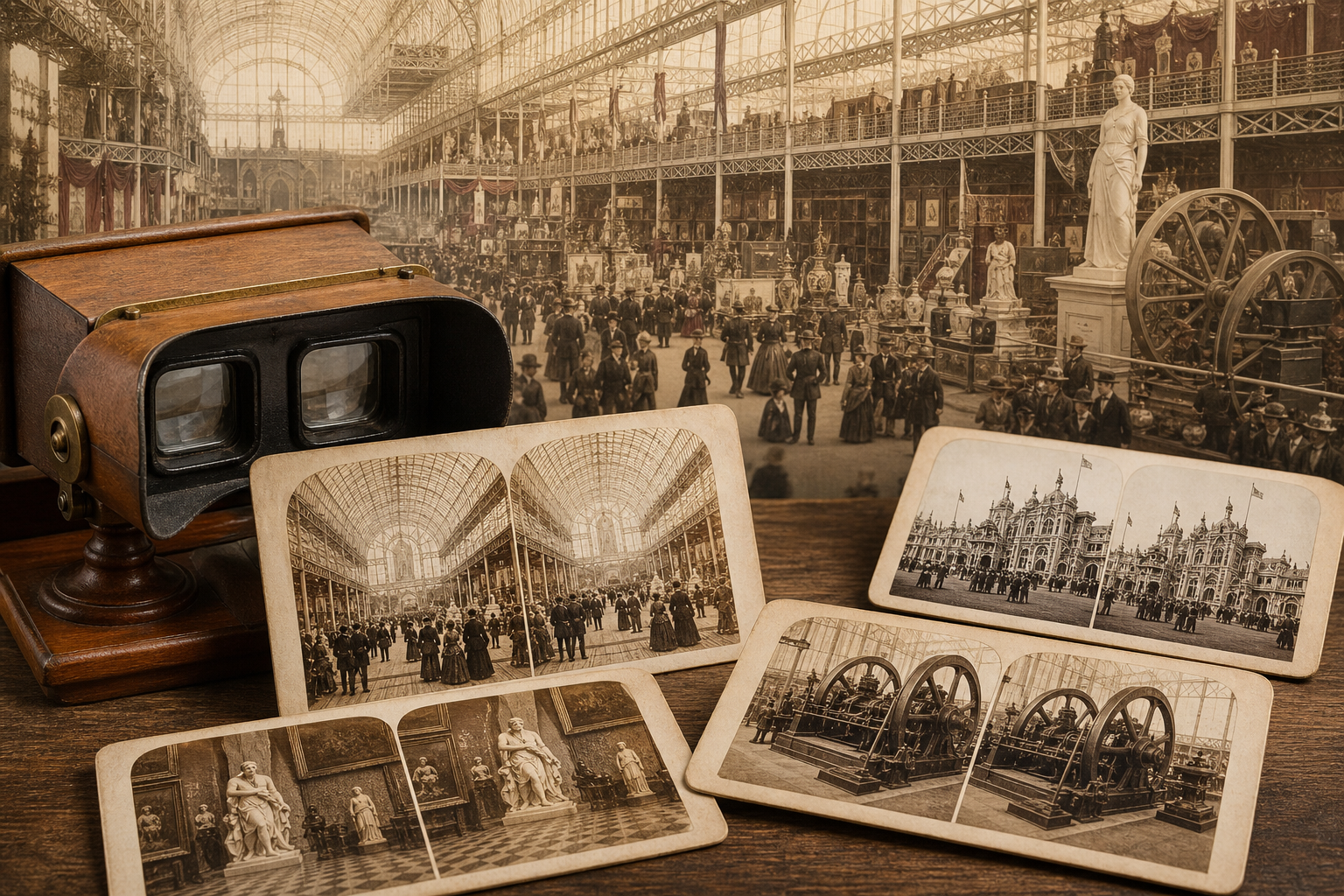
International exhibitions were undertakings based on scale, diversity and the juxtaposition of objects from many fields. Visitors viewed the exhibition architecture, national pavilions, works of art, machinery and handicrafts. After the event ended, this elaborate space disappeared, while its image survived, among other places, in photographs.
In the case of London’s International Exhibition of 1862, stereoscopy occupied a special place. The Library of Congress catalogues a series of stereographs devoted to it as having been published by the London Stereoscopic and Photographic Company, and attributes the photographs to William England. The surviving material allows the exhibition to be viewed not as a single photographic subject, but as a multifaceted documentary theme.
Photography on institutional and market terms
A study available in the Birkbeck repository indicates that the London Stereoscopic and Photographic Company obtained the exclusive right to photograph the exhibition’s exhibits and sell photographs to the public. This is an important fact because it defines both the institutional and commercial position of the company.
In this case, LSC was not merely a later distributor of randomly assembled views. The right to take photographs linked the company directly to the process of documenting the event, while the ability to sell them made photography part of the experience available to the public. The exhibition could first be seen in person, and its visual trace could then be taken home.
A fact confirmed by the Birkbeck study is the company’s exclusive right to photograph the exhibits and sell the photographs. An interpretation, on the other hand, is to view the entire series as the equivalent of a spatial catalogue. The term aptly describes the function of the surviving cards, but does not mean that the series was a formal catalogue of all objects or that it documented the exhibition in its entirety.
William England and a cross-sectional view of the exhibition
The Library of Congress attributes the photographs to William England. This identification is supported by an object record at the Powerhouse Museum, which describes a stereograph of French machinery as a photograph taken by England and published by LSC in 1862. We therefore have both a catalogue of the entire group and a museum description of a specific example.
The range of subjects recorded in the Library of Congress catalogue is broad. The surviving stereographs show, among other things:
- the nave of the exhibition building,
- national pavilions,
- picture galleries,
- machinery,
- sculptures,
- glass and porcelain wares.
This list reveals several levels of documentation. The view of the nave relates to the overall organisation of the space. The pavilions make it possible to identify the division of the exhibition according to national representation. The galleries, sculptures and artistic wares show its aesthetic dimension, while the machinery draws attention to technology and industry.
It is therefore neither exclusively an architectural series nor a collection of close-ups of selected objects. The stereographs move from the overall space to individual sections and objects. This change in viewing scale helps the contemporary viewer understand that the exhibition was at once a vast interior, a system of organised displays and a collection of specific products.
Why stereoscopy suited the exhibition
A stereograph consists of two views intended to be seen as a spatial image. Unlike a single photograph, it enables the viewer to perceive the relationships between different planes more clearly. In the case of an extensive exhibition, it was not only the appearance of the objects that mattered, but also their positions relative to one another, the amount of space they occupied and the way they were arranged in the halls.
This can be seen most easily in the example of the nave. A flat photograph may convey its overall appearance, but a stereoscopic image additionally organises the successive planes: foreground elements, the sequence of displays and the more distant part of the interior. A similar principle applies to rows of machinery, groups of sculptures or display cases containing wares.
This does not mean that a stereograph provides a complete reconstruction of dimensions or replaces an architectural plan. The surviving image remains a selected frame taken from a specific viewpoint. It can, however, provide clearer indications of depth and the relative positions of objects than a single view of the same place.
This is precisely why the series is valuable as a record of the exhibition. It shows not only what was exhibited, but also, to some extent, how the exhibits functioned within the space. This is an interpretation based on the properties of the stereoscopic image and the cross-sectional range of subjects listed in the collection catalogue.
Machinery, art and pavilions in a single medium
The surviving view of French machinery described by the Powerhouse Museum is particularly telling. It brings together three elements of the entire undertaking: the photographer, the publisher and a specific part of the exhibition. William England was responsible for the photograph, LSC for publishing it, and the subject was technology presented at the exhibition.
Stereoscopy may have been well suited to such subjects because machines are three-dimensional objects with elaborate structures. Their outline is not the only important feature in a photograph. Overlapping components, gaps and the relationship between the devices and their exhibition setting also matter. For this reason, a card depicting machinery is more than a simple image of a product: it also documents the way in which the product was presented to the public.
Stereographs of picture galleries and sculptures provide a different kind of information. The former show works arranged within the exhibition space, while the latter concern objects whose perception is strongly connected with three-dimensional form. Views of glass and porcelain, in turn, point to an interest in objects of craftsmanship and artistic production.
The combination of these subjects allows the series to be treated as a record of the exhibition’s diversity. However, the surviving group should not be taken as evidence that every section or all important exhibits were photographed. The Library of Congress catalogue confirms the presence of specific categories of views, but does not provide grounds for claiming that the entire event was documented comprehensively.
Albumen prints and hand colouring
The Library of Congress states that the collection contains albumen stereographs as well as hand-coloured examples. This information is important because it serves as a reminder that nineteenth-century stereoscopic photography was not merely a way of recording a view. Its final form also depended on the production and treatment of the physical card.
The albumen print provided the photographic basis of the image. Hand colouring added colour that did not come directly from the photographic recording. Viewers could therefore encounter both a photographic tonal record and a version supplemented by the work of a colourist.
At the same time, hand-coloured examples should not automatically be regarded as reliable sources of information about the actual colours of all objects. The source materials confirm the presence of hand colouring, but do not describe the principles used to select the colours or the extent to which they matched the appearance of the exhibition. Colour can be analysed as an element of the card’s material form, but its documentary accuracy must be assessed with caution.
The difference between an uncoloured print and a hand-finished one also shows that the series functioned at the intersection of documentation and an attractive visual product. There is no contradiction in this. The same stereograph could preserve information about the exhibition while also being prepared as an object intended for sale and viewing at home.
The image as a souvenir available beyond the exhibition
LSC’s exclusive right covered not only photographing the exhibits, but also selling the photographs to the public. In this way, the visual record of the event entered commercial circulation. The card did not remain solely institutional material; it could reach a private viewer.
This model can be interpreted as extending the reach of the exhibition itself. The physical experience of the enormous exhibition could not be transported beyond London, but selected views of its interiors and collections could be distributed. Stereographs also offered a sense of space that was particularly well suited to subjects such as the nave, pavilions or rows of machinery.
The supplied materials do not reveal how many people bought the series, how the individual cards were distributed or which views attracted the greatest interest. It can, however, be stated that sales to the public were included in the rights granted to the company. The commercial nature of the undertaking is therefore a confirmed element of its history, rather than merely an assumption based on the survival of the cards.
See for yourself: how to read the surviving stereographs
The Library of Congress catalogue and the Powerhouse Museum object record make it possible to conduct a simple analysis without assuming that a single view represents the entire exhibition. It is worth comparing the images on three levels:
- Overall space — in the view of the nave, note the successive planes and the arrangement of the displays extending into the depth of the interior.
- Method of presentation — in stereographs of pavilions, galleries or machinery, observe the relationship between the object and its surrounding arrangement.
- Form of the card — distinguish photographic information from later hand colouring and do not treat the added colours as an automatically accurate record.
Viewing them in this way helps separate three layers: the subject photographed at the exhibition, the spatial manner in which it was presented, and the material treatment of the stereograph intended for the viewer.
A spatial trace of the event
The 1862 series shows how stereoscopic photography could combine the functions of document, souvenir and commodity. The confirmed information forms a coherent picture of the undertaking: LSC had the exclusive right to photograph the exhibits and sell the photographs, William England was the photographer, and the surviving cards encompass a broad selection of subjects—from the nave and pavilions to machinery, art, glass and porcelain.
The most important value of this group lies not merely in the survival of striking views. The stereographs preserve fragments of the exhibition’s organisation and make it possible to analyse the spatial relationships between the exhibits and the places in which they were displayed. They are not a complete reconstruction of the event, but they constitute a multifaceted spatial record of one of the major exhibition undertakings of the Victorian era.