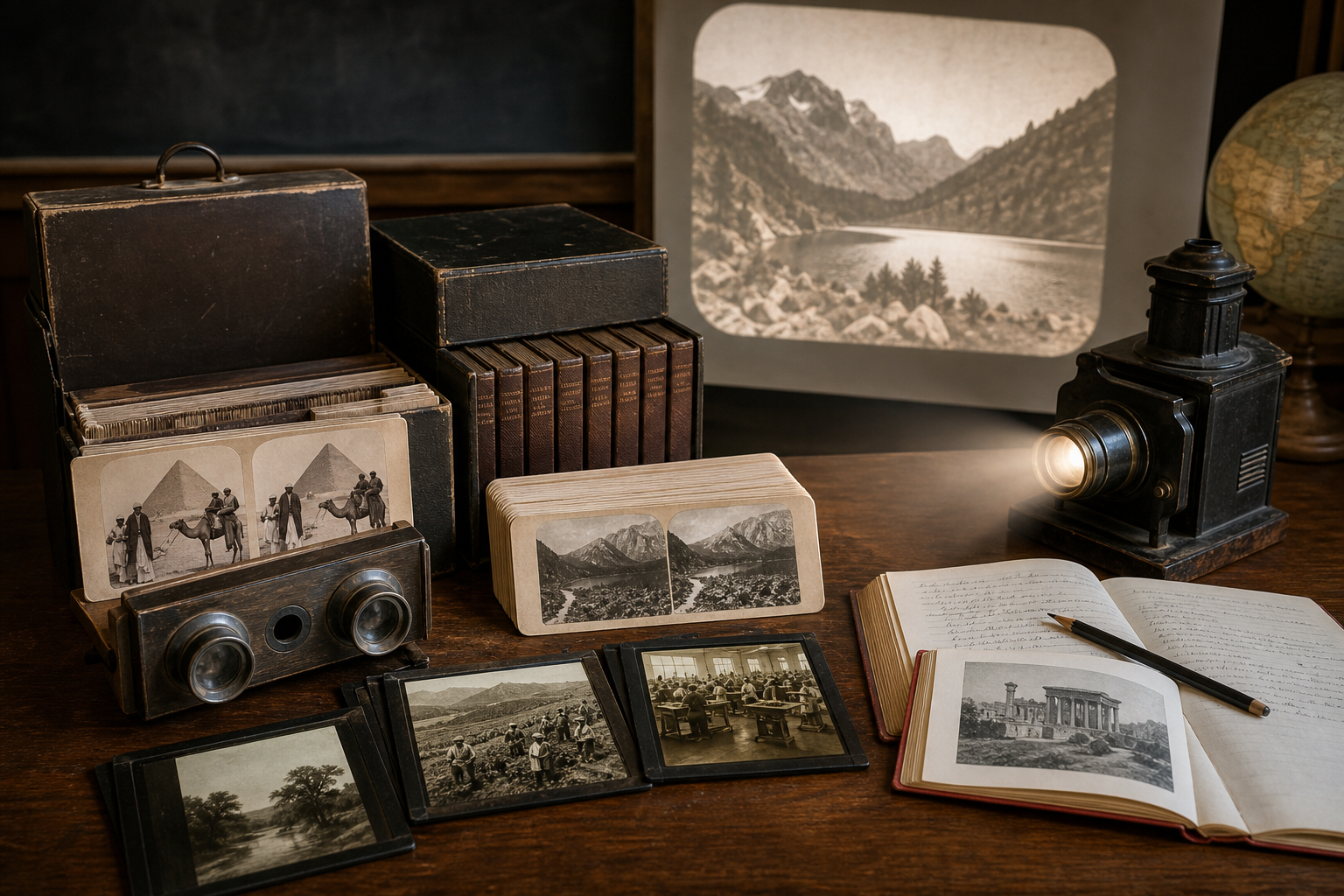
In the early twentieth century, stereoscopy could serve not only as entertainment or a way to discover distant places. The Keystone “600 Set” shows how attempts were made to incorporate three-dimensional images into regular education. The set was not limited to individual cards viewed through a stereoscope. It was accompanied by materials for teachers, and its content was also available in the form of glass slides intended for classroom presentation.
This combination changes how the Keystone project should be assessed. The most important element was not a single stereograph, but the entire system: a large collection of images, their thematic selection, explanations, and the possibility of individual and group work. At the same time, the promise of showing students the world requires critical reading today. An educational image is not a neutral window—it always presents reality from a particular point of view.
600 stereographs as an image of the world
According to a research study associated with the University of Rochester and the George Eastman Museum, the “600 Set” was first introduced in 1906 with an explicitly educational purpose. Each set contained 600 stereographs intended to form a comprehensive image of the world.
The scale of the collection was an important element of its concept. An individual card could depict a selected place, object, or human activity, but only an extensive collection made it possible to organize the material by subject and use it in successive lessons. The number 600 therefore represented more than merely the size of the product. It suggested an ambition to create a broad visual curriculum from which teachers could select content appropriate to the topic under discussion.
It is a fact that the set was intended for educational use and represented a declared attempt to depict the world through 600 stereographs. By contrast, regarding the collection as a kind of visual curriculum remains an interpretation. This reading is nevertheless supported by the surviving guides, boxed thematic sets, and slides intended for classroom use.
Not a collection of cards, but a teaching environment
The Library of Congress provides digital access to a guide published around 1922 under the title Visual education; teachers’ guide to Keystone “600 Set”. The catalog links the publication to visual education, stereoscopic views, and lantern slides. The very fact that a separate guide was prepared for teachers indicates that the images were not intended to function solely as stand-alone curiosities.
In this model, a stereo card was part of a planned classroom situation. The visual material had to be placed within a subject, explained, and used in accordance with an educational objective. The guide helped shift the emphasis from viewing alone to teaching through images. Students were expected not only to see a scene, but also to connect it with the knowledge being conveyed.
At the same time, a three-dimensional image should not be equated with direct experience. A stereograph could enhance the sense of presence, but it still remained a selected and captioned representation. What students saw and how they were expected to understand it were determined by the choice of view, the image’s place within the collection, and the accompanying narrative.
Two ways of working with images
Keystone materials included both stereographs and lantern slides. It is therefore possible to speak of two complementary modes of visual education. Stereo cards were suitable for viewing with a dedicated device, while slides enabled an image to be presented to the entire class.
The surviving archival descriptions do not provide grounds for reconstructing the exact course of every lesson. It is possible, however, to identify the possibilities arising from the system’s design. Teachers had material for group discussion, while stereographs allowed students’ attention to be focused on a specific view. The guide united both formats within a common teaching framework.
This is an important technical and organizational distinction. Projection facilitated simultaneous instruction for a group. Viewing a stereograph was more individual in nature. Keystone therefore offered not merely a new type of illustration, but a set of formats suited to different classroom situations.
What the surviving collections reveal
The description of the San Diego State University archive covers 16 boxed Keystone educational sets dating approximately from 1920 to 1925. They were teaching aids intended for elementary school students. Most of the sets concerned the natural sciences, while two sets associated with the reading curriculum addressed home life and childhood.
This cross-section shows that visual education was not limited to geography or the presentation of distant landscapes. Images were also used to teach the natural sciences and subjects relating to children’s everyday experiences. From the perspective of media history, this expansion is particularly interesting: stereoscopy was intended to support different areas of the elementary school curriculum rather than function as a separate attraction.
Another part of the system is documented by the College of Charleston. Its collection contains 218 glass slides from a version of the “600 Set” prepared for classroom use. Their subjects include industry, agriculture, architecture, history, landscape, and astronomy.
The surviving 218 slides should not automatically be treated as a complete set or as an exact reflection of all the thematic proportions within the “600 Set.” The collection nevertheless confirms the breadth of the material. It combined scientific topics, economic activity, the environment, buildings, and the historical past. This enabled images to serve as a common tool across many lessons.
The promise of visual knowledge
The idea of a comprehensive image of the world fits well with the logic of visual education. Rather than limiting students to textual descriptions, the system provided an extensive set of representations. Stereography added an experience of spatial depth, while slides enabled selected topics to be presented to a group.
This does not mean, however, that images alone guaranteed more complete or more objective knowledge. A collection numbering hundreds of representations was still the result of selection. Someone decided which places, kinds of work, achievements, landscapes, and scenes from life deserved inclusion in the curriculum. Equally important was the meaning assigned to them by the educational texts.
In this sense, the “600 Set” can be analyzed on two levels. The first concerns technology and lesson organization: stereographs, projection, boxed sets, and the guide. The second encompasses the construction of knowledge: the way in which a limited number of images was intended to represent a complex world.
A critical reading of cultural representation
The study by the University of Rochester and the George Eastman Museum indicates that Keystone’s educational sets also perpetuated problematic ideas. The source material provided does not allow specific examples of descriptions to be quoted with confidence or particular claims to be attributed to individual cards. It does, however, justify a critical analysis of how cultures and societies were represented.
Two claims should be clearly distinguished here. It is a confirmed fact that researchers identify problematic ideas in the set. By contrast, the conclusion that the technological impression of viewing the world may have reinforced the authority of these representations is interpretive. An image perceived as compelling and educational could appear to constitute evidence in its own right, even though it remained part of a constructed narrative.
Contemporary analysis of such materials should be reduced neither to admiration for historical stereoscopy nor to rejection of the entire collection. It is more useful to examine the technology, pedagogy, and language of representation together. This makes it possible to see how a medium can support learning while also transmitting the cultural assumptions of the curriculum’s authors.
Why the “600 Set” remains important
The Keystone “600 Set” is a valuable example of the transition from an individual image to an organized system of educational media. Its components had different functions: stereographs offered three-dimensional views, slides served classroom presentation, the guide supported teachers, and thematic sets organized material intended for students.
The surviving collections also document the breadth of the curriculum. Natural sciences, reading, home life, childhood, industry, agriculture, architecture, history, landscape, and astronomy formed a broad field for the use of images. Not every part of the system has survived to the same extent, so the individual archives show different parts of the project rather than a single complete example.
The most important lesson from the history of the “600 Set” concerns the relationship between technology and the curriculum. Stereoscopy alone did not determine the educational value of the material. Its value also depended on the selection of content, its sequence and description, and the way lessons were conducted. It was this combination that made the Keystone project more than a large box of stereo cards—and that also means it should be studied both as a teaching solution and as a document of its era.