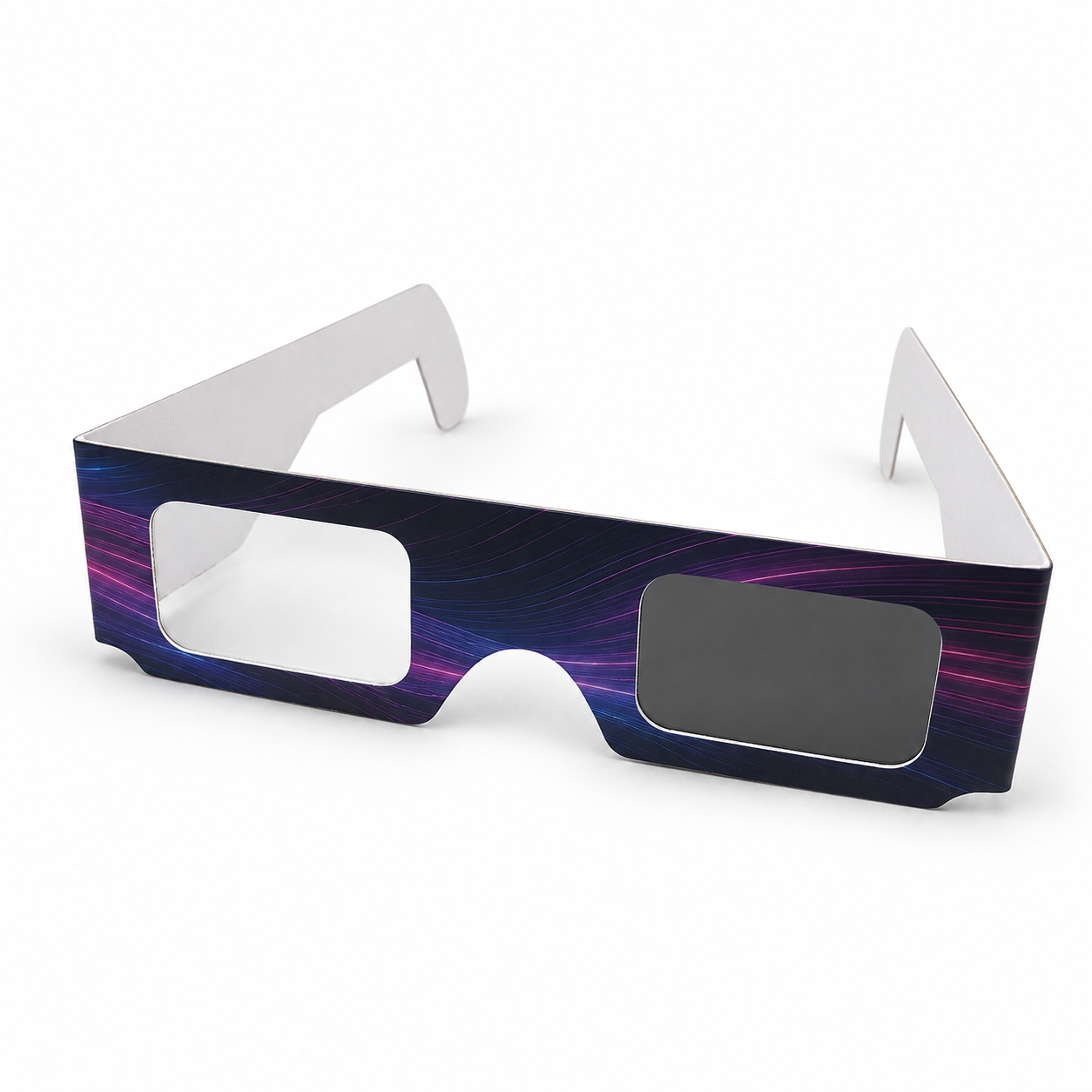
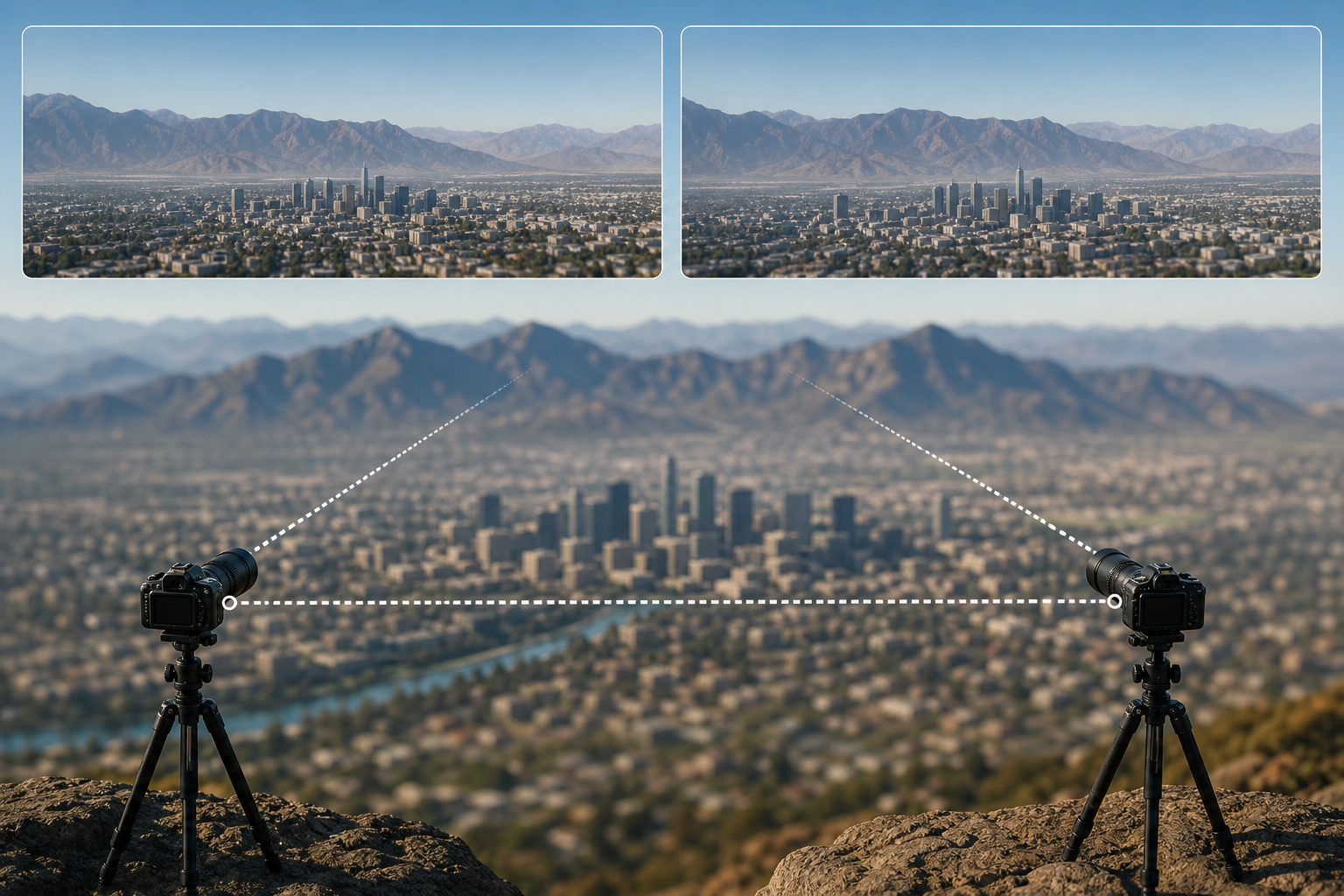
A distant panorama photographed in the usual way may appear much less three-dimensional than the observer remembers. Mountains form almost flat layers, while buildings in a distant district are difficult to separate in terms of depth. Hyperstereo makes it possible to recover this depth by increasing the distance between the positions of the left and right shots. The price, however, may be the characteristic impression that we are looking at a scale model of a city or a model of a mountain range.
This is not a miniature filter or simply the result of using a telephoto lens. The effect arises from the geometry of the stereoscopic pair: the relationship between the shooting base, the distance to the photographed scene, and the way in which the finished pair is viewed.
What is the stereoscopic base?
The stereoscopic base, also known as the stereobase, is the distance between the position from which the left shot was taken and the position of the right shot. In a two-camera setup, it corresponds to the spacing between the cameras. When successive frames are photographed with a single camera, it is the distance by which the camera is moved between exposures.
In photography that imitates natural vision, a base similar to the interpupillary distance is used. Such a setup can reproduce space well in many typical situations, but it does not guarantee clear relief for every subject. The farther away the scene is, the smaller the difference may be between what is recorded from the left and right viewpoints.
Hyperstereo begins when the shooting base is increased relative to the base regarded as normal. The two images show the same scene from points that are farther apart. As a result, corresponding elements acquire greater horizontal displacement, meaning greater parallax.
Why do distant mountains lose depth?
Stereopsis—the ability to perceive depth from differences between the images seen by the left and right eyes—requires sufficiently clear differences between the views. These differences arise easily for nearby objects. For distant buildings, panoramas, and mountains, however, a normal base may produce two very similar images.
This does not mean that a distant landscape is actually flat. Its shape can still be recognized through the overlapping of planes, perspective, and other cues present in a single image. However, the signal arising directly from the difference between the left and right views becomes weak.
Increasing the base is like increasing the spacing between the observation points. A nearer ridge and a more distant peak shift more clearly relative to each other between the left and right frames. When the images are combined, the viewer can once again perceive depth differences that were almost invisible with a normal base.
Hyperstereo does not add artificial depth to a landscape. It enhances the stereoscopic legibility of distances by increasing the difference between the observation points.
Where does the scale-model appearance come from?
The same operation that restores relief to distant planes changes the perceived scale of the scene. A pair taken with a large base presents the world as though the observer had a much greater distance between their eyes. Hence the popular metaphor of a “giant's-eye view.”
A fact confirmed in historical and educational accounts is the association between hyperstereo and the impression of viewing a real scene as a reduced-scale model. The interpretation of this effect is as follows: the brain receives a pattern of differences characteristic of observation from an unnaturally wide base, while the viewed image still depicts familiar objects—houses, streets, towers, and mountains. The combination of strong relief with recognizable landscape elements may be interpreted as a reduction in the scale of the entire scene.
The individual buildings and their proportions in the image do not shrink. What changes is the impression of spatial scale. A city may resemble an urban scale model, while a mountain massif may look like a relief model of the terrain. The effect is sometimes described as stereoscopic miniaturization or Lilliputism.
This is not the same as a shallow-depth-of-field “miniature”
In two-dimensional photography, a model-like appearance can be suggested using selective focus or appropriate image processing. Hyperstereo is based on a different mechanism. The key factor is not a change in blur, but the difference in viewpoints recorded in two frames.
Similarly, hyperstereo should not be equated with the ordinary perspective compression associated with photographing distant scenes. A telephoto image can change the framing and the relationships visible in a single shot, but hyperstereo requires a pair recorded from two viewpoints. Its essential cue appears only when both images are viewed stereoscopically.
A larger base does not always mean better stereo
The intuitive rule that “a larger base produces stronger depth” describes only part of the phenomenon. Increasing the base does indeed increase the horizontal differences between corresponding points. However, this does not mean that the base can be increased without limit.
If the images differ too much, the viewer may have difficulty fusing them into a single, stable spatial image. For distant points, an improperly prepared or presented pair may even require divergent eye alignment. This makes fusion more difficult and may cause discomfort.
The success of the photograph is therefore not determined by the base value alone. The distances within the scene, the resulting parallax, and the conditions of the final presentation also matter. For this reason, there is no single enlarged base suitable for every panorama. What produces clear relief in one scene may prove too weak or excessive in another.
A practical approach to working with hyperstereo
The source package does not provide a single universal value or simple conversion factor that can be safely applied to every landscape. The most responsible approach is therefore to compare variants under controlled conditions rather than selecting the largest possible camera displacement.
- Start with a scene that genuinely needs a larger base. Good candidates include distant city panoramas, mountains, and expansive views in which a normal base produces too little difference between the images.
- Identify the arrangement of depth planes. Consider which objects should form the nearest and which the farthest layer of the composition. The aim is not merely to obtain large displacements, but to clearly separate the important planes.
- Take a series of pairs with an increasing base. This material allows you to compare the point at which relief becomes visible with the stage at which the miniaturization effect begins to dominate or the images become difficult to fuse.
- Evaluate the finished pair stereoscopically. Two frames may look correct when viewed separately yet still create uncomfortable stereo. The assessment must include ease of fusion and the perceived scale of the space.
- Do not automatically choose the strongest variant. The greatest depth may not serve the subject best. A documentary panorama may require more restrained relief than an image deliberately created as a stylized “model.”
The nearest plane as a warning sign
As the base increases, so do the differences between the images. In practice, this means that the pair should be evaluated as a whole rather than solely in terms of the distant mountains or buildings. If part of the scene acquires a difference too large for comfortable fusion, the recovered depth of the background does not compensate for problems in viewing the image as a whole.
This is an important distinction between hyperstereo as a tool and a hyperbase used without control. The first approach matches the spacing of the viewpoints to the scene. The second assumes that every increase in the base will improve the result, even though the sources clearly indicate the possibility of losing comfortable fusion.
See for yourself: comparing several bases
The effect can be tested without adopting an arbitrary numerical value. Choose a static, distant panorama and take several pairs, increasing the distance between the left and right viewpoints each time. Maintain the correct shot order and compare all variants using the same viewing method.
Pay attention to three stages. In the first pair, the relief may be barely noticeable. In the next, layers of buildings or ridges should become easier to separate. With an even larger base, the scene may begin to resemble a model, and in the most extreme variant, fusing the images may become tiring or unstable.
Such a series demonstrates that hyperstereo is not a switch operating on an “on–off” basis. It is a continuum of changes: from an almost flat image, through clear relief, to pronounced miniaturization and possible fusion problems.
Documentation or deliberate stylization?
The miniature appearance of a city does not have to be a mistake. It can be a predictable consequence of the geometry and can be used deliberately. Hyperstereo is suitable both for revealing the spatial structure of distant terrain and for creating an image with a scale-model aesthetic.
However, it is worth distinguishing between two goals. If the priority is the most natural possible sense of scale, the base should be increased cautiously and testing should stop once the relief becomes sufficiently clear. If the intention is to show the city “through a giant's eyes,” stronger miniaturization may form part of the concept—provided that comfortable viewing remains possible.
The most important lesson is simple: hyperstereo recovers the depth of distant scenes because a larger base increases parallax. At the same time, that same base affects perceived scale, which is why mountains and cities may look like models. A good result does not come from maximizing the spacing between viewpoints, but from deliberately choosing a balance between clear relief, intended miniaturization, and viewer comfort.