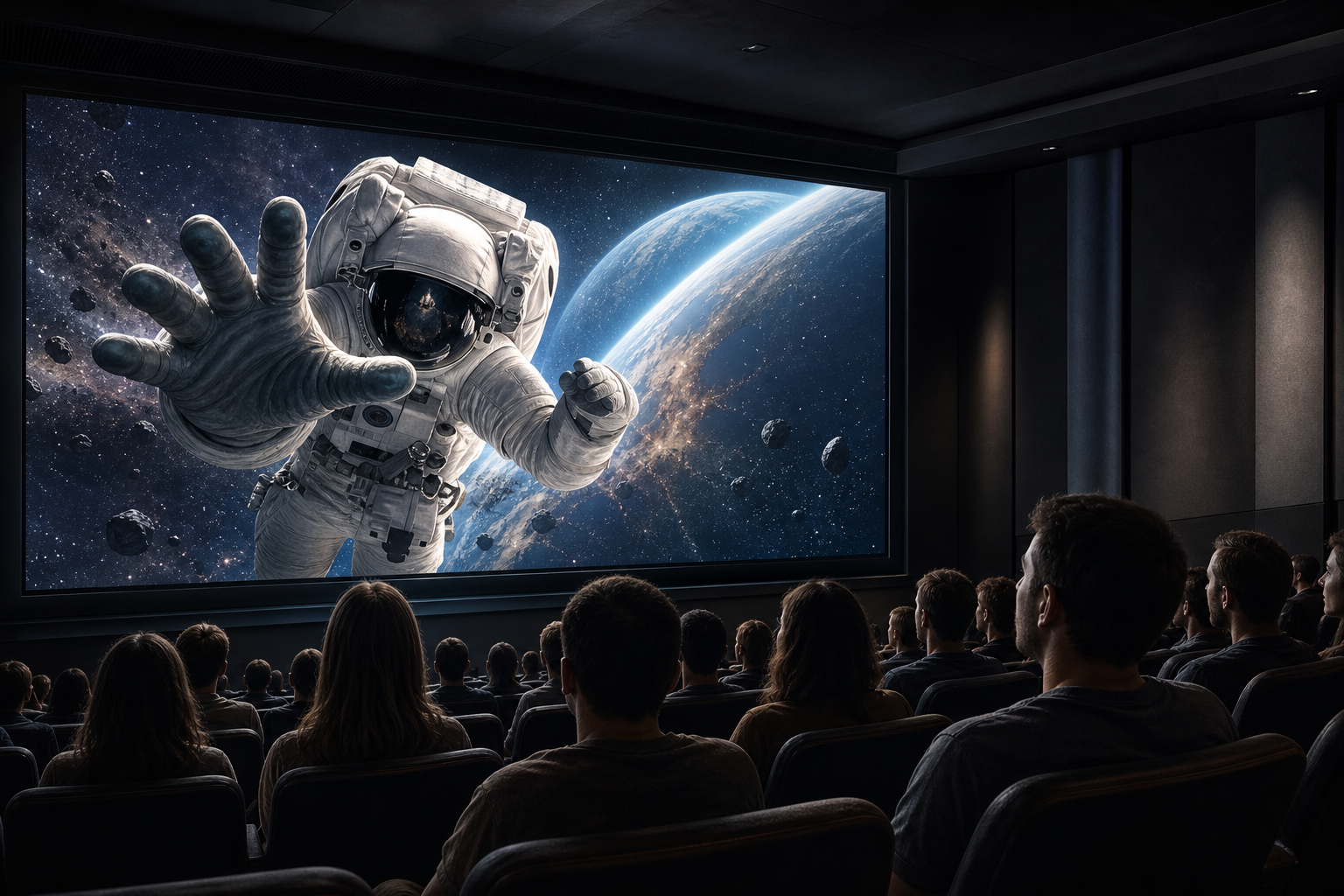
The promise of glasses-free 3D cinema sounds like an attempt to remove one of the most recognizable features of a stereoscopic screening. The viewer would simply take a seat in front of the screen, while the device itself would provide a three-dimensional image. In 2025, the subject returned through research into an LED display with a radial barrier and a prototype intended for cinema applications that used a MiniLED panel.
However, this is not an idea developed from scratch. The description of the modern design refers directly to Russian solutions from the 1940s. History has therefore come full circle in an interesting way: rather than abandoning the old principle, researchers are investigating what happens when it is combined with a modern emissive panel and a method for reducing moiré.
Autostereoscopy Brought to the Movie Theater
Autostereoscopy in this context means presenting a 3D image without requiring viewers to wear special glasses. Simply removing the glasses, however, does not solve every problem. The system must be designed not for a single observer standing in front of a small screen, but for an audience occupying different seats in a theater.
This focus on cinema is confirmed by the SID Display Week 2025 program. It listed a paper entitled “Glasses-Free 3D Display for Cinema Applications Employing a MiniLED Display and Radial Parallax Barrier.” Philip Surman of the Southern University of Science and Technology was named as the author. The title of the presentation alone identifies the project’s two fundamental elements: a MiniLED panel and a radial parallax barrier.
The paper description indicates that the evaluated prototype was intended for a cinema audience. This is an important distinction. It was not merely a demonstration of a small glasses-free display, but a reconsideration of the principle at a scale and in a configuration associated with screenings for multiple viewers.
What Does the Radial Barrier Change?
In the supplied materials, the modern solution is described as a display based on a radial barrier. The key factor here is geometry adapted to viewers positioned in front of the screen. This geometry provides the starting point for an attempt to solve the multi-viewer problem of glasses-free cinema.
Caution is nevertheless warranted. Merely identifying a cinema application does not establish how large a group of viewers can simultaneously see a correct image, which seats provide the best effect, or how the image behaves when the viewer moves their head. The supplied information also does not specify the dimensions of the presented system, its image resolution, brightness, or the number of supported viewing positions.
What the materials do confirm is the arrangement of the basic components: in the prototype, the projector used in the earlier principle was replaced by a MiniLED panel positioned behind the barrier. This marks a transition from a projection-based design to a solution in which the image is produced by a panel located directly within the display system.
This is not merely a cosmetic substitution of one image source for another. From the perspective of technological development, it makes it possible to re-examine the historical concept using a modern display. However, it should not be assumed on this basis that all the limitations of earlier autostereoscopic cinema have automatically been eliminated. The presented materials do not confirm that.
Moiré: A Visible Problem and a Specific Attempt to Reduce It
A peer-reviewed article published in 2025 in “Optics Express” describes a glasses-free 3D display with an LED screen and a radial barrier. The authors used a diffuser film to reduce moiré.
This information is important for two reasons. First, it shows that current research does not simply involve placing a barrier in front of an image source again. The designers had to account for an artifact visible in such a system and introduce an additional optical element. Second, the presence of diffuser film is a reminder that the quality of an autostereoscopic image depends on the interaction of several layers, not solely on the type of panel.
However, the available data do not make it possible to determine the extent to which moiré was eliminated under conditions corresponding to a full-size theater. It can only be said that the problem was recognized and that diffuser film was used as a means of reducing it. This is the difference between a documented technical solution and a more far-reaching assessment of its effectiveness.
Moscow, February 4, 1941
The most striking aspect of this story may not be the MiniLED panel itself, but the fact that its underlying principle has a clear historical predecessor. A recently released study devoted to the history of glasses-free 3D cinema dates the opening of Moscow’s autostereoscopic movie theater to February 4, 1941.
The modern prototype is described as an update of the earlier principle used in Russian designs from the 1940s. The change identified in the materials is the replacement of the projector with a MiniLED panel positioned behind the barrier. The connection between these two stages of development is therefore not merely a loose historical association, but part of the description of the new project.
This continuity clearly illustrates how three-dimensional imaging technology develops. Not every new demonstration requires a completely new optical principle. Sometimes an older geometry returns because currently available components make it possible to build it differently and reassess its practical value.
At the same time, this does not mean that the 2025 prototype is a straightforward reconstruction of the Moscow theater. The materials describe an update to the principle, not a recreation of the earlier installation. The difference between a projector and a MiniLED panel is clearly identified and forms the basis of the modern experiment.
Why Is a Cinema Audience the Key Test?
A small laboratory demonstration can confirm that a particular system generates a 3D image without glasses. A cinema application, however, raises a broader question: can the effect be made available to an audience spread across many seats? This is why the prototype’s intended use is more significant than the mere use of the term MiniLED.
The supplied materials indicate that the design was evaluated with a cinema audience in mind. They do not, however, indicate that it is ready for deployment in regularly operating theaters. Data are lacking that would make it possible to assess, among other things:
- how large an area of the auditorium is covered by the correct 3D effect,
- how the viewer’s position affects image perception,
- how the system performs with a larger screen,
- the brightness and resolution of the presentation,
- how effective moiré reduction remains under different conditions,
- how content is prepared for this method of display.
The points above are questions worth asking when evaluating future demonstrations, not parameters of the described prototype. Distinguishing between these two categories is particularly important for experimental technologies. Announcing a cinema application is not the same as confirming readiness for practical use.
The MiniLED Panel Does Not Settle Everything
The term MiniLED may attract attention because it identifies the modern component of the overall design. In this project, the panel serves as the image source positioned behind the radial barrier and replaces the earlier projector-based system. However, there are no grounds for concluding solely from this change that all the problems of glasses-free cinema have been solved.
Success will depend on the entire system: the barrier geometry, its interaction with the panel, the control of unwanted patterns, and the ability to extend the effect across an audience. The publication on the LED display confirms the use of diffuser film to reduce moiré, while the conference program confirms the development of a variant intended for cinema. However, the materials do not provide the full set of results needed to compare this technology with existing 3D projection methods.
The safest approach is to regard the design as a documented research prototype that combines a modern panel with the historically rooted principle of a radial barrier. This is already an interesting stage, but it is not yet evidence that such screens will soon become commonplace in movie theaters.
The Return of an Idea, Not a Ready-Made Revolution
The history of autostereoscopic cinema is not a straight line leading from the 1941 experiment to the 2025 MiniLED panel. They are nevertheless connected by a recognizable principle that, after many decades, has once again been evaluated using a different image source.
The verified information establishes that an LED display with a radial barrier was built, diffuser film was used to reduce moiré, and a MiniLED panel variant for cinema applications was presented as a topic at SID Display Week 2025. It is also known that the project consciously refers to Russian designs from the 1940s and that Moscow’s autostereoscopic movie theater opened on February 4, 1941.
What remains unknown is whether the solution meets all the requirements of regular, multi-viewer cinema presentation. This boundary between a confirmed prototype and full deployment is currently the most important issue. The radial barrier has returned to research into glasses-free cinema, but its practical success can only be assessed on the basis of detailed specifications and the results of trials with a real audience.