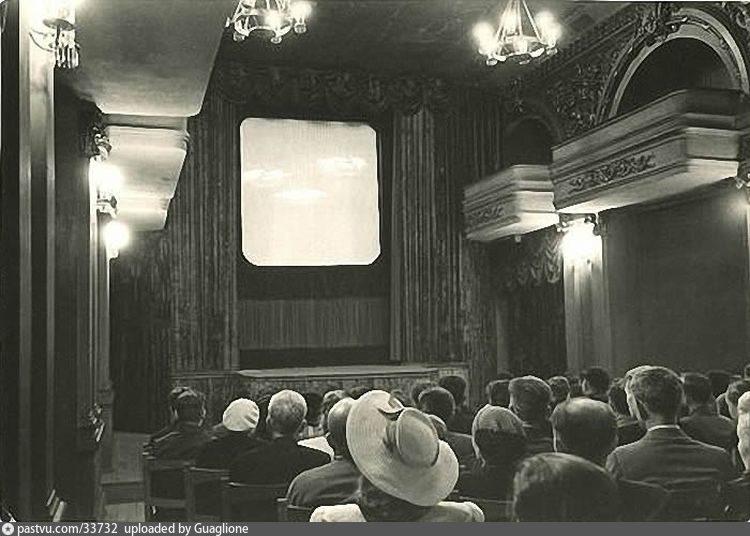
Imagine Moscow at the beginning of 1941. The premiere of Citizen Kane is still several months away. Television is a technological curiosity, color cinema remains a luxury, and the digital computer practically does not exist. A viewer enters a small cinema auditorium, sits down in front of the screen and… is not given any glasses.
The lights go out.
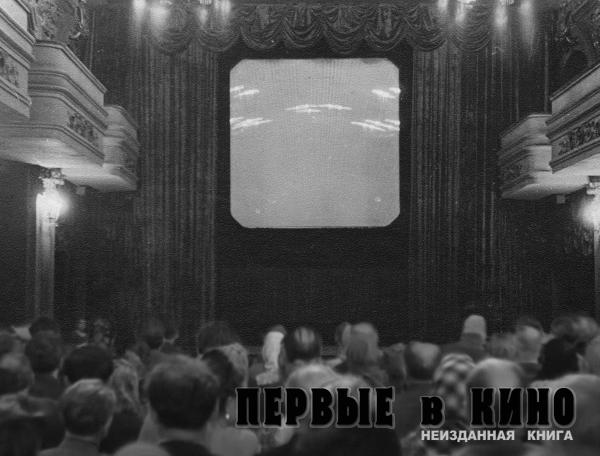
The opening credits do not look as though they are on the screen. They seem to hang in front of it. Then the sea appears, the waves gain volume, and objects emerge toward the audience. A juggler throws a ball in such a way that some viewers instinctively duck their heads.
This is not a description of a modern light-field display demonstrator. These are accounts of a Moscow cinema from February 4, 1941.
The history of this device, however, reaches much further back.
It began with the idea of “moving the glasses onto the screen”
Every conventional stereoscopic cinema must solve exactly the same problem: the left eye should see the image intended for the left eye, while the right eye should see the other image, photographed from a slightly different position.
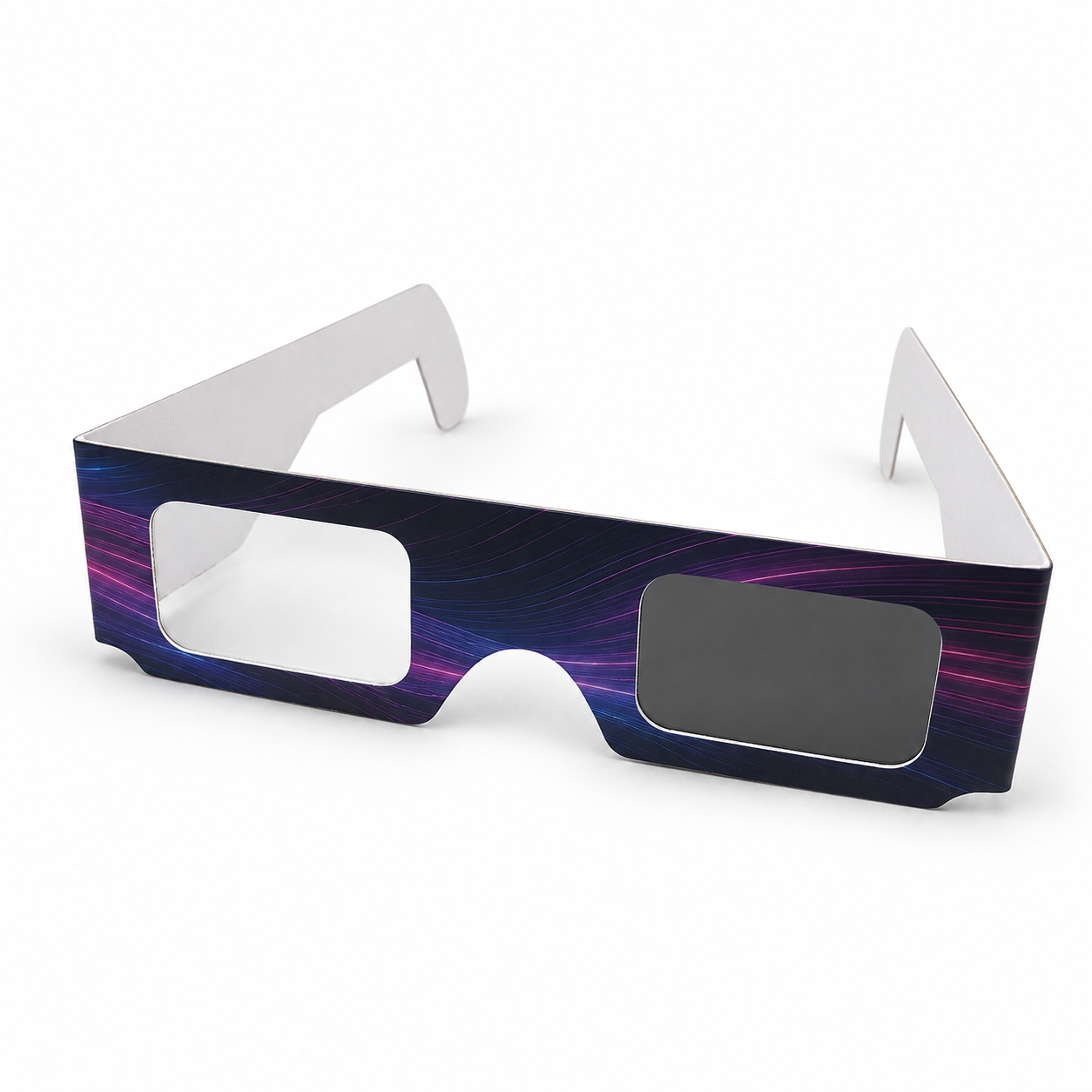
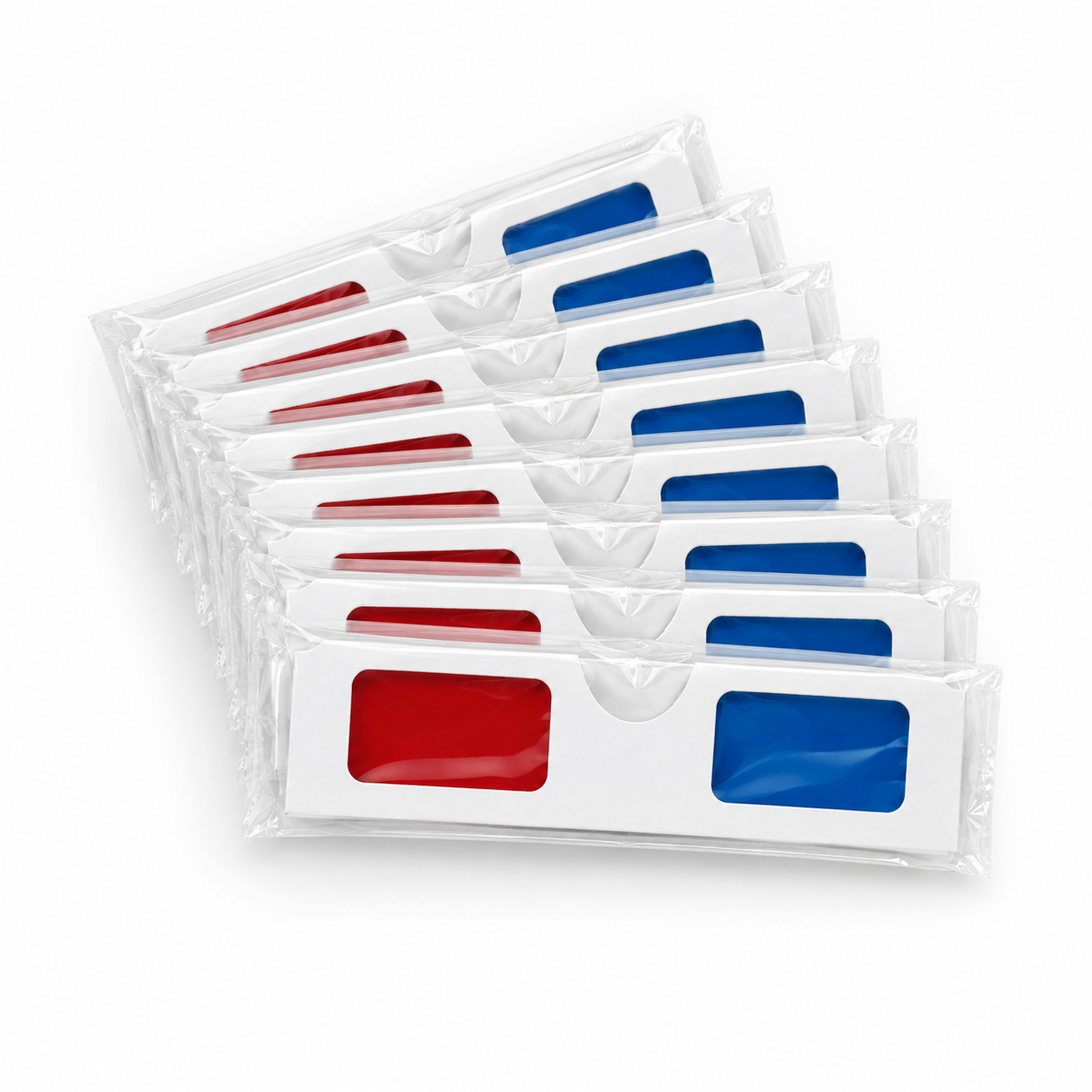
In anaglyphs, this is done with colors. In polarized cinema—with light polarization. In active glasses—by alternately blocking the eyes.
But the problem can be reversed: instead of placing a separator on the viewer’s head, the separator can be positioned in front of the image itself.
This idea was described as early as the 19th century. In 1896, Auguste Berthier presented the concept of an image composed of interlaced vertical strips viewed through a raster of opaque and transparent lines. Several years later, the American Frederic Eugene Ives built a working version and in 1903 received US patent 725,567 for a parallax stereogram.
The principle was ingeniously simple.
Imagine an image composed alternately of very thin strips:
L R L R L R L R…
where L comes from a photograph taken for the left eye, and R from one taken for the right.
In front of it, we place something resembling an extremely fine vertical blind:
slit — barrier — slit — barrier…
If the geometry is configured correctly, the left eye sees the L strips through the slits, while the R strips are blocked from it. The right eye is several centimeters away, and the situation is reversed.
No glasses are needed.
This is the essence of the parallax barrier.
The problem appears immediately when an awkward question is asked:
What about two hundred people sitting in a cinema?
A parallax barrier works perfectly—as long as the viewer sits in the right place
A conventional barrier with parallel vertical slits creates specific viewing zones. In one place, the image reaches both eyes correctly. A dozen or so centimeters away, the images may begin to mix, while in yet another position they may swap places.
For a single photograph or a single-user display, you can simply position your head in the right place.
In a cinema, the situation is entirely different. Viewers occupy more than a dozen rows, sit on the left and right sides of the auditorium, and are located at different distances from the screen.
Barry Blundell aptly describes the two tasks that an autostereoscopic screen must therefore perform: multiply the available image pairs and direct them to the appropriate areas of the audience. An ordinary parallel parallax barrier handles this poorly.
The solution turned out to be the geometry of the radial raster.
And this is where the real story of Moscow begins.
A fan instead of a fence
In an ordinary parallax barrier, the strips are parallel:
||||||||||||
In a radial raster, they do not run perfectly parallel. When geometrically extended, their directions converge at a specific point, forming a very subtle fan.
This makes it possible to distribute the correct viewing zones much more widely throughout the auditorium.
Interestingly, the concept of the radial raster did not first appear in the USSR. The Belgian researcher Edmond Noaillon worked on it in the 1920s. However, it was the Soviet team, and above all Semyon Pavlovich Ivanov (Семён Павлович Иванов), that brought the solution to the stage of a practical cinema system. Blundell emphasizes this distinction: Noaillon developed increasingly complex electromechanical solutions, while Ivanov and his colleagues pursued a design that could realistically be put into use.
Ivanov patented his own glasses-free cinema system in the mid-1930s. At NIKFI—the Soviet research institute for film and photographic technology—work on a practical raster system began in 1937.
The goal was extraordinarily ambitious:
not to build a stereoscope for one person, but a stereoscope the size of a cinema auditorium.
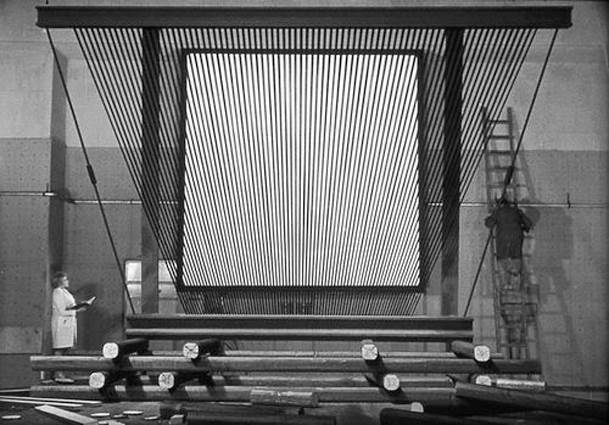
A screen with… a steel structure and kilometers of wire
The first Moscow installation was a device that would be rather difficult to order from a cinema equipment supplier today.
An extremely precise raster made from an enormous number of thin wires was constructed in front of the screen. Sources differ on the details of its construction—figures range from around 50 km to more than 150 km of wire used—so I would not treat any specific number as entirely certain. They do, however, agree on the basic principle: a screen measuring approximately 5 × 3 m worked with a large radial wire structure to create stereoscopic viewing zones for the audience.
It was therefore not simply a screen covered with lenticular film.
It was part of the cinema’s architecture.
The geometry of the screen, raster and seating arrangement formed a single optical system. One could say that the audience was inside a gigantic stereoscope.
And that is precisely why a print of such a film could not later be taken and shown in any cinema.
February 4, 1941: “Концерт”—Concert: Land of Youth
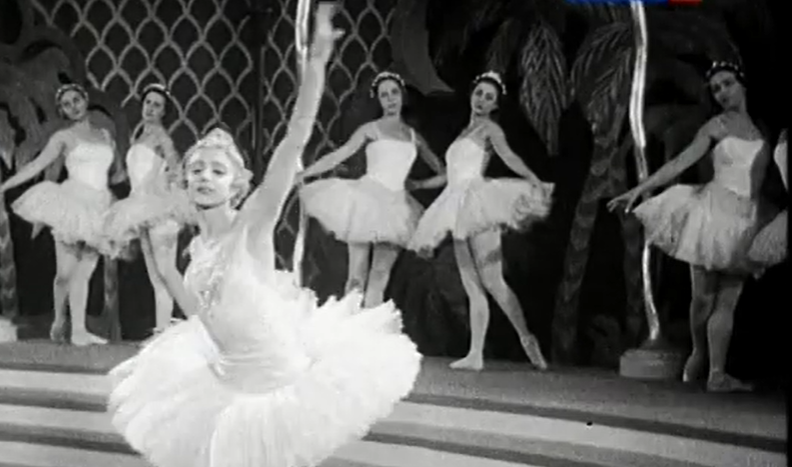
The first film regularly screened using Ivanov’s system was Концерт, also known as Земля молодости—Concert (Land of Youth). It was produced in 1940 at the Soyuzdetfilm studio. It was directed by Aleksandr Andriyevsky, with Dmitry Surensky responsible for the stereoscopic cinematography.
And the choice of film itself was extremely sensible.
They did not immediately attempt to make a major drama. Instead, they produced an approximately forty-minute concert film consisting of seven parts. The audience saw, among other things, harpist Vera Dulova, pianist Yakov Flier, dance, vegetation, birds, fish, the sea and—particularly spectacularly—a juggling act by Vitaly Spivak. Some sequences were even made using an experimental two-color process.
It was practically a textbook catalog of subjects for stereoscopy.
Water made it possible to show successive depth planes. Vegetation and architecture provided clear reference points for depth. The juggler could direct objects toward the audience. A harp with dozens of strings looked much more spatially interesting than it would on a flat screen.
Modern 3D films often use exactly the same tricks.
Accounts from 1941 mention titles detaching themselves from the surface of the screen, fish “swimming” toward the audience, and objects extending out in front of the screen. Ivanov also described a juggler throwing a ball toward the audience, triggering instinctive reactions from viewers.
And yet the greatest curiosity was located outside the entrance to the auditorium.
Instructions for operating… your own head
The audience was given instructions.
They were advised, among other things, to keep their eyes horizontally aligned and to find a position in which the titles appeared to be in front of the screen. According to Nikolai Mayorov’s reconstruction, there were several points for each seat at which the stereoscopic effect was correct.
This reveals the most important flaw of the entire system.
With glasses, the separator moves together with the head. If we shift by 20 centimeters, the filter remains in front of our eyes.
In Ivanov’s system, the screen was the separator.
Therefore, if the head moved from one zone to another, the left eye could begin receiving part of the right-eye image. Crosstalk appeared, depth disappeared, or pseudoscopy occurred—the spatial image could, in a sense, become “reversed.”
Today’s user of a Nintendo 3DS or a modern autostereoscopic monitor would recognize the problem immediately: moving the head outside the sweet spot causes the effect to deteriorate or break down.
The physics has remained the same.
Did it really attract half a million viewers?
Many accounts repeat an extraordinary claim: over four months, Concert was supposedly seen by more than 500,000 people. This figure is given both in later Russian reconstructions of film history and by Blundell. The film ran for about 40 minutes, so numerous screenings were organized each day.
However, I would approach this figure with some caution.
Sources disagree about the capacity of the first auditorium—figures of around 180–200 seats are mentioned—and not all information about the number of daily screenings is easy to reconcile. Therefore, “more than half a million” should be presented as a figure cited by historical sources, not as an indisputable box-office statistic.
This does not change the essential point: the system was not a private demonstration for a group of engineers. From February 1941 onward, it operated as a regular public cinema attraction.
And then history intervened.
On June 22, 1941, the Third Reich launched Operation Barbarossa and attacked the USSR. The cinema experiment was interrupted.
It might seem that this was the end.
It was only the first chapter.
1947: the second generation—away with the wiresEven during the war, the stereoscopic program was not completely abandoned. In 1944, the “Stereokino” studio was established by a special government decision, and the team worked on the next generation of the system.
The most important change concerned the screen.
A parallax barrier has a terrible property: its opaque elements perform their function precisely because they absorb light.
If half the surface consists of barriers, an enormous proportion of the projector’s energy is simply lost.
Ivanov and his colleagues therefore decided to do something extremely important: instead of blocking the light, they began directing it.
The radial slit raster was replaced with a radial lenticular raster. Instead of a set of dark barriers, optical elements were used to direct the individual images toward the appropriate viewing zones. The image could be much brighter.
This is exactly the same evolution that we see in the history of autostereoscopic images:
parallax barrier → lenticular.
In February 1947, a new permanent “Stereokino” venue opened in Moscow in the building of the former Vostok-kino cinema. The auditorium had 176 seats in 17 rows, and the first lenticular-raster screen measured approximately 3.1 × 3.2 m.
Robinson Crusoe appeared on the screen.
The rope that flew out of the screenРобинзон Крузо was already a feature-length narrative film. It was screened using the Stereo 35/19 system. The image pair was placed on a single strip of 35 mm film, and specially perforated film stock was used to increase the available area.
British critic Joseph Macleod, who saw the postwar system in Moscow, drew attention not only to the spectacular sight of objects “popping out” of the screen. He also described how stereoscopy intensified Crusoe’s loneliness and the materiality of the depicted world—the ropes, wood and sails. In other words, he noticed what James Cameron would discuss several decades later:
good 3D does not have to consist of throwing objects at the viewer. It can build the space in which the story unfolds.
This is particularly interesting because the Hollywood boom of Bwana Devil and House of Wax did not begin until 1952–1953.
Moscow had experimented with feature-length autostereoscopic cinema several years earlier.
It was not a one-off stunt
The postwar history challenges the popular notion that “the Russians showed something once and then the technology disappeared.”
The system continued to be developed. Frame formats, optics and screen sizes were changed. Moscow’s Stereokino operated for years. Raster technologies also reached other cities in the USSR—sources mention Leningrad, Kyiv and Astrakhan, among others, with additional centers appearing in other lists.
Further films were produced, including Machine 22-12, Crystals, May Night, Aleko and A Precious Gift.
Stereoscopy remained an important field of Soviet film research long after the glasses-free cinema program ended. NIKFI later developed the Stereo-70 system, for which the institute received a technical award from the American Academy of Motion Picture Arts and Sciences in 1991.
As early as 1947, Sergei Eisenstein was so convinced of the future of stereoscopy that he wrote:
“To doubt that stereoscopic cinema has its tomorrows, is as naïve as doubting whether there will be tomorrows at all.”
History showed that he was partly right.
The future arrived—just not in the form that had been expected.
Why, then, do we not go to glasses-free cinemas today?This is the most interesting question in the entire story.
The Soviet experiments demonstrated that autostereoscopic cinema is possible. They did not, however, demonstrate that it is economically practical.
First, the viewing zone remained a problem. The viewer did not have complete freedom of movement. The larger the screen and auditorium, the harder it was to provide everyone with correct channel separation.
Second, the slit raster lost an enormous amount of light. The lenticular raster significantly improved the situation, but required very precise manufacturing.
Third, the cinema ceased to be an ordinary auditorium with a screen. The geometry of the seating area became part of the projection system. It was not easy to increase the number of seats or move the installation between venues.
Fourth, the Soviet systems required specialized prints, optics and, in some variants, unusual film perforations. Moscow’s Stereokino was simultaneously a laboratory, a cinema and an optical device.
Meanwhile, polarized 3D cinema requires the viewer to perform one trivial action:
put on glasses.
In exchange for this minor inconvenience, the cinema owner gains an enormous benefit: the audience can sit almost anywhere in the auditorium and move their heads, the screen can be many times larger, and the system is much easier to standardize. Blundell identifies screen scalability, audience density and costs as the fundamental advantages of systems using glasses.
It was not the physics of autostereoscopy itself that lost.
It was defeated by the economics of the cinema auditorium.
Ivanov versus AvatarAt this point, the story comes full circle in a fascinating way.
After the premiere of Avatar in 2009, the entire electronics industry once again came to believe that viewers wanted spatial images. 3D televisions failed, however, partly because people did not want to wear glasses for everyday viewing.
And yet this problem had been solved in Moscow… in 1941.
Except that the solution created another problem: the viewer had to be in the right place.
Modern autostereoscopic displays still struggle with exactly the same compromise. Parallax barriers and lenticular arrays divide the available pixels among different views, reducing the effective resolution and often the brightness. The more independent viewing directions we want to support, the more image information we must generate and distribute.
Digital technology, however, adds something Ivanov did not have:
head and eye tracking.
If a camera knows where the viewer’s eyes are, the system can dynamically shift the viewing zones. It is then no longer necessary to require a person to adjust their head to the screen—the screen can adapt to the person.
And that is why an experiment from more than eighty years ago looks so surprisingly modern today.
The most extraordinary thing about Moscow’s Stereokino
It is not the wire screen.
It is not even the fact that this happened before World War II.
The most extraordinary thing is that Ivanov and his team correctly identified the problem with which the 3D industry still struggles today: glasses are a technically simple solution, but from the user’s perspective they are a foreign element between the person and the image.
So they tried to remove them.
They did so using a brutally mechanical method: kilometers of thin wire, special auditorium geometry, unusual projection and precisely calculated viewing zones.
Then they replaced the wires with lenses.
Today, we replace them with microlenses, LCDs, OLEDs, eye tracking, multiview rendering algorithms and light-field displays.
But the idea remains astonishingly similar.
For this reason, Moscow’s Stereokino should not be treated merely as a curiosity in the history of Soviet film technology. It is one of the most important experiments in the entire history of 3D imaging. Unlike dozens of patents and prototypes created by earlier inventors, it proved that an audience could be seated in front of a large screen and shown a stereoscopic film without a device worn on the face.
What is more—people actually bought tickets.
And perhaps this is the best way to end the story:
in 1941, the problem with Soviet glasses-free cinema was not that it did not work. The problem was that it worked in a way that was too complicated for it to become a global standard.