The history of Japanese lenticular printing in the 1960s and 1970s is sometimes presented as a story of technological boom. However, surviving materials do not always make it possible to describe all the companies involved with equal precision. The case of Toppan is particularly well documented: from development work begun in the late 1950s, through a refrigerator catalog from 1960, to a broad range of applications and the English-language promotion of the Top Stereo and Top Vue names.
This is not a complete history of the entire Japanese market. It is, however, a reconstruction of one of the best-documented production programs, showing how printing that created an impression of depth or image change moved beyond the experimental stage. Of key importance here are not only the dates, but also the types of objects: catalogs, displays, postcards, labels, matchboxes, dish covers, and book covers. Their diversity reveals much about the direction in which the technology developed.
The Beginning of the Program Around 1958
According to documentation cited by the Toppan Printing Museum library, the company began work on stereoscopic printing around 1958. The word “around” is important: the available information indicates the approximate beginning of the program, rather than the exact date on which a specific production process was launched.
This period preceded the appearance of the first confirmed product. Comparing the two dates makes it possible to distinguish the development phase from commercial implementation. About two years separated the start of the work from the project identified by the archival account as the first Toppan product to use this technique.
It should not be assumed automatically that all later products were made in the same way or featured the same type of visual effect. The materials use terms referring to stereoscopic printing, lenticular printing, and the trade names Top Stereo and Top Vue. Without additional technical documentation, this does not provide a basis for assigning detailed parameters or a single production configuration to each group of objects.
A Refrigerator Catalog as the First Product
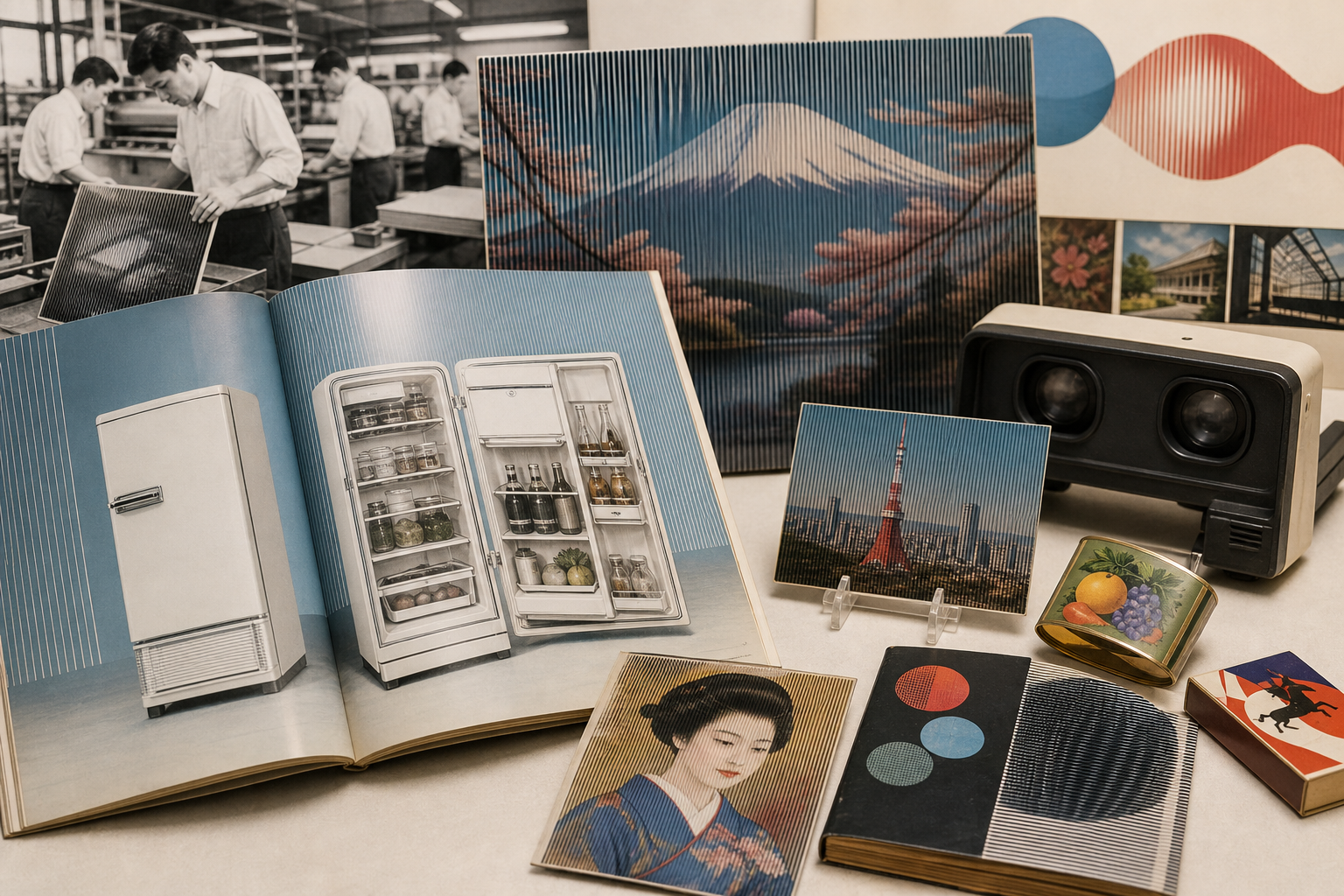
The first confirmed product of the program was a catalog prepared in 1960 for Hitachi Home Appliance Sales. It concerned refrigerators, meaning that it was not a collectible or tourist souvenir, but commercial material presenting household appliances.
This choice is significant. It shows that stereoscopic printing was considered from the outset as a visual communication tool that could be used in ordinary sales channels. The catalog had a specific client and a practical function. It was not merely a demonstration of capabilities prepared without any connection to the market.
The available data do not indicate the size of the print run, the number of pages in the catalog, or exactly which images were used. Nor do we know the details of its production. What is certain, however, is the year, the client, the type of product promoted, and its place in the history of Toppan’s program. This is sufficient to regard the project as an important point in the transition from research to practical application.
1961 and the Rapid Expansion of Applications
From 1961 onward, Toppan used stereoscopic printing across a much broader range of products. The documented list includes:
- displays,
- postcards,
- labels,
- matchboxes,
- dish covers,
- book covers.
The diversity of this list is as important as the date itself. The technology appeared on media of different sizes and functions, with varying expected periods of use. A display served presentation purposes, a label identified or promoted a product, a book cover drew attention to a publication, and a postcard could function as both a souvenir and a standalone image.
At the level of interpretation, this can be described as a transition from a single implementation to a program encompassing multiple printing segments. However, there is no basis for determining their sales volumes, their share of Toppan’s revenue, or the popularity of each of the listed applications. The list demonstrates the breadth of the offering, but it does not rank its commercial successes.
The pace of change is also noteworthy. The first identified product dates from 1960, and from the following year stereoscopic printing was already being applied to many types of media. Such a short interval suggests that the range of applications was expanded efficiently. This is a conclusion derived from the chronology, not a directly documented assessment of the plant’s efficiency or the scale of its production facilities.
Top Stereo and Top Vue in an Export Catalog
The Toppan Printing Museum library also refers to an English-language export catalog titled 3-D PRINTING: TOP STEREO and TOP VUE. The material is dated to the 1960s and contained seven small samples.
The language itself and the export nature of the catalog indicate that the offering was not communicated exclusively within the Japanese market. The Top Stereo and Top Vue names were presented to international audiences in material that was not limited to a verbal description. The inclusion of samples made it possible to demonstrate the effects directly in visual form.
However, the catalog should not be assigned a significance unsupported by the sources. Its existence proves that export promotion was conducted and that an English-language presentation was prepared. It does not automatically establish the volume of exports, the list of target countries, or the dates on which the brand entered individual markets. Nor is there any basis for treating the seven samples as a complete overview of Toppan’s entire production.
Nevertheless, the catalog has considerable historical value. It links the technology with recognizable trade names and shows that a sample of the finished print formed part of the presentation aimed at potential customers. For effects dependent on viewing a physical object, such a set offered a more direct demonstration than an ordinary reproduction.
Traces of the Brand Outside Japan
The international context is reinforced by materials recorded in the Deutsches Museum archive. The inventory of one collection lists advertising materials from Toppan Printing and the Top Stereo brand. This does not provide a complete picture of the company’s activities in Europe, but it confirms that related printed materials found their way beyond Japanese archival circulation.
In this case, the presence of a document in a collection must be distinguished from a commercial presence in a particular market. The archival inventory confirms that the materials were preserved, but in itself it does not indicate how widely they were distributed, who originally received them, or what contracts may have resulted from them. Combined with the English-language export catalog, however, it creates a consistent picture of a brand prepared for international communication.
This is a good example of the role played by technology archives in lenticular research. Information need not be sought exclusively in the histories of printing companies themselves. It may survive in export catalogs, advertising materials, museum inventories, and descriptions of specific objects. Only by bringing these traces together is it possible to distinguish well-documented facts from conjecture about the scale of the phenomenon.
Postcards and the Later Recognition of Top Stereo
Physical postcards held in the Jonathan Ross Holography Collection provide separate evidence. Based on the printer’s credits visible on the objects, the collection identifies Toppan Top Stereo as one of the most frequently encountered producers of lenticular postcards in the late twentieth century.
This information is different in nature from the company chronology. It does not describe the start of the work or the first implementation, but is based on the markings found on surviving objects. It demonstrates the long-lasting visibility of the Top Stereo name in collectible material, particularly in the field of postcards.
However, the frequency with which the name appears in a single collection cannot be converted into a share of the entire global market. Collections are shaped by particular interests and the availability of objects. Without production or sales data, it is impossible to compile a reliable ranking of manufacturers. It can, however, be stated that Toppan Top Stereo credits recur on surviving examples often enough for the brand to have been singled out by the collection’s creator.
Postcards were only one of the applications listed from 1961 onward, but from the perspective of later collections they became a particularly visible medium. A refrigerator catalog and display materials may have been tied to a specific campaign or client. Postcards, by contrast, functioned as separate objects that could be stored, exchanged, and collected. This is an interpretation that helps explain their presence in collections, not a documented statistic on surviving printed materials.
What Does the Toppan Case Tell Us About the Japanese Boom?
Three stages can be distinguished on the basis of the available material. The first was the start of work around 1958. The second consisted of commercial implementation in the 1960 refrigerator catalog and the expansion of applications from 1961 onward. The third encompassed export promotion and the later presence of the Top Stereo brand on surviving postcards.
This sequence shows the path from a development program to a diversified offering. However, it is not sufficient to describe the entire Japanese lenticular industry or to provide a detailed comparison of the companies operating in the 1960s and 1970s. The strongest evidence concerns Toppan, so it is more reasonable to treat this history as a well-documented case study than as a complete panorama of the industry.
What stands out above all is the practical nature of the implementations. Stereoscopic printing did not remain confined to technical demonstrations. It appeared in a commercial catalog, packaging, labels, publications, displays, and postcards. The breadth of this list indicates a search for multiple roles for the visual effect, from advertising to souvenirs.
From Practical Print to Collectible Object
The history of Top Stereo does not begin with a postcard, although postcards are particularly easy to notice in collections today. Its first confirmed milestone is the 1960 refrigerator catalog, preceded by work begun around 1958. From 1961 onward, the range of applications was already much broader, while an English-language catalog with samples presented Top Stereo and Top Vue to export customers.
The surviving museum and collection materials do not answer every question about the scale of production, target markets, or process parameters. They do, however, make it possible to trace an important change: stereoscopic printing became a solution used on many everyday media, while the Top Stereo name remained a recognizable marking on physical objects from the later twentieth century. It is this combination of company documentation, catalogs, archives, and surviving postcards that provides the most reliable picture of the brand’s development.