Accounts of the beginnings of 3D cinema often tempt us with a simple date and a single inventor. In the case of William Friese-Greene’s stereoscopic camera, however, such an answer would be misleading. The device from around 1890 did indeed record two parallel images, and a fragment of film made with it has survived in a museum collection. At the same time, the camera did not achieve the speed needed to produce a true impression of motion, and the sources do not confirm a successful projection.
This is why Friese-Greene and Frederick Henry Varley’s experiment is interesting not as the undisputed “first 3D film,” but as a borderline case. It shows a moment when stereoscopic photography, the mechanical recording of successive frames, and the idea of projection came together in a single undertaking, but had not yet formed a complete stereoscopic cinema system.
What does “the first stereoscopic cinema” actually mean?
Assigning historical priority depends on the criterion adopted. Is it enough to construct a camera with two image tracks? Must the device record stereoscopic material? Or are smooth motion, projection, and a public screening also required?
It is useful to distinguish three stages that are often treated as a single achievement in abbreviated accounts:
- Recording two images – the camera must simultaneously record two corresponding views.
- Illusion of motion – successive images must be produced at a rate that allows the scene to be perceived as moving, rather than merely as a series of separate shots.
- Stereoscopic presentation – the recorded images must be shown effectively in a way that allows them to be viewed as a three-dimensional moving scene.
This distinction is an interpretive tool, not an additional claim about the camera’s design. It does, however, make it possible to assess precisely what the experiment achieved and what is not confirmed by the surviving materials.
The camera from around 1890
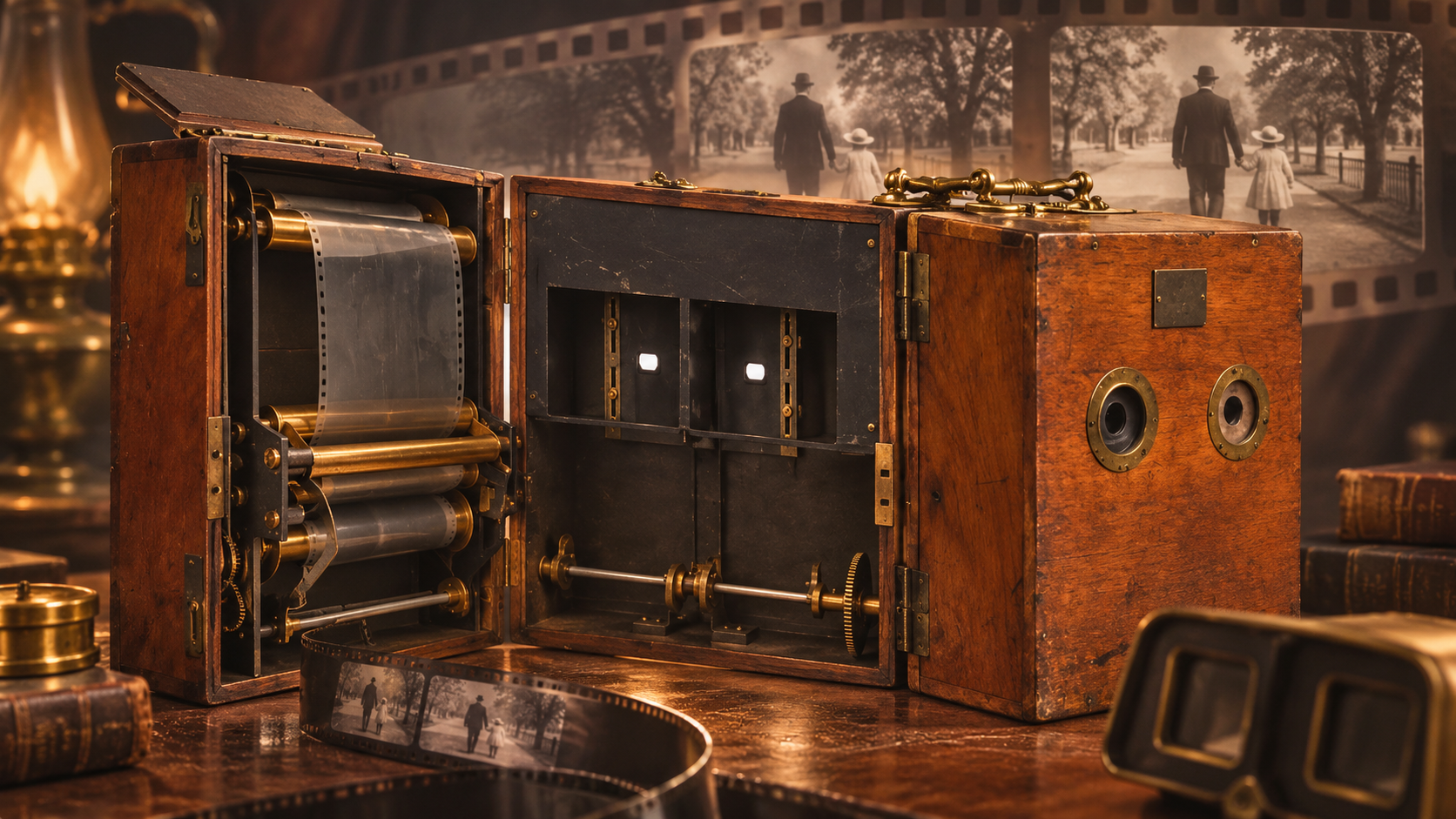
The Science Museum Group dates William Friese-Greene’s stereoscopic cine camera to around 1890. The device was made by the London company A. Lege & Co. The object itself has survived, so the history of this undertaking is not based solely on later accounts or recollections.
The camera was patented in 1893. Its design drew on a similar solution by Frederick Henry Varley, patented three years earlier, in 1890. For this reason, discussing the device solely as Friese-Greene’s independent achievement obscures an important technical and chronological connection.
A specialist study of the history of pre-cinema devices describes Varley’s arrangement as a system that simultaneously recorded two parallel tracks of images on 155 mm film. This is the key element of the entire experiment: the design was not limited to taking successive photographs on a single track, but incorporated from the outset a dual recording intended for stereoscopic imagery.
Two tracks do not yet make a complete system
Dual recording was an important step, but a camera is only one part of the imaging chain. The material must also be recorded at the appropriate rate, the two sequences must remain synchronized, and they must then be presented effectively. Only the combination of these elements makes it possible to speak of a functioning stereoscopic cinema in the full sense of the term.
In the case of Friese-Greene’s design, we have physical evidence of an attempt to record two tracks. However, we do not have equally strong grounds for attributing a successful solution to the subsequent stages to the same undertaking.
The film that actually survived
The most tangible trace of the camera’s operation is a surviving fragment of film. It depicts a man and a child walking through a park. The material is held in the Science Museum Group collection, and a specialist chronology of early cinema indicates that only a few frames have survived.
This modest scene is of considerable documentary significance. It confirms that the camera did not remain merely a patent design or an unused mechanism. It was used to record an actual subject. Moreover, the recording was made as two parallel images, in keeping with the design’s stereoscopic premise.
However, conclusions drawn from the surviving fragment should not go too far. A few frames are evidence that a test was carried out, but do not in themselves prove that a smooth film sequence or an effective screening was achieved. The material’s historical value lies precisely in the fact that it reveals the difference between an experimental recording and a complete spectacle.
Why did motion remain a problem?
The Science Museum Group catalogue description states that the camera did not take pictures quickly enough to produce a true moving-image effect. This is one of the device’s most important limitations, because it concerns a fundamental feature of cinema.
A series of images does not automatically become a film perceived as smooth motion. In this case, dual recording complicated the task: the camera had to handle two sets of images in parallel, but did not achieve the rate needed to create a proper illusion of motion. The sources in the source set provide no basis for a detailed explanation of the mechanical cause of this limitation, so it should not be speculated upon.
The consequence, however, can be stated clearly. The camera was closer to the stereoscopic recording of successive shots than to an effective system for moving three-dimensional images. This does not diminish its significance, but it changes the category in which it should be described.
The unsuccessful projection in Chester
The second problem is the presentation of the recorded material. The Science Museum Group records no successful projection of film from this period. The alleged demonstration at the Chester Photographic Convention in 1890 is described as unsuccessful.
This is an important qualification to the narrative about the birth of 3D cinema. Public projection is not a minor addition to the operation of a camera. It is the stage at which a recording must be transformed into an experience for the viewer. Without a confirmed screening, it is difficult to speak of a functioning stereoscopic spectacle, even if the recording method itself was ingenious.
At the same time, the absence of confirmed success should not be equated with proof that no attempts were made. The sources refer to an alleged demonstration, but assess it as unsuccessful. The safest conclusion is therefore that there was an attempt or intention to present the material, but there are no grounds for portraying the Chester event as a successful screening of a moving stereoscopic film.
Three levels of historical achievement
On the basis of the available information, the status of the experiment can be organized without diminishing its significance and without constructing a legend greater than the surviving evidence supports.
- Confirmed fact: around 1890, Friese-Greene’s stereoscopic camera existed; it was made by A. Lege & Co. and its design was related to Varley’s earlier solution.
- Confirmed fact: the system was designed to record two parallel image tracks simultaneously, and a fragment of material made with it has survived.
- Confirmed fact: the camera did not operate at a speed sufficient to produce a true impression of motion.
- Confirmed fact: no successful projection is recorded, and the alleged screening in Chester is considered unsuccessful.
- Interpretation: the device can be regarded as an important experiment at the intersection of stereoscopy and the emerging medium of film, but not as an undisputed example of a functioning stereoscopic cinema.
This distinction protects the history of technology from two extremes. The first is giving the device the straightforward title of the “first 3D cinema,” despite the absence of smooth motion and successful projection. The second would be to consider the experiment insignificant simply because it did not develop into an effective presentation system.
Why does an unsuccessful device remain important?
The history of technology does not consist solely of designs that immediately worked as intended. The surviving camera and film fragment demonstrate a practical attempt to address the problem of dual recording. The experiment left behind both a technical object and visual material, making it possible to analyze it on the basis of more than a patent description.
The case of Friese-Greene and Varley also reveals that the development of stereoscopic cinema was not a single invention. It required several distinct problems to be solved: the parallel recording of two views, an appropriate recording rate, and their effective presentation. The camera in question addressed the first of these problems, but did not provide confirmed success with the other two.
From today’s perspective, it is precisely this incompleteness that is particularly valuable. The physical experiment shows how far a sound optical premise can go before the limitations of the system as a whole halt its progress toward a finished spectacle.
Greater caution with the label “first 3D film”
Friese-Greene’s camera is most accurately described as one of the earliest surviving physical attempts to combine stereoscopy with the recording of successive images. This wording takes account of the design, the dual track, and the surviving frames, while not implying achievements that the sources do not confirm.
The term “first stereoscopic cinema” would first require establishing whether we mean a camera, recorded material, smooth motion, projection, or the viewer’s public experience. The experiment from around 1890 meets some of these conditions, but not all of them.
Its place in history is therefore more interesting than a simple claim of priority. It is a surviving attempt to cross the boundary between stereoscopic photography and cinema—an attempt that was technically concrete, but incomplete. The camera recorded two images and the film survived, but motion and projection had not yet become a coherent 3D spectacle.