Photographing small objects in 3D combines two problems that do not always occur with equal intensity in conventional stereo photography. The first is the need to use a very small stereoscopic baseline, meaning the distance between the camera positions for the left and right shots. The second is the depth of field, which decreases rapidly as magnification increases.
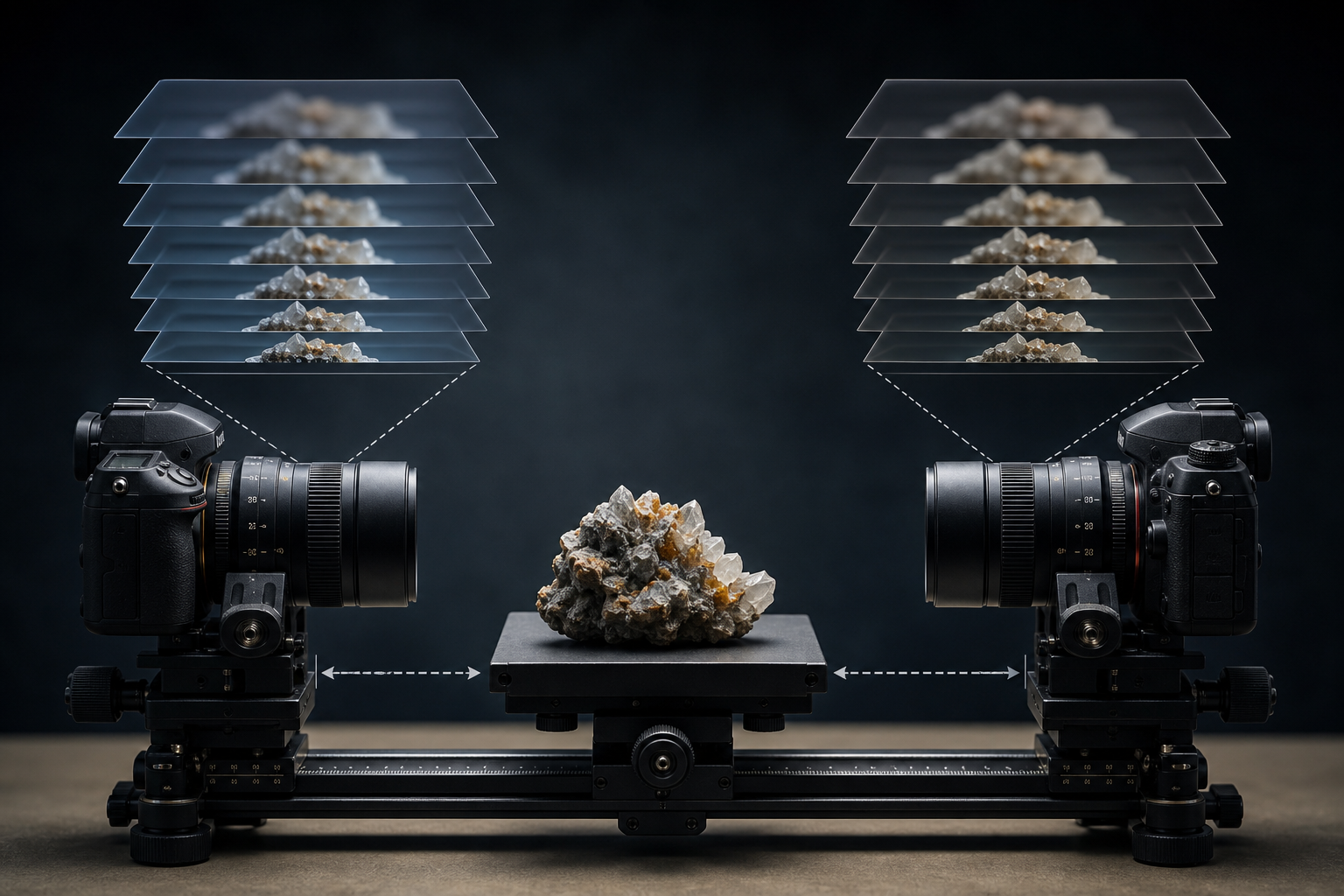
For a stationary object, both problems can be addressed with a single structured process: capture a complete series of images for stacking from the left viewpoint, shift the camera parallel to itself by a small baseline, and then capture the corresponding right-hand series. After merging each set into an image with increased depth of field, we obtain two views intended to be assembled into a stereoscopic pair.
Why a Conventional Stereo Baseline Does Not Work in Macro Photography
The stereoscopic baseline, also called the stereo base or simply the baseline, defines the distance between the points from which the left and right views are recorded. The difference in the positions of visible scene elements, known as parallax, provides the information needed to recreate the impression of depth.
In stereo photography with parallel optical axes, the baseline should be reduced when photographing at close range. Retaining a wide separation at a short distance from the object results in excessive differences between the left and right images and, consequently, a distorted representation of space.
Technical fact: in close-up photography, the required baseline is determined, among other things, by the reproduction ratio. At a fixed magnification, the required baseline remains constant regardless of the focal length used. Simply changing the lens is therefore no substitute for correctly selecting the shift between shots.
Practical conclusion: the spacing used when photographing larger scenes should not automatically be transferred to macro photography. The closer the shot and the greater the magnification, the more carefully the baseline must be selected. The source material does not provide a single universal value, so it is safer to match it to the specific magnification and check the result using a test pair.
The Second Problem: Very Shallow Depth of Field
In macro photography, increasing magnification is associated with a rapid decrease in depth of field. Even a stationary object may not fit within the sharp range of a single exposure: only part of it is clear, while elements located slightly closer or farther away remain out of focus.
Focus stacking involves capturing a series of frames focused on successive planes of the object. The sharp areas from the individual exposures are then combined into a single image with a greater effective depth of field.
Materials concerning work with macro and stereomicroscopy equipment indicate that the in-focus ranges of successive images should overlap. As magnification increases, smaller focusing steps are required. It is therefore not enough to record the front and back of the object in focus—omitted intermediate planes may leave areas without sufficiently sharp source material.
The Most Reliable Process: Two Independent Stacks
A 3D macro pair should contain two corresponding images: left and right. If a single shot does not provide the required depth of field, each of these images must be built from a separate series. This means creating not one shared stack, but two complete focus stacks.
1. Stabilize the Camera and Prepare a Stationary Object
A stable camera mount is a fundamental requirement for successful stacking. This is particularly important in stereo macro photography because, after the first series, the camera must be shifted in a controlled manner rather than repositioned in an arbitrary location.
The process described here is intended primarily for stationary objects. Each viewpoint requires multiple successive exposures, so the complete pair is not created in a single instant.
2. Choose a Small Baseline
The shift between the left and right views should be significantly smaller than in typical photography of distant scenes. Its purpose is to provide useful parallax without introducing excessive stereoscopic differences.
In practice, baseline selection should be treated as a separate test rather than as a by-product of framing. Maintain the chosen magnification and take test left and right shots. Only an assessment of such a pair makes it possible to determine whether the shift is appropriate for the specific object.
3. Capture the Left Focus Stack
At the first camera position, capture a series covering successive planes of the object. The in-focus ranges should overlap. At higher magnification, reduce the focusing steps to avoid leaving gaps between the sharp areas of adjacent frames.
The series should be completed before changing the viewpoint. The left stack must contain all the material needed to create a complete left image.
4. Shift the Camera Parallel to Itself
After completing the first series, shift the camera parallel to itself by the previously selected baseline. The aim is to change the viewpoint while maintaining controlled capture geometry. This shift creates the difference in perspective required for stereoscopy.
The controlled shift should not be replaced by arbitrarily repositioning the camera. In this process, the baseline is a technical parameter, not an approximate distance assessed only after the photographs have been taken.
5. Capture the Right Stack
From the second viewpoint, capture the corresponding series, once again covering all the required focus planes. As in the left-hand set, adjacent ranges should overlap, and the step size must take the applied magnification into account.
A good organizational principle is to treat both sets symmetrically: if the left image was created from a complete pass through the depth of the object, the right image should cover an analogous range. The point is not for each exposure in one stack to be a ready-made stereo counterpart of an individual exposure in the other. Only the two final images created from their respective series become counterparts.
6. Merge the Stacks Separately, Then Align the Pair
First, merge the frames from the left-hand set into a single image with increased depth of field. Then perform the same operation for the right-hand set. The result should be two complete images, each representing its own viewpoint.
Only then should these images be treated as the left and right parts of the stereo pair and aligned with each other. Separating the stages makes the process more structured: stacking is responsible for the focus range, while the camera shift and final alignment are responsible for the stereoscopic geometry.
The Most Common Mistakes in This Process
- Baseline too large: spacing suitable for a larger scene may cause excessive differences between images of a small object.
- Attempting to compensate for the baseline with focal length: at a fixed magnification, the required baseline does not depend on the focal length used.
- Focus steps too large: at high magnification, smaller intervals between successive settings are required.
- No overlap between in-focus ranges: the series should provide continuous coverage of the depth of the photographed object.
- Unstable mounting: this makes both capturing the stack and moving to the second viewpoint in a controlled manner more difficult.
- Incomplete second stack: both final images should cover corresponding ranges of the object.
See for Yourself: A Simple Test with a Stationary Object
Position the camera securely in front of a small, stationary object with visible depth. Capture the first series, moving the focus through successive planes and ensuring that they overlap. Then shift the camera parallel to itself by a small, controlled baseline and repeat the series.
Merge the two stacks separately, then align the resulting images as a stereo pair. If the spatial effect is exaggerated, perform another test with a smaller baseline. If either image contains areas that remain out of focus, reduce the step between planes during the next capture. Such a test makes it possible to assess two key parameters separately: the baseline responsible for stereoscopy and the focusing step responsible for continuity of focus.
Summary
Effective stereo macro photography of stationary objects requires treating the stereo baseline and depth of field as two separate issues. A short working distance and high magnification require a smaller baseline, while the shallow depth of field necessitates the use of focus stacking.
The most structured process consists of a left-hand stack, a parallel camera shift by a small baseline, a right-hand stack, and the separate merging of both series. Only the two completed, aligned images form the proper stereoscopic pair. Repeatability of the settings is more important here than the number of tools used: stable mounting, overlapping in-focus ranges, and a controlled shift form the foundation of the entire method.